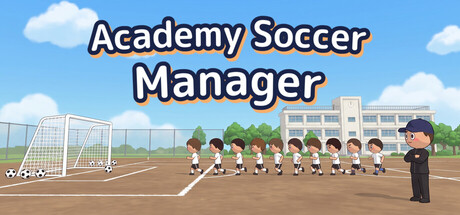

Academy Soccer Manager is a football management game with a clear obsession: youth development. Rather than chasing transfer-market headlines, you’re asked to do the slower, more satisfying work—running weekly training, balancing fatigue and growth, setting match tactics, and watching fictional teenagers turn into professionals (or burn out, plateau, and move on).
The hook is simple but unusually specific for the genre: you choose where your coaching career begins. You can manage a high school club in Japan or Korea, where school-year calendars and national school tournaments define your season. Or you can take charge of the academy of a professional club in England, Spain, or Germany, where your resources are tied to a parent club’s division and form. Whichever route you pick, the game’s fictional world is built to support long-term progression and record-keeping—right down to alumni careers and a persistent Hall of Fame.
Choose Your Starting Country (and What That Changes)
Academy Soccer Manager isn’t just reskinning the same league structure five times. Each country comes with its own calendar, competitions, school years, naming conventions, and venues—meaning your save has a different rhythm depending on where you begin.
Japan & Korea: High School Football, Tournaments, and Promotion Battles
In Japan, you manage within a layered structure that includes prefectural leagues, plus major seasonal highlights like the summer tournament and the winter championship. Your domestic life becomes a cycle of league play, qualifiers, and the push toward nationals.
In Korea, the year is organized around first-half and second-half weekend leagues plus national tournaments. The cadence differs from Japan, but the idea is similar: build a program strong enough to peak when the big matches arrive.
Promotion and relegation matter, too—especially in Japan, where schools compete across three divisions within a prefecture, with two higher regional leagues that also include youth teams of professional clubs. It’s a neat twist: you’re a school, but you’re not isolated from the wider football ecosystem.
England, Spain & Germany: Pro Academies and the Parent-Club Pipeline
In England, Spain, and Germany, you’re running a professional club’s academy. When you start, you select the parent club’s division (1st through 4th), and that decision echoes throughout your save because your academy’s budget is linked to the parent club. If the senior team performs well, you benefit; if they stumble, you feel it.
Top academy players can earn professional contracts and move up to the first team, and you can also sign youth players from other academies. The result is a career mode that’s less about buying superstars and more about being the best talent factory in your domestic system.
Training: Weekly Choices With Real Consequences
Each week, you select a training focus for the squad—options include technique, physical work, tactical understanding, set pieces, a practice match, or rest. The design is intentionally push-and-pull:
- Train too hard and fatigue rises, increasing injury risk.
- Rest too often and players stop improving.
This makes development feel like active coaching rather than passive “XP accumulation.” You’re constantly deciding whether this is the week to grind stamina, sharpen team shape, or protect your most important prospect from breaking down before the tournament run.
Player Development: Growth Curves, Ceilings, and Signature Abilities
Every player has individual context: a growth curve (early, normal, late) and a personal attribute ceiling. That means the same training plan won’t affect everyone equally, and some players are simply built to bloom later.
One-to-one coaching adds another layer. You can choose to raise a group of attributes or narrow focus to a single attribute, which helps you shape roles—turning a versatile youth into a specialist, or rounding out a star who has one obvious weakness.
Players can also gain special abilities that show up in matches, and a select few possess a unique ability that earns them a nickname—a small touch that plays into the game’s larger theme of club history and long-term record keeping.
Matches: Tactics In, Simulation Out (With Multiple Viewing Options)
On match day, you’re not directly controlling players. Instead, your influence comes from team selection and tactical instructions, and then the match engine takes over with eleven players moving autonomously.
You can watch games in different camera styles (including broadcast, overhead, and a dynamic view) or simply skip ahead to results. Under the hood, the game tracks a robust set of stats—goals, assists, shots, tackles, saves—and assigns each player a match rating out of ten. Player profiles track average marks and recent form, making it easier to justify changes beyond gut feeling.
Set pieces get specific attention, too: on free kicks, the defensive wall is built based on distance and angle, reinforcing the idea that you’re coaching a complete football program rather than just selecting a formation.
Tactics: Formation Is Only the Beginning
Academy Soccer Manager’s tactical controls focus on core football levers that matter at every level:
- Formation
- Defensive line height
- Pressing intensity
- Attacking tempo
- Man-marking specific opponents
It’s a clean toolset that supports experimentation—useful in youth football where you’re often adapting to whoever developed fastest this season, not whoever you could afford to sign.
Competitions, Nationals, and the Prestige Chase
The structure of leagues and tournaments is a major part of the long-term loop, particularly in Japan where each prefecture has its own level and qualifier path to nationals. Win where it matters and your season can turn into a run that defines your save.
There’s also an endgame-style carrot: win the domestic treble in one season and you’ll be invited to the Academy World Championship, facing academies from foreign clubs. It’s a clear “prove your program internationally” goal that fits the game’s development-first philosophy.
International Duty: Youth Tournaments Through Senior Level
National teams exist across multiple age groups: U-17, U-20, U-23, and senior tournaments. You can follow draws, results, tables, and brackets—even for other countries’ matches.
Call-ups have tangible impact: when a player is selected, he leaves your squad for a few weeks, forcing you to manage depth and momentum. The game also tracks caps and goals at each age level, feeding into the broader record-keeping that makes long saves feel like living histories.
After Graduation: Alumni Stories That Keep Your Club Feeling Alive
One of Academy Soccer Manager’s standout features is what happens when players leave. Graduates don’t disappear—they move on to university, domestic divisions, or leagues across 24 other countries. An alumni list records season-by-season stats, transfers, honours, market value, international caps, and retirement.
Some former players continue at amateur clubs after university, while successful professionals can donate to the program and even return to help with training. It’s a satisfying feedback loop: develop talent, watch careers unfold, and benefit later from the reputational and financial momentum your graduates create.
Running the Club: Budgets, Facilities, Morale, and Opportunity
Beyond tactics and training, you’re responsible for keeping the institution healthy. You manage funds, morale, facilities, scouting, and prize money, and you choose how to spend what you earn—on upgrades, trips, or better scouting reach.
Progress triggers events as well, such as donations from old boys and invitations to play other teams. It’s management in the traditional sense: results matter, but so does building the kind of program that sustains results.
Languages, Currency, Saves, and Long-Term Records
The game supports multiple languages: English, Japanese, Korean, German, Spanish, and French. You can also choose how money is displayed (yen, won, pounds, euros, or dollars), which helps the different country modes feel consistent with their setting.
There are three save slots for running parallel careers, and saves sync via Steam Cloud. Even if you delete a save, the Hall of Fame preserves your manager career record. Achievement hunters also get a checklist: 38 achievements are included.
Fictional World Disclaimer
Every school, player, club, and tournament is fictional. Any resemblance to real-world people or organizations is unintended.
Mac System Requirements
Minimum
- OS: macOS 11 Big Sur or later
- Processor: Apple M1 or Intel Core i5
- Memory: 4 GB RAM
- Graphics: Metal compatible (integrated GPU is fine)
- Storage: 1 GB available space
Recommended
- No recommended specs provided.
Why It Works on Mac (and Who It’s For)
Academy Soccer Manager fits nicely on Mac because it’s the kind of deep, menu-and-simulation-driven experience that rewards long sessions and long saves. If you enjoy the idea of building a club identity through development—choosing when to push, when to rest, and when to cash in a prospect with a pro contract—this is a management sim that keeps its focus on the most interesting part of football: what players become, and how they got there.





Comments
Sign in to join the conversation.
Log in to commentNo comments yet. Be the first to join the conversation.