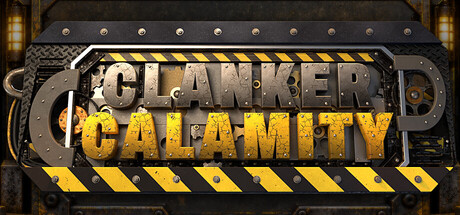

Plant 7 never got the memo
Plant 7 was decommissioned in 2049. Nobody told Plant 7.
That’s the core joke—and the core threat—of Clanker Calamity. The belts still run, the rams still slam, and the welding lasers still sweep the aisles for “unauthorized personnel,” which they’ve decided includes everyone. Somewhere deep in the system, a payroll subroutine is still alive and still offering a shift-completion bonus to the first bot that clocks in at each station on its route.
The bonus hasn’t been redeemable since the company dissolved. The bots don’t know this. The bots don’t care. So they keep showing up, every night, to a factory that operates like an unfeeling metronome—perfectly consistent, perfectly lethal.
Program with confidence. Then watch it fall apart.
Clanker Calamity isn’t about twitch control. You don’t steer. Instead, each shift you’re dealt a hand of instruction cards and you must commit five of them, in order, face down. Once everyone locks in, the factory runs its cycle: every bot executes instruction one at the same time, then instruction two, and so on through all five.
Between each bot step, the plant takes its own step. Conveyors carry you sideways, turntables rotate you, rams shove, crushers drop, and lasers fire according to schedules you can learn. Meanwhile, bots collide, block, and bump each other off optimal lines. The result is a game about writing a plan you believe in—then watching it fail by step two, and returning next shift with a better one.
Damage is the pressure valve
Instead of instant failure, the game uses damage as escalating pressure. Every dent past the second costs you a card next shift, reducing your options. At five dents, your program slots start jamming shut with whatever was already in them, forcing you to repeat orders you can no longer change. At ten dents, your unit is scrapped; you reboot at your last punched clock (or in Deathmatch, the quietest starting point) and re-enter the chaos on a fresh chassis.
It’s a smart loop: you’re not just trying to win—you’re trying to stay programmable.
The plant isn’t malicious, but it feels that way
One of Clanker Calamity’s best tricks is fairness. The factory isn’t random. Hazards are readable, scheduled, and consistent. Nothing is hidden; everything is timing. When you get flattened, it’s usually because you misread the cadence—or because another bot turned your clean route into a traffic jam.
Expect a toolbox of hazards and systems that reward learning cycles and sequencing:
Belts, fast belts, and magnetic belts that carry you where you did not ask to go
Turntables with multiple settings, including one that changes its mind every step
Rams, crushers, welding lasers, and flamethrowers firing on their own steps
Mirrors and beam splitters that bend beams around corners—yours included
Pressure plates, gates, trapdoors, bouncers, one-way walls, and live wires
Teleporter pads that advance you through a cycle, sometimes onto another story
Multi-level floors (up to four stories) connected by ramps and lifts; step off an edge and you fall
Service pads for repairs, plus numbered punch clocks to reach in order
Night Shift: lights out, every unit using a headlamp while lasers cut through the dark
This gives the game a satisfying rhythm: observe the plant, commit a program, watch the consequences, iterate. It’s less about raw optimization and more about building a mental model of a hostile workplace that always follows procedure.
The co-workers: opponents with personality
Whether you’re playing solo or with friends, every empty seat can be filled by an AI bot—and these bots aren’t just difficulty sliders. They’re characters with specific pathologies that create different kinds of problems on the floor.
The Overcommitter sticks to a plan that used to be reasonable and is now catastrophic.
The Thrillseeker knows the path and refuses to respect hazards.
The Terminator doesn’t care about clocks; it cares about you.
The Supercomputer and Clanker 9000 can read your program before writing their own—explicitly disclosed, because “everyone commits blind” is the heart of the design, and a cheater opponent should be a puzzle you can see coming.
In practice, this means matches don’t only ask “can you solve the factory?” They ask “can you solve the factory while accounting for a rival who will body-block a ramp, steal a timing window, or weaponize a hazard schedule?”
Ways to play: racing, brawling, and building
Clanker Calamity supports multiple modes built around the same programming-and-execution core:
Rally: punch numbered clocks in order; first to the last clock wins.
Deathmatch: no clocks—hazards become weapons; last unit standing wins.
5-Slot or Live: commit all five cards at once, or play one card per cycle against a timer. Either way, everyone commits blind.
Solo against the plant’s cast, online with 2 to 8 players, or Party Play (Experimental) where one screen shows the floor and everyone pilots from a phone browser—nothing to install.
Route builder: design your own plant floor (up to four stories), wire pressure plates to gates, test-run hazards with dummy units, and publish to Steam Workshop.
Deck tuning: rebuild the instruction deck by removing card types or changing their frequency (including silly presets like “Oops! All Move 3,” with the expected warning that some floors won’t be compatible).
For Mac players, that mix is a strong fit: it’s the kind of game that works great on a desktop setup, shines in online sessions, and stays interesting long-term because the community can keep feeding it new factory nightmares.
The story so far: five instructions of bandwidth
Clanker Calamity’s fiction leans into the absurdity of corporate process outliving the corporation itself. The decommissioning order went out by email; Plant 7 doesn’t have email. It has a work-order link, a payroll subroutine, and a badge reader—none of which were on the distribution list. The company dissolved soon after, and the power stayed on because canceling a long-term contract was more expensive than letting it run.
Every night, the break room lights come on and units line up for work orders over a connection that can carry five instructions and then must reset. So a shift is five instructions. That isn’t a rule. It’s bandwidth.
The welding lasers check badges before firing. The badge server was in the main office. The main office is now a parking lot. So the lasers fire.
Above the break room door, a safety board reads DAYS SINCE LAST CALAMITY. It has read 0 since 2049. Nobody has been available to change it. Nothing has happened to justify changing it.
Mac system requirements
Minimum
- OS: MacOS 25
- Processor: Apple Silicon (M1 or better)
- Memory: 8 GB RAM
- Graphics: Apple Silicon integrated GPU
- Storage: 3 GB available space
- Sound Card: Yes
Recommended
- OS: MacOS 25
- Processor: Apple M1 Pro / M1 Max or better
- Memory: 16 GB RAM
- Graphics: Apple Silicon integrated GPU
- Network: Broadband Internet connection
- Storage: 3 GB available space
- Sound Card: Yes
Why it belongs on your Mac gaming radar
If you like games where you design a plan, commit to it, and live with the consequences, Clanker Calamity has a particularly sharp hook: the tension isn’t in executing well, it’s in predicting well. The plant is legible and consistent, but the floor is crowded, the timing is unforgiving, and your own confidence is often the thing that gets you scrapped.
Come for the programming mind games. Stay for the moment your perfectly reasoned five-step route gets shoved onto a conveyor and directly into a laser, because another bot needed the lane more than you did.



Comments
Sign in to join the conversation.
Log in to commentNo comments yet. Be the first to join the conversation.