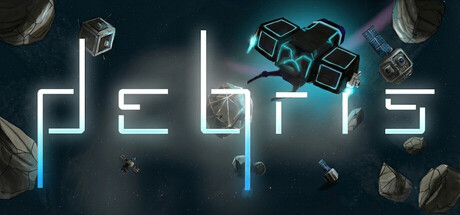

debris drops you into a near-future crisis where humanity has reached Mars—and left a dangerous mess behind. It’s 2060, the orbit is crowded with forgotten satellites, and catastrophe has finally arrived: Kessler Syndrome. One collision becomes many, shards create more shards, and the entire sky turns into a self-sustaining storm of metal. Your job is simple to explain and hard to survive: launch a drone, find debris, grab it, and make it home in one piece.
Collect: Navigate the storm, bring back the scrap
Your primary loop is salvage under pressure. Using your drone’s NavComp, you locate valuable debris fields, plot a route, and push into zones where a single mistake can turn your run into confetti. The tension comes from the contrast: the environment is beautiful and quiet, but everything around you is moving fast enough to end a mission instantly.
Each trip out is a risk calculation—how far you can go, how much you can safely carry, and whether you should retreat early rather than gamble the return. The goal isn’t just to grab wreckage; it’s to do it without getting destroyed and to make it back home “literally in one piece.”
Build: Turn old satellites into new systems
Every piece of scrap you recover was once part of a satellite. In debris, that history becomes your toolset: you repurpose the past to secure the future. Salvaged resources feed directly into crafting and construction, letting you upgrade both your drone and your station.
On the drone side, you’ll assemble modules to suit your approach—whether that means building the “best drone ever” for efficiency and safety, or building something experimental that only reveals its flaws once you’re deep in the debris field. On the station side, you expand your odds of survival by constructing modules like greenhouses, solar panels, and other infrastructure that supports long-term living and sustained operations.
Manage: Power, air, food, water—and constant tradeoffs
Salvage isn’t meaningful unless it keeps you alive. debris leans into survival management where you’re always watching your resources. Run short on essentials and you won’t just be inconvenienced—you’ll starve, suffocate, or dehydrate. Even a power shortage can cascade into bigger problems when life-support and production can’t keep up.
The core of this management layer is choice. Resources are limited, and you’re repeatedly forced into practical, stressful decisions: Do I craft this or that? Do you invest in safety and sustainability now, or chase a bigger upgrade that might pay off later? The game keeps those questions relevant by making every build decision feel like it has an opportunity cost.
Dynamic story: Your actions shape what happens next
debris isn’t just a fixed sequence of missions. It’s built around a dynamic story where your actions influence what is happening, allowing the narrative to be experienced multiple times in meaningfully different ways. The idea is that the story adapts to your play instead of forcing you down a single track.
Every debris field carries a piece of context, and your decisions affect the orbit itself. The game frames the chaos as something with an underlying pattern—a rhythm to the destruction—hinting that there’s more going on than simple cleanup. You’re free to act, but you’re also expected to live with the results, whether you choose to fight the system or try to rewrite it.
Setting and stakes: Stop the chain reaction
The premise is rooted in real-world orbital concerns: as collisions multiply, the debris cloud grows and accelerates, turning orbit into an increasingly hostile environment. In debris, the catastrophe is already in motion, and the only way to stop the vicious cycle is to “take the fuel away”—reduce what can still collide and fragment.
The game pushes urgency with a butterfly-effect mindset: every second counts, and waiting has consequences. That pressure gives your salvage work weight—your runs aren’t just loot hunts, they’re attempts to slow a disaster before it becomes irreversible for you, your station, and Mars.
About the developer
debris is a passion project developed by a single informatics student from Vienna, inspired by a fascination with Kessler Syndrome and orbital mechanics. The developer describes the game as emerging from a simple question asked on a walk to school: “What if they all crash?” This project is their first Steam release, with more planned beyond launch.
Mac performance and system requirements
debris targets Apple Silicon Macs and keeps storage needs light, which is great for smaller internal SSDs. The developer notes testing on a MacBook Air M3 Liquid Retina Display at around 50fps, and approximately ~40fps at 4K.
Minimum (Mac)
Minimum:- OS: Big Sur or later
- Processor: Apple M1 or better
- Memory: 8 GB RAM
- Graphics: Apple M1
- Storage: 2 GB available space
- Additional Notes: Tested on Macbook Air M3 Liquid Retina Display@50fps 4K@~40fps
Recommended (Mac)
Recommended:- OS: Big Sur or later
- Processor: Apple M1 Pro or better
- Memory: 8 GB RAM
- Graphics: Apple M1 Pro
- Storage: 2 GB available space
Why Mac players should watch this one
If you like survival management that’s driven by hard tradeoffs, base-building that directly supports your next run, and a sci-fi setup grounded in a real space hazard, debris offers a compelling hook. The central fantasy—threading a drone through a lethal orbital scrapyard, then turning that scrap into the modules that keep you alive—fits perfectly on Mac for players who enjoy tense, systems-driven games with replayable story outcomes.





Comments
Sign in to join the conversation.
Log in to commentNo comments yet. Be the first to join the conversation.