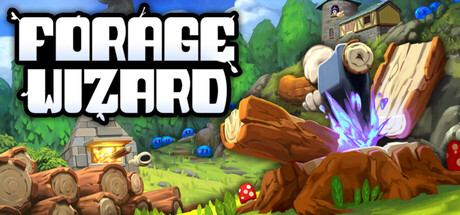

Forage Wizard is an incremental crafting and automation game that wraps classic “gather, refine, expand” progression in a cozy magical-woods theme. You begin with simple foraging—pulling resources out of the glade with the power of your cursor—then quickly graduate into a loop of refining materials into stronger ingredients, unlocking new buildings, and shaping a base that steadily produces more on its own. The long-term goal is clear: progress through a magic skill tree, uncover hidden locations, and ultimately work toward an all-powerful artifact.
Core Loop: Forage, Refine, Upgrade, Repeat
The early game leans into a clicker-inspired rhythm: chop wood, mine rocks, harvest wheat, and scoop up whatever the woods will give you. Those raw materials become the backbone for crafting ingredients used in both buildings and upgrades. As you scale, the focus shifts from manual collection to creating a self-sustaining production line—less “can I get enough wood?” and more “how do I route my resources to maximize output?”
That constant escalation is what makes Forage Wizard satisfying on longer sessions: each new tool or structure tends to unlock another tier of efficiency, and the game keeps pushing you toward the next bottleneck to solve.
Incremental Skill Tree: Build Your Own Wizard
Progression is anchored by an incremental skill tree that changes how you play over time. Rather than just increasing numbers, your choices can reshape priorities—whether you want to emphasize faster gathering, stronger refining chains, better automation, or more robust combat and farming. The result is a steady sense of identity: you’re not just collecting more, you’re becoming a more capable wizard with a production philosophy of your own.
Base Building and Automation: From Hut to Arcane Factory
Once you unlock the right blueprints, your base becomes the real star. You’ll place structures that refine, store, and generate items, then iterate on layout and throughput. The game encourages experimentation: you can organize for comfort and readability, or push for maximum efficiency with tightly optimized production lines.
Expect to build machines and magical infrastructure—like self-chopping trees and elemental distilleries—designed to reduce repetitive tasks and keep resources flowing. The best moments come when a newly placed structure “solves” a problem and frees you up to chase the next upgrade tier.
Alchemy and Refining: Turning the Mundane Into the Mythic
Forage Wizard’s crafting leans heavily into alchemy. You’ll refine ores into ingots, work with elemental processes, and generally turn basic materials into increasingly potent resources. This is where the game’s tone shines: it treats production as magic, and magic as production—an arcane assembly line powered by your growing knowledge of the glade.
Farming, Monsters, and Exploration
To keep the loop from being purely industrial, Forage Wizard folds in crop farming and monster farming. These systems broaden the resource ecosystem and give you more ways to gather what you need (or trade for gold). Meanwhile, exploration teases deeper secrets—hidden locations tucked away in the woods that reinforce the “mystery of the glade” framing.
Feature Highlights
Clicker-style foraging and harvesting that grows into automated production.
An incremental skill tree with meaningful choices that influence your playstyle.
Build structures to refine, store, and generate items.
Alchemy-focused crafting and refining, including elemental processes.
Blueprint shop progression for unlocking new buildings and infrastructure.
Farm crops and monsters to diversify resources and progression routes.
Trade resources for gold to smooth out bottlenecks.
Hidden locations to uncover deeper in the woods.
Who It’s For
If you like incremental games that evolve from hands-on clicking into hands-off automation—with a clear progression path and a constant stream of upgrades—Forage Wizard is built for you. It’s especially appealing if you enjoy crafting chains, base organization, and the satisfaction of watching a once-scrappy operation turn into a polished, magical production machine.
Mac System Requirements
Minimum
OS: 10.14 Mojave
Processor: Apple M1 or Intel Core i7
Memory: 8 GB RAM
Storage: 500 MB available space
Recommended
No specific recommended requirements were provided.





Comments
Sign in to join the conversation.
Log in to commentNo comments yet. Be the first to join the conversation.