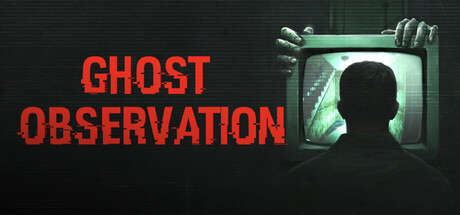

Ghost Observation takes a simple idea—watching a security feed—and turns it into a pressure-cooker of paranoia. You aren’t a hero with a flashlight or a fighter with a shotgun. You’re an assigned observer, stationed behind a surveillance system, tasked with monitoring cursed locations using a fully rotatable 360° camera. Your tools are limited, your exposure is constant, and your survival hinges on one skill that horror games love to punish: noticing what changed.
Premise: You’re Not Just Watching
The game’s central tension is baked into its framing: you are observing something that should not exist. Each shift is spent scanning an environment for abnormalities—items moved a fraction, objects disappearing, shadows forming where they never belonged. The longer you remain on duty, the more the location begins to shift, as if your attention itself is provoking the haunting.
Core Gameplay: Observation Is Survival
Ghost Observation is fundamentally about attention to detail and memory. You’ll continuously sweep the scene with the 360° camera, checking corners, doorways, and familiar reference points. The game dares you to build a mental snapshot of “normal,” then challenges that snapshot with subtle corruption.
- Micro-changes: a chair nudged, an object rotated, something placed where it doesn’t belong.
- Clear disruptions: an item vanishes, an unexpected presence appears, a room’s composition feels “off.”
- Unnatural events: anomalies that read as impossible rather than merely suspicious.
Miss a change and the problem doesn’t stay contained. Anomalies accumulate, and as they stack up, the night becomes harder to stabilize—more to track, more to doubt, and more chances to second-guess your own memory.
Reporting System: Precision Matters
Spotting something wrong is only half the job. When you detect an anomaly, you must report it accurately. Correct reports remove anomalies immediately, acting like a pressure valve that restores some control. But the game doesn’t reward panic-clicking: false reports or hesitation allow anomalies to spread, escalating the danger minute by minute.
This creates a tense loop that Mac players who enjoy pattern-recognition horror will appreciate: you’re constantly balancing speed against certainty. Do you file the report the moment you feel something is off, or do you risk another scan to confirm? That decision becomes the difference between a clean night and a runaway cascade.
Night Shift Structure: Midnight to Dawn
Your objective is deceptively straightforward: survive from midnight to dawn. As the hours drag on, anomalies appear more frequently and turn more threatening. Early on, you may feel in control—tracking a couple of suspicious changes. Later, the same environment can feel hostile, unstable, and overloaded with problems you should have caught sooner.
Make it to morning, and the mission is a success. Let too many anomalies pile up, and the location tips into something worse.
Niwarn: The Punishment Realm
When conditions become critical, the game drags you into Niwarn, a distorted punishment realm where the familiar layout becomes oppressive and unfamiliar. It’s a sharp tonal shift: anomalies disappear, but safety doesn’t return. Instead, your task becomes singular and urgent—find and report the Sacred Talisman before time runs out.
The twist is that Niwarn isn’t a one-off scare. Each return shortens the time limit, raising the intensity and forcing faster, riskier decisions. It’s a smart way to translate “you’re losing control” into a system that players can feel mechanically, not just emotionally.
Cursed Locations: Multiple Maps, Unique Threats
Ghost Observation spreads its anomaly-hunting across several haunted environments, each with its own personality and set of dangers:
- Abandoned House
- Abandoned Factory
- Traditional Thai Abandoned House
- Abandoned School
Different spaces change how you scan. A factory may encourage long, sweeping checks over industrial clutter, while a house rewards remembering small domestic details that are easy to misremember under stress. The variety helps the core loop stay tense rather than repetitive, because your “baseline normal” has to be rebuilt for every new location.
Why It Works on Mac: A Good Fit for Focused, System-Driven Horror
Surveillance horror lives or dies on clarity, pacing, and responsiveness, and Ghost Observation leans into a focused setup: one viewpoint, one job, escalating consequences. For Mac players, it’s also notable that the developer lists the game as tested on Apple Silicon with a native build (no Rosetta), which is exactly what you want for a game that relies on quick camera control and constant scanning.
Key Features at a Glance
- 360° surveillance gameplay with free camera rotation to inspect every corner.
- Anomaly detection horror built on subtle environmental changes and supernatural intrusions.
- Psychological tension where memory and attention determine survival.
- Punishment realm system: Niwarn runs with a timed Sacred Talisman objective and increasing pressure.
- Multiple cursed locations featuring unique anomalies and hidden dangers.
Mac System Requirements
Minimum
Minimum:- OS: macOS 14 Sonoma
- Processor: Apple M1
- Memory: 8 GB RAM
- Graphics: Apple M1 GPU (Integrated)
- Network: Broadband Internet connection
- Storage: 2 GB available space
- Sound Card: Built-in Audio
- Additional Notes: Tested on Apple Silicon (native build, no Rosetta)
Recommended
Recommended:- OS: macOS 14 Sonoma
- Processor: Apple M1
- Memory: 8 GB RAM
- Graphics: Apple M1 GPU (Integrated)
- Network: Broadband Internet connection
- Storage: 2 GB available space
- Sound Card: Built-in Audio
- Additional Notes: Tested on Apple Silicon (native build, no Rosetta)
Verdict: A Night Watch You’ll Feel in Your Gut
Ghost Observation is horror made from vigilance—an escalating test of whether you can trust your eyes, your memory, and your instincts under pressure. The hook isn’t combat or chase sequences; it’s the creeping realization that the room you’re watching is rewriting itself, and that your only defense is catching the lie before it spreads.
Remember: your job is to watch. But that doesn’t mean you are the only one watching.




Comments
Sign in to join the conversation.
Log in to commentNo comments yet. Be the first to join the conversation.