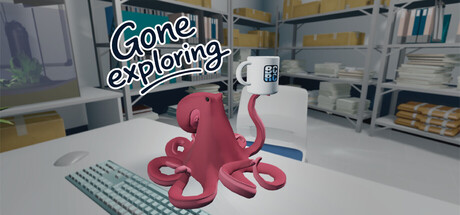

Gone Exploring: curiosity, corridors, and a tank you’re done with
The tank is boring. Everything outside the tank looks fascinating. In Gone Exploring, that simple truth kicks off a small escape that turns into a surprisingly engaging journey through the Blue Current Research Centre—a place packed with tight corridors, odd rooms, and an alarming number of devices that hum, blink, and spin.
And yes, you’re going to touch them.
Play as a curious octopus—using all eight arms
Gone Exploring’s defining hook is its hands-on interaction model. You’re not managing a backpack full of items or sorting through menus; you’re physically manipulating the world with eight independent arms. Picking things up, carrying multiple objects, nudging mechanisms, and experimenting with unfamiliar equipment becomes the game’s language.
This makes the station feel like a real place full of stuff, not just a set of “puzzles.” Every object is an opportunity: something to drag, push, hold, stack, or test. The result is a constant sense of playful improvisation—less about perfect solutions and more about satisfying, tactile problem-solving.
No inventory, no UI clutter—just interaction
Gone Exploring keeps the screen clean and the focus tight. There’s no traditional inventory and no UI noise competing for attention. Instead, your “interface” is the octopus herself: what you’re holding, what you can reach, and what you can manipulate right now.
For Mac players, that simplicity reads well on smaller displays and laptops—exploration stays readable, and the game’s charm comes through without distraction.
Exploration-driven storytelling
The Blue Current Research Centre isn’t just a maze—it’s a story delivery system. As you move through rooms and corridors, you gradually piece together why she’s here and what’s going on in this underwater facility. The narrative is designed to be uncovered through movement and curiosity, not exposition dumps.
The goal is clear and emotionally grounded: find your way back to the ocean. The path there is filled with small discoveries and environmental details that reward poking around and trying things you “probably shouldn’t.”
Short, cozy, and self-contained
Gone Exploring positions itself as a short and cozy experience—ideal if you’re in the mood for a complete, self-contained adventure rather than a sprawling open-ended time sink. It’s the kind of game that works well as a weekend palate cleanser: low stress, high curiosity, and built around the delight of interacting with a strange place.
Key features
Explore an underwater research station as a curious octopus
Pick up, carry, and interact with objects using all 8 arms independently
No inventory, no UI clutter—just hands (a lot of them)
Uncover why she’s here, and find your way back to the ocean
Short, cozy, and self-contained
Mac system requirements
Minimum
- OS: macOS 10.15 (Catalina) or later
- Processor: Intel Core i3 or Apple M1
- Memory: 4 GB RAM
- Graphics: Metal-compatible GPU (Intel HD 6000 or later)
- Storage: 2 GB available space
Why it belongs on your Mac gaming list
If you enjoy exploration games that prioritize physical interaction over UI management, Gone Exploring is an easy recommendation. Its strongest moments come from simply being a curious creature in a fascinating space—reaching, grabbing, carrying, and experimenting your way forward—one questionable button press at a time.




Comments
Sign in to join the conversation.
Log in to commentNo comments yet. Be the first to join the conversation.