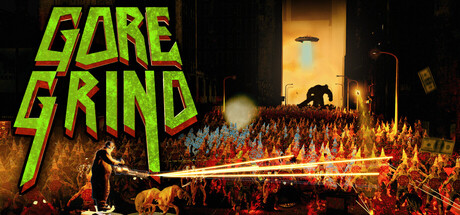

Gore Grind on Mac: pizza grease, mutant streets, and co-op survival
Gore Grind drops you into a city that mutated overnight—no internet, no normal life, and only one business still reliably open: a pizzeria. Years of Tommy’s pizza left you so thoroughly greasy the mutagen “slid right off,” and that’s exactly why you’re still standing.
Now you work for Tommy, and the job description is simple: survive the night, take what the city drops, bank your cash, and turn your earnings into bigger guns, nastier gadgets, and (if needed) a second chance at life.
What kind of game is it?
At its core, Gore Grind is a first-person roguelite horde shooter designed for 1 to 4 players with both online co-op and couch co-op. Runs revolve around enduring relentless pressure, making quick spending decisions, and pushing far enough to kill the night’s boss—because the night ends only when the boss is dead, not one second before.
Co-op that’s built for arguments (in the best way)
Gore Grind leans into the social chaos that makes co-op shooters memorable. With up to four players sharing the same streets and the same opportunities, you’ll split attention between:
- Loot priorities: who takes the new gun and who gets the leftovers?
- Risk management: do you bank now, or squeeze out another fight?
- Revive politics: who is worth saving when the pressure spikes?
Whether you’re playing online with friends or passing controllers on the couch, the game’s systems encourage constant team decision-making under stress.
The horde isn’t “waves”—it’s weather
If you’re expecting neat rounds and predictable breaks, Gore Grind aims for something meaner. The horde comes continuously, more like a storm than a schedule. Your toolkit is designed for messy crowd control and improvised survival: freeze what you can, burn what you can’t, and explode the rest.
And yes—the soundtrack is metal. Obviously.
Money is life: banking, death debt, and second chances
One of Gore Grind’s standout hooks is its relationship with currency. Cash is survival, and dying doesn’t just reset momentum—it adds a bill. The cost of coming back doubles every time you die that night, turning repeated wipeouts into a runaway debt spiral if you’re not careful.
To stay ahead, you’ll need to bank what you earn before something else takes it. The game’s world is populated by strange threats and opportunists—including gnomes that will take your money and vanish if you let them. You can also gamble some of your stash (roulette is mentioned for a reason), reinforcing the game’s risk-reward loop: play safe, or play greedy.
Guns, gadgets, and “hardware of uncertain origin”
You’ll spend your banked earnings on a rotating mix of firepower and tools. Expect the fun part of roguelite progression here: assembling a run-defining kit from what you can afford and what you can find.
Defensive and utility options play a major role too. The Mechanic sells deployables like turrets, barrels, and other suspicious gear that can keep enemies off you while you reload or reposition. The game’s writing makes it clear you shouldn’t ask where any of it came from—Tommy certainly won’t tell you.
Tommy, the radio AI, Crankers, and the city’s weirdness
Gore Grind’s tone mixes gritty splatter with absurd, confident narration. Tommy runs the pizzeria, hands out work, and maintains the kind of economy you probably don’t want to investigate too closely.
Meanwhile, a rogue AI pipes in through the city’s radios, taking credit for everything and insisting it’s in charge. It’s not. But it does hype up major threats—particularly the Crankers, which the AI essentially “imagines into existence” hard enough that they show up to ruin your night, announced with theatrical flair.
Extra activities between the bloodshed
- Buy a Hog at the Mechanic’s garage and race across town.
- Deliver pizza between shifts (because it’s still a business).
- Boss-gated nights: the run doesn’t end until the boss is dead.
It’s all part of a world that feels equal parts survival scenario and deranged night shift—done for a slice of gabagool.
Mac performance notes: what you’ll need
Gore Grind’s listed Mac requirements are Apple Silicon-only, and the minimum spec starts at an M1 with a notably high memory baseline. If you’re planning 4-player couch co-op on a single machine, meeting (or exceeding) the recommended spec is a smart idea.
Minimum Mac Requirements
Minimum:
- Requires an Apple processor
- OS: macOS Sequoia 15
- Processor: Apple Silicon M1
- Memory: 16 GB RAM
- Storage: 10 GB available space
Recommended Mac Requirements
Recommended:
- Requires an Apple processor
- OS: macOS Tahoe 26
- Processor: Apple Silicon M2
- Memory: 32 GB RAM
- Storage: 10 GB available space
Who is Gore Grind for?
- Players who want a first-person co-op shooter with roguelite stakes and replayable runs.
- Groups looking for a rare combo: online + couch co-op up to four players.
- Fans of horde pressure that feels constant, not neatly segmented into waves.
- Anyone who enjoys games where tone and mechanics align: filthy humor, metal energy, and brutal economy-driven survival.
Bottom line
Gore Grind’s hook is simple and effective: survive a nonstop mutant “weather system,” keep your money safe long enough to matter, and build a loadout that gets you to the boss alive—preferably with friends, preferably on the same couch, and definitely while the radio AI claims it “restored” everything.




Comments
Sign in to join the conversation.
Log in to commentNo comments yet. Be the first to join the conversation.