
Overview
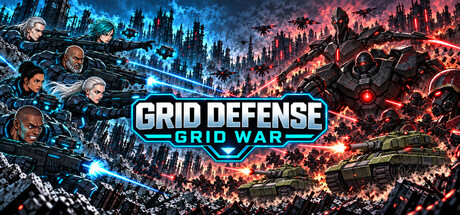
GRID DEFENSE: GRID WAR is a sci-fi tower defense game focused on layered decision-making: tower placement, lane coverage, anti-air planning, and the timing of hero ultimates and support abilities. Its biggest selling point is refreshingly straightforward—100 Scenario stages across 10 chapters are always free. That means Mac players can commit to a full-length campaign without hitting a paywall.
100 Scenarios, Always Free
The Scenario campaign is the core of GRID DEFENSE: GRID WAR. It’s structured as a 100-stage climb where the game teaches you its systems over time: how to build complementary tower clusters, how to stabilize weak lanes, and how to time high-impact abilities to blunt spikes in difficulty.
As you progress, enemy pressure shifts from simple lane pushes to mixed threats—heavies, bosses, and air units forcing you to diversify your defensive plan rather than relying on a single “best” tower. Importantly, the developer positions Scenario as a complete experience: later chapters are not gated behind paid modes.
22 Tower Types and the Importance of Synergy
The game’s tower roster is built around roles that combine into a cohesive defense. Expect familiar tower-defense archetypes with a crisp sci-fi theme: artillery for area damage, freezing for control, electrical weapons for multi-target pressure, lasers for sustained damage, and anti-air coverage to prevent airborne enemies from bypassing your plan.
What makes this lineup interesting is how much GRID DEFENSE emphasizes interlocking coverage:
- Control an approach: slow or disrupt a lane so your damage towers can work longer.
- Cover vulnerable routes: patch gaps where fast units or aircraft would otherwise slip through.
- Focus fire where it matters: create kill-zones to delete priority threats and boss phases.
Enemy composition pushes you to stay flexible. Ground units and aircraft stress different parts of your layout, and later waves can punish overly specialized builds. The result is a campaign where “good enough” placement can still lose—while smart positioning and complementary tower roles can hold even when you’re underpowered.
Six Wardens (Heroes), Six Battlefield Jobs
Alongside your static defenses, you bring a hero unit called a Warden. Each Warden is designed around a distinct role, giving you a way to respond to threats your towers aren’t currently set up to handle.
- VANGUARD: mobile assault fire to meet threats along the front.
- LONGVIEW: long-range precision and heavy single shots for priority targets.
- BULWARK: area bombardment for clustered enemies and wave control.
- MENDER: repair support to keep buildings standing under pressure.
- TINKER: a support field that strengthens nearby towers (ideal for defensive hubs).
- SKYWARD: rockets and explosive attacks effective against both ground and air threats.
This hero layer is where GRID DEFENSE often becomes less about passive building and more about active management—moving to the right lane, picking the right target, and pairing your Warden’s strengths with whatever tower cluster you’ve established.
26 Support Options and Ultimate Timing
Where many tower defense games live and die by the build phase, GRID DEFENSE adds a second axis of strategy with 26 support cards (including four robot-unit cards). These supports cover the usual high-impact categories—airstrikes, missile barrages, EMP disruption, battlefield control, and reinforcements.
The key decision isn’t just what you bring, but when you spend it. Burning an ultimate or support to stop a wave immediately can save a run, but holding it may be necessary for the heavier push or boss right behind it. The game is designed to reward players who can recognize those inflection points: the moment a lane is about to collapse, or a cluster of enemies is perfectly positioned for a decisive wipe.
Paid Modes: Basic, World, and GRID COMMAND
Beyond the free Scenario campaign, GRID DEFENSE: GRID WAR offers additional paid modes:
- Basic (paid)
- World (paid)
- GRID COMMAND (paid): an aerial, survivors-style combat mode where you pilot a fleet through escalating battles above city maps.
If you’re curious before buying, the developer notes one-minute highlight experiences are available for Basic and GRID COMMAND, functioning like quick previews.
Interface and Accessibility Notes
GRID DEFENSE: GRID WAR includes interface support in 12 languages. Control-wise, the Mac build expects a traditional setup: keyboard and mouse required, which fits the precision demands of lane management and tower placement.
Mac Performance and Requirements
GRID DEFENSE: GRID WAR supports Apple Silicon and Intel Macs. Requirements are listed as preliminary and may change prior to release.
Minimum Mac Requirements
Minimum:
- OS: macOS 12 Monterey or later
- Processor: Apple M1 / Intel Core i5 (6-core)
- Memory: 16 GB RAM
- Graphics: Apple M1 integrated GPU / AMD Radeon Pro 5300 (4 GB)
- Storage: 5 GB available space
- Additional Notes: Keyboard and mouse required. Supports Apple Silicon and Intel Macs. Preliminary requirements; subject to change before release.
Recommended Mac Requirements
Recommended:
- OS: macOS 13 Ventura or later
- Processor: Apple M2 / Intel Core i7 (8-core)
- Memory: 16 GB RAM
- Graphics: Apple M2 integrated GPU / AMD Radeon Pro 5500 XT (8 GB)
- Storage: 5 GB available space
- Additional Notes: Keyboard and mouse required. SSD recommended. Preliminary requirements; subject to change before release.
Why Mac Tower Defense Fans Should Watch It
GRID DEFENSE: GRID WAR’s pitch is strong for Mac gamers who love methodical strategy but also want moments of explosive power: you get the long-form satisfaction of refining layouts across a 100-stage free campaign, plus the active decision-making of heroes and support cards that can swing a failing defense into a last-second recovery. If you’re looking for a sci-fi tower defense game that emphasizes synergy, anti-air planning, and clutch ability timing, this is one to keep on your radar.


Comments
Sign in to join the conversation.
Log in to commentNo comments yet. Be the first to join the conversation.