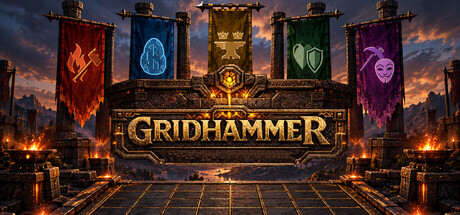

Forge your strategy, shatter your rival
GridHammer is a competitive, head-to-head tactical battler set in a world of dwarven forge masters, where victory comes from reading the board and exploiting angles rather than building an engine or drawing the perfect hand. Two players fight over a compact 6×4 battlefield using a shared forge pool of 45 metal plates. Each plate has four sides, each side has a value (from 2 to 8), and every turn is a positional decision that can either spark a chain reaction of captures or leave your flank exposed.
The hook is immediate: you and your opponent draw from the same pool. Every plate you commit is also one your rival will never see again, turning what looks like a straightforward placement game into something closer to a drafting mind-game with tactical consequences.
The shared forge pool and the five houses
The 45 plates come from five smithing houses—Stillforge, Runeweaver, Embercrest, Stoneheart, and Shadowmine—each contributing nine plates into the same common pool. Both forge masters draw from this pool throughout the match. You hold six plates in hand and draw one after every play, so you’re rarely “stuck,” but you’re constantly balancing short-term captures with long-term board shape.
GridHammer’s strategy is less about what you’re dealt and more about where you place it—because every placement creates edges your opponent can attack, and every capture can open lanes for combos.
Directional combat: winning by angles
After the first plate is placed, every new plate must be played touching an existing plate. When two plates touch, the touching sides clash:
- Higher value wins and captures the opposing plate (flipping it to your side).
- Ties hold (no capture).
This is where the house identities matter. Each house biases strength toward a direction:
- Embercrest tends to dominate from above.
- Shadowmine tends to crush from below.
- Stillforge anchors from the left.
- Stoneheart locks down the right.
- Runeweaver stays balanced, aiming to avoid obvious directional weaknesses.
The result is a clean, legible tactical puzzle: a modest plate can topple a stronger one if it hits the correct edge, while a “powerful” plate dropped into the wrong adjacency can be immediately flipped.
Combo chains: when one capture becomes a sweep
Captures aren’t always the end of the interaction. The five houses form a ring that enables chaining. If you capture a plate belonging to the house your current house chains into, that newly captured plate immediately strikes again from its new position. Done right, a single placement can explode into a multi-capture cascade that flips huge portions of the board in one turn.
This is GridHammer’s most thrilling layer: you’re not just calculating “will this capture,” but “what will this capture cause next,” including what lanes the chain opens for your opponent on the following turn.
The Hammer: a charged, board-wide SLAM
GridHammer’s comeback-and-closer mechanic is The Hammer. Each capture you make builds steam in your hammer’s tube. Fill all eight pips and your SLAM arms. On a later turn, you can spend your entire action to bring the hammer down on the entire board:
- Every plate loses a life—including your own.
- Enemy plates that break from the SLAM drain their essence.
- The SLAM captures nothing; it’s pure attrition and timing.
Because it hits both sides, the Hammer isn’t a panic button—it’s a finisher or a calculated reset. The best SLAM turns are the ones where the wreckage falls disproportionately on your opponent’s side of the board.
Forge Essence: the match’s life total
Instead of traditional “health,” each forge master has a vial of 30 Forge Essence, and it only ever drains. Pressure comes from two sources:
- Capturing any plate costs your rival 1 Essence.
- Plates have three lives; a capture that shatters (breaks) a plate costs the rival 2 Essence.
Win by emptying your opponent’s vial—or, if the board fills, by holding the most Essence. This creates a satisfying push-and-pull between board control (owning territory and angles) and direct attrition (forcing drains, setting up shatters, and choosing when to SLAM).
Modes, mastery, and replay value
For Mac players who like their competitive games to come with structure, GridHammer leans into progression and measurable skill:
- Online multiplayer with quick matches, Steam friend invites, and fast rematches.
- AI opponents across three difficulties (from Bellows Hand up to Forge Tyrant) for practice and pattern learning.
- 41 Steam achievements spanning win streaks, big combo links, multi-break SLAMs, flawless victories, and comeback wins.
- Titles and global leaderboards tracking stats like plates shattered, streaks, biggest combos, and SLAM performance.
- The Anvil Codex, an illustrated in-game guide to rules, houses, and matchups.
The learning curve is friendly—rules click quickly—but the ceiling is high because every plate influences the geometry of future turns. Once you start seeing chain setups and “unsafe” edges a turn ahead, the game opens up.
Mac performance and requirements
GridHammer is lightweight on storage and designed to run on modern macOS systems with Metal support, making it a strong fit for MacBooks and iMacs used for competitive online play.
Minimum Mac Requirements
Minimum:- OS: macOS 11.0 (Big Sur)
- Processor: Apple M1 or Intel Core i5
- Memory: 4096 MB RAM
- Graphics: Metal compatible GPU
- Network: Broadband Internet connection
- Storage: 500 MB available space
Recommended Mac Requirements
Recommended:- OS: macOS 13.0 (Ventura)
- Processor: Apple M1 or Intel Core i7
- Memory: 8192 MB RAM
- Graphics: Metal compatible GPU
- Network: Broadband Internet connection
- Storage: 500 MB available space
Why GridHammer belongs on a Mac strategy shortlist
GridHammer distills competitive tactics into a small board and a simple ruleset, then adds just enough asymmetry (directional house identities), volatility (combo chains), and timing pressure (Forge Essence and the Hammer) to keep every match tense. If you enjoy turn-based duels where positioning matters more than randomness—and you want something that works well on Mac without demanding huge disk space—GridHammer is an easy recommendation.
Learn the basics in minutes, then spend dozens of matches mastering edges, baiting unsafe touches, and choosing the perfect moment to SLAM.


Comments
Sign in to join the conversation.
Log in to commentNo comments yet. Be the first to join the conversation.