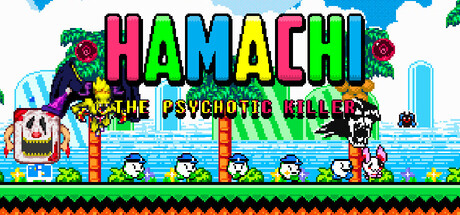

Hamachi the Psychotic Killer on Mac: when the “hero” is the problem
Hamachi the Psychotic Killer flips the usual platformer fantasy on its head. Instead of saving townsfolk and cleansing evil, you play as Hamachi—a piece of tofu who winds up possessed and weaponized by Demon Queen Deity, an entity with one simple ambition: conquer the world through mass murder. The hook isn’t just that the premise is absurd; it’s that the game systematizes your morality (or lack of it) and builds the playthrough around the choices you make.
Core premise
You’re dropped into a classic side-scrolling platformer framework—run, jump, fight—except the game constantly asks what kind of menace you want to be. Civilians aren’t set dressing; they’re decision points. Bosses aren’t always meant to be defeated; they can be pacified. And your actions don’t vanish into a score counter—the world reacts, and the pressure escalates.
Three routes, three tones
Hamachi’s structure is built around three distinct routes, each with its own ending:
- Pacifist: prioritize mercy, avoid unnecessary killing, and seek non-lethal solutions where possible.
- Neutral: a mixed approach—some violence, some restraint—often producing the most unpredictable moral fallout.
- Genocide: commit fully to the Demon Queen’s agenda and treat every encounter as an opportunity to erase it.
This isn’t just a “choose your ending” checklist. The route you drift toward changes the feel of the playthrough: how you approach encounters, what resources you rely on, and how tense the game becomes as consequences stack up.
Bosses: defeat or pacify
Boss fights are designed with more than one resolution. You can defeat demonic bosses the traditional way, or attempt to pacify them. Pacification isn’t just a moral gold star—pacified bosses will join your side, shifting the sense of progression from “I beat it” to “I recruited it.” That adds an interesting strategic layer: sometimes restraint can be power.
World design: 8 pixel-art stages with distinct identity
The campaign spans 8 visually distinct worlds built with original pixel art. The variety helps the game keep momentum as you push further into the Demon Queen’s influence, and it gives the story’s escalation a sense of place—your actions are happening in a world that feels constructed, not generic.
Power and brutality: the chainsaw power-up
If you’re looking for a mechanical representation of “going too far,” the game offers it in a single pickup: a chainsaw power-up that grants temporary invincibility and destroys any being you touch. It’s a classic arcade-style empowerment moment—except here, empowerment is explicitly monstrous, and the game’s route system ensures you can’t pretend it didn’t happen.
Health and resources: souls, sushi, and survival
Staying alive is tied to what you do and who you hurt. You can restore health by:
- Collecting souls from dead civilians.
- Picking up sushi dropped by Penelope Pom Pom Pink.
That contrast—sustenance earned through kindness (or at least a non-murder source) versus healing from the aftermath of violence—reinforces the game’s central tension: it’s not just asking what you want to do, but what you’re willing to rely on.
Consequences: the authorities are watching
One of the most compelling promises in Hamachi the Psychotic Killer is simple and threatening: your crimes will not go unnoticed by the authorities. In many games, civilian casualties are either impossible or meaningless. Here, they’re part of the design. If you lean into chaos, expect the world to push back.
Who this is for (and who should skip it)
- You’ll probably like it if: you enjoy choice-driven runs, route-based endings, dark comedy, and pixel-art platformers with a twist on morality.
- You may want to skip if: you dislike games that put violence (especially against civilians) at the center of their decision-making, even when presented satirically.
Mac requirements
Mac system requirements: Not provided.
If you’re interested in covering performance details for Mac players, check the game’s store page for updated requirements (macOS version, processor, RAM, and GPU) or verify whether it runs via native build, Rosetta 2, or a compatibility layer.
Bottom line
Hamachi the Psychotic Killer is a platformer built around agency: you can be merciful, indifferent, or outright evil, and the game commits to making those choices matter through routes, boss outcomes, and escalating consequences. If you’re looking for a Mac game that’s equal parts pixel-art romp and moral pressure test, Hamachi’s bizarre tofu-and-demons premise might be exactly the kind of uncomfortable fun you’re after.



Comments
Sign in to join the conversation.
Log in to commentNo comments yet. Be the first to join the conversation.