
Overview
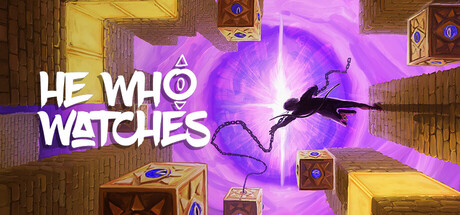
He Who Watches is an atmospheric first-person puzzle game about navigating a seemingly impossible structure—an ancient, shifting labyrinth that asks you to reconsider what “ground” even means. Instead of giving you enemies to shoot, it gives you puzzle chambers to untangle, built around spatial reasoning, perspective changes, and gravity-defying traversal where every surface is a possible pathway.
The vibe is contemplative and mysterious: you move through stark, otherworldly spaces filled with cryptic symbols and hidden routes, always nudged forward by the question of what lies at the center—and who, exactly, is watching.
Puzzle Design: Perspective, Planes, and Patience
The core hook is the game’s relationship with space. You’ll be asked to:
- Walk on walls and ceilings, slipping between planes as gravity shifts and the world reorients around you.
- Think in chain reactions, where one change sets off a sequence of movements, activations, and new routes.
- Read rooms like mechanisms, learning how each chamber’s rules interlock before committing to a solution.
It’s the kind of puzzle-platformer where progress often comes from a single realization—spotting a surface you hadn’t considered walkable, or understanding how a repositioned object will behave once gravity flips. The game explicitly rewards persistence: you may iterate, experiment, and slowly assemble the “logic” of each space.
The Bow (Not a Weapon): A Tool for Manipulating the World
Your bow is not for combat. It’s the game’s primary interaction tool, paired with a single magical arrow and a magical chain that turns shots into physical consequences. In practice, it becomes a compact toolbox for environmental problem-solving. You’ll use it to:
- Open doors and access new sections of a chamber
- Move blocks into place to create paths or trigger systems
- Activate switches at a distance or from unconventional angles
- Pull yourself across gaps using the arrow’s chain for traversal
This design keeps the focus on space and interaction rather than inventory management. The satisfaction comes from learning how far the tool’s logic can stretch—and how to combine it with gravity shifts to create solutions that feel inevitable in hindsight.
Scale, Secrets, and the “Watching” at the Center
He Who Watches leans into mystery without dumping exposition. The labyrinth feels ancient, intentional, and unsettlingly vast. As you progress, the game encourages you to look closer: secret paths, hidden mechanics, and subtle visual cues suggest that many rooms have more to say than their obvious solution.
If you’re the kind of player who likes poking at the edges of puzzle games—checking odd corners, testing assumptions, and revisiting spaces with new understanding—there’s a strong promise of extra depth beyond simply reaching the exit door.
How Much Game Is Here?
- Over 100 handcrafted puzzles, designed to ramp up in complexity and demand.
- A playable hint system for when you’re stuck, aimed at nudging you forward without fully robbing the “aha” moment.
- Secrets throughout for completionists and curious explorers.
It’s also worth noting: the game states that no generative AI was used in development.
Developer & Publisher
- Developer: Solo developer Bobby Vanden
- Publisher: Draknek & Friends (well-known for puzzle-focused releases)
That pairing is a strong signal of intent: tightly constructed puzzles, careful ramping of ideas, and a premium on clarity of interaction even when the spaces themselves feel impossible.
Mac System Requirements
Minimum
- OS: macOS Big Sur
- Processor: Apple M1
- Memory: 4 GB RAM
- Storage: 9 GB available space
Recommended
- OS: macOS Big Sur
- Processor: Apple M1
- Memory: 4 MB RAM
- Storage: 9 MB available space
Note: The listed recommended specs appear to contain a likely typo (showing MB instead of GB for memory and storage). Expect the practical recommendation to be similar to or slightly above the minimum, but verify the latest requirements on the game’s store page before installing.
Who Is This For?
On Mac, He Who Watches is a great fit if you enjoy first-person puzzlers that emphasize spatial reasoning and environmental logic—especially those that let you bend rules like gravity and traversal. If you like unraveling dense puzzle chambers, experimenting with a small set of consistent mechanics, and chasing secrets through an eerie, minimalist world, this one belongs on your radar.
Seek the imprisoned god at the center. He is waiting.





Comments
Sign in to join the conversation.
Log in to commentNo comments yet. Be the first to join the conversation.