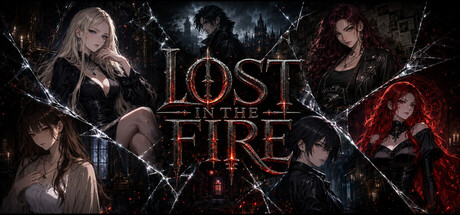

Lost in the Fire (Mac) – Overview
Lost in the Fire is a dark gothic psychological thriller visual novel centered on memory, guilt, desire, and the residue of trauma that refuses to die. It begins fifteen years after the Ashborne Lodge fire—an event that shattered childhoods and left the mountain estate as a burned-out husk. For protagonist Adrian Vale, the past isn’t simply calling back; it’s luring him in with an invitation that has no sender, no explanation, and one impossible message:
“The fire didn’t take you. It saved you for later.”
From there, the game pushes you into a claustrophobic mystery where the lodge feels less like a location and more like a living wound—full of ash, silence, and rooms that don’t behave like rooms should.
Ashborne Lodge: A Setting Built on Secrets
Adrian returns to the ruined lodge where his childhood ended, only to find himself trapped alongside several women tied to the tragedy in different ways. Each carries a secret. Each remembers a different version of the night the fire began. The tension comes not only from what the lodge hides, but from what the characters hide from one another—and from themselves.
As you explore, the story leans into gothic horror staples—hidden passages, forbidden rituals, locked doors, and spaces that suggest the building is still inhabited by something left behind. The narrative hints at deeper threads beneath the ruin: the Ember Covenant, the mystery of a lost child, and the possibility that Adrian’s role in the catastrophe is far darker (or stranger) than he’s been able to admit.
Choice-Driven Investigation and Relationships
As a visual novel, Lost in the Fire lives and dies by its decision points. Dialogue choices shape:
- How characters respond to Adrian and how close they allow him to get.
- What is revealed (and what remains buried) through memory flags and discovery beats.
- Relationship dynamics influenced by trust, fear, guilt, desire, and obsession.
Expect character interactions to be volatile: one person may offer comfort, another may accuse, and another may guide Adrian toward answers that feel less like salvation and more like a match held to gasoline.
Horror, Romance, and Mature Themes
This is not a cozy mystery VN. The game’s tone is explicitly bleak and psychological, mixing supernatural horror with adult romance elements. The lodge becomes a stage for grief, distorted recollections, and the creeping sense that the truth is not merely hidden—it is actively resisting discovery.
Content note: The developer describes mature themes including psychological and supernatural horror, disturbing memories, grief, fire-related tragedy, suggestive dialogue, nudity, and adult sexual/romantic content. All romantic/sexual content is described as involving consenting adults aged 21 or older.
Key Features
- A dark gothic psychological thriller visual novel focused on memory, guilt, trauma, and supernatural horror.
- A burned mountain lodge setting packed with hidden rooms, passages, ritual spaces, and “impossible” architecture.
- Multiple major female characters, each connected to Ashborne Lodge and the tragedy in distinct ways.
- Choice-driven dialogue with relationship values, memory flags, and reactive character behavior.
- Cinematic event CGs and atmospheric horror sequences (including adult romantic visuals).
- Steam achievements tied to major discoveries and story milestones.
Mac System Requirements
Minimum
- OS: Mac OSX 10.15 or better
- Processor: Apple M1 or Intel Core 2 Duo
- Memory: 4 MB RAM
- Graphics: Compatible OpenGLR
Note: The listed memory requirement appears unusually low for modern macOS titles; treat it as publisher-provided information and expect practical requirements to be higher depending on assets, resolution, and background apps.
Why Mac Gamers Should Watch This One
If you enjoy visual novels that prioritize atmosphere and psychological unraveling over straightforward detective work, Lost in the Fire aims for that slow-burn dread: conflicting accounts, relationship-driven tension, and a setting where every opened door feels like a mistake. Between its choice-driven structure and its fixation on unreliable memory, it’s a game built for players who like to interrogate every character—especially the protagonist.
Just don’t expect a safe room. According to the game’s own warning, Ashborne Lodge only has doors you haven’t opened yet.




Comments
Sign in to join the conversation.
Log in to commentNo comments yet. Be the first to join the conversation.