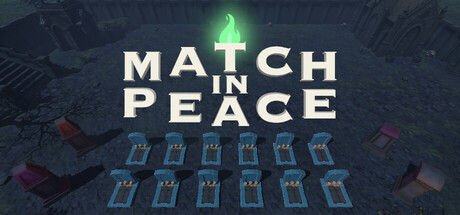

Match In Peace takes the familiar satisfaction of finding pairs and turns it into a tense, run-based battle system. Instead of calmly clearing a board, you’re matching identical monsters hiding inside tombstones to earn Points, chain a Combo, and unleash monster-powered effects against enemies—all while a Timer pressures every decision.
The result is a compact roguelike loop that feels part puzzle game, part score attack, and part build-focused battler. Winning isn’t only about being fast; it’s about choosing the right monsters, bending the rules with stone cards, and preparing for encounters that demand different approaches.
How the core gameplay works
Each fight is a race: match two identical monsters to score points and keep your momentum. Every match contributes to your overall output, but the real leverage comes from:
- Monster effects: Matching isn’t just scoring—your monsters can trigger offensive/utility effects that help you handle specific enemy threats.
- Combo management: Maintaining a combo can be the difference between scraping by and blowing past a difficult setup.
- Timer pressure: You’re constantly weighing “safe” matches versus optimal lines that keep your combo alive and your score climbing.
It’s a simple input (match pairs) with a layered outcome: speed, sequencing, and build synergy all matter.
Roguelike progression: build your haunted toolkit
Runs in Match In Peace revolve around assembling a flexible set of tools that modify how you score, how you fight, and how reliably you can maintain tempo.
Monsters: your active arsenal
- You start with 4 random monsters, immediately pushing variety and adaptation.
- Over the course of a run, you can collect up to 12 monsters, shaping a build that matches your preferred style—whether that’s burst scoring, consistency, control, or high-risk combo play.
Stone Cards: rules are meant to be broken
Stone Cards change the rules of the game, letting you pivot into strategies that feel closer to a deckbuilder’s “run-defining modifiers” than a traditional matching game’s incremental upgrades.
Statues: passive power that stacks
Statues provide powerful passive effects—exactly the kind of long-run value that makes roguelikes click. They’re especially important for smoothing out inconsistency and enhancing whatever your core plan is (combo stability, scoring boosts, survivability against tough setups, etc.).
Potions: situational answers to big threats
Potions function as tactical support: the right potion can swing a tough fight, buying breathing room when a particular enemy configuration pressures your timer or disrupts your flow.
Events: big boons, bigger risks
Between fights, Events offer special Boons that you won’t find elsewhere—tempting power spikes that can define a run. The catch is that events can also leave you Cursed, forcing you to decide whether the upside is worth potential long-term instability.
This risk/reward layer matters because the game’s challenge isn’t static: what helps you dominate one encounter might leave you vulnerable in the next.
The Swap Shop: spend gold, reshape your build
Your run economy feeds into the Swap Shop, where you can spend gold to improve the parts of your build that aren’t clicking yet. The shop supports multiple types of adjustments:
- Pick up more useful monsters to improve your effect toolkit.
- Acquire stone cards, statues, and potions to round out your strategy.
- Convert excess gold into other currencies when direct purchases aren’t the best value.
In practice, this is where you turn “a run that’s merely surviving” into “a run that’s scaling.”
Combat variety: 150 enemy setups to solve
Match In Peace isn’t content with one kind of puzzle. You’ll face up to 150 different enemy setups, and the game asks you to respond with smart reward choices and playstyle shifts. That might mean prioritizing raw points in one fight and valuing consistency, timer control, or synergy pieces in another.
If you enjoy roguelikes that reward adaptation over rote execution, this variety is one of the strongest hooks.
Mac performance and requirements
On Mac, Match In Peace targets Apple Silicon systems and macOS Catalina or later.
Minimum Mac requirements
- Requires an Apple processor
- OS: macOS 10.15 (Catalina)
- Processor: Apple Silicon
- Memory: 8 GB RAM
- Network: Broadband Internet connection
- Storage: 3 GB available space
Recommended Mac requirements
- Requires an Apple processor
- OS: macOS 10.15 (Catalina)
- Processor: Apple Silicon
- Memory: 8 MB RAM
- Network: Broadband Internet connection
- Storage: 3 MB available space
Note: The listed recommended memory and storage values appear unusually low compared to typical game requirements; if you’re planning installs across multiple Macs, it’s worth double-checking the store page for any updated figures.
Who is this for?
- Players who want a fast, tense puzzle game with real consequences for routing and mistakes.
- Roguelike fans who enjoy buildcraft: stacking passives, bending rules, and chasing synergy.
- Score-chasers who like optimizing combo paths under time pressure.
Summary
- Match monsters hidden in tombstones to score points and trigger monster effects.
- Manage timer and combo to keep runs alive.
- Start with 4 random monsters and collect up to 12 per run.
- Collect Stone Cards, build Statues, and use Potions to handle escalating threats.
- Take on up to 150 enemy setups, plus high-stakes Events with boons and curses.
- Use the Swap Shop to buy, swap, and convert resources to refine your build.


Comments
Sign in to join the conversation.
Log in to commentNo comments yet. Be the first to join the conversation.