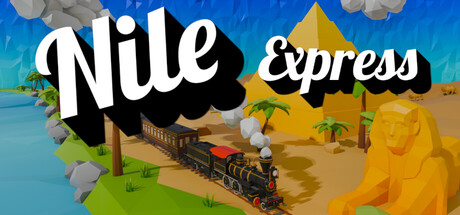

Nile Express brings classic rail-network problem solving to 1850s Egypt, tasking you with building one of Africa’s earliest railway systems along the Nile. Across six handcrafted levels, you’ll connect towns and industries, move passengers and goods on schedule, and constantly refine your layout to squeeze more value out of every train and stretch of track.
Rail-building in 1850s Egypt
The premise is straightforward: build rail lines, run trains, and earn money by delivering what the map demands. The challenge comes from doing it efficiently. Each level is a contained scenario where you’ll be balancing expansion with reliability—pushing for profit while ensuring your network doesn’t collapse under its own complexity.
Gameplay: efficiency is the real objective
Rather than focusing on freeform sandbox sprawl, Nile Express emphasizes planning and optimization. Your income depends on how well you route passenger and freight transport, which naturally turns every level into a logistical puzzle:
- Fulfill transports of passengers and goods: Your network needs to serve multiple demands, and the best layouts often rely on smart routing rather than brute-force expansion.
- Earn money through throughput: The more consistently your trains move and deliver, the more stable your finances become.
- Budget pressure: Build until you run out of money—or take on limited loans to keep expanding, knowing you’ll need the network to pay you back.
Accidents, recovery, and speed discipline
Nile Express adds a practical operational hazard: trains can crash if they take curves too fast. That means track geometry and route design matter, not just connectivity. When things go wrong, you’ll need to:
- Replace trains after accidents
- Rebuild rails to restore service
- Adjust how you run routes so a single high-speed mistake doesn’t become an expensive recurring problem
This risk-reward layer makes “faster” an engineering choice rather than a default upgrade, and it encourages networks that are robust—not merely direct.
Station routing and advanced network control
A key feature is how stations can support multiple rails, allowing you to choose which track a route should use. That opens the door to more complex networks where you can separate traffic, reduce congestion, and plan overtakes and clear paths through busy hubs.
You also get meaningful rolling-stock control:
- Choose wagon types to match the cargo you’re moving
- Select locomotives to fit the route and your operational needs
- Reuse wagons efficiently by chaining multiple goods tasks together, creating higher utilization per train
Smarter stops: unload without loading
An interesting operational tool is the ability to decide where a train should only unload goods and not load. That may sound minor, but it enables tactical routing: you can create extra stops that help clear track segments, reduce station dwell conflicts, and keep critical lines moving for other trains.
Level design and terrain authenticity
The six levels are built on maps created from real terrain profiles, grounding your routes in believable geography. (The developer notes that buildings, trains, ships, and the river are not scaled exactly to terrain size.) In practice, this means the landscape will influence how you plan curves and connections—especially when you’re trying to avoid costly, crash-prone layouts.
Mac system requirements
Minimum:
- OS: Sequoia
- Processor: Apple M1 or Intel Core i7
- Memory: 16 GB RAM
- Storage: 1 GB available space
Recommended:
- (Not specified)
Graphics note: Vulkan requirement
The game requires a Vulkan-compatible graphics card and driver. For older hardware with an Nvidia GPU, the developer advises using a driver version 425.31 or newer to ensure Vulkan support.
Where to share feedback
If you have feedback for the developer, they request that players post in the game’s Steam Discussion Board.
Who Nile Express is for
If you enjoy rail-network games where the satisfaction comes from clean routing, high utilization, and steady throughput, Nile Express aims squarely at that itch. With scenario-based levels, budgeting constraints, and the constant push to improve flow through multi-track stations, it’s a focused railway management experience built around efficiency—and the occasional hard lesson from taking a curve too fast.



Comments
Sign in to join the conversation.
Log in to commentNo comments yet. Be the first to join the conversation.