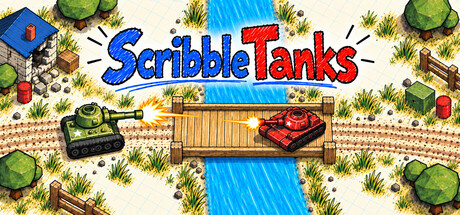

Scribble Tanks on Mac: one page, one tank, one relentless horde
Scribble Tanks drops you into a stylized warzone that looks like it was drawn on graph paper—crisp outlines, cross-hatching, and scribbly details wrapped around a fully 3D battlefield. The hook is simple and immediately readable: you begin each run with a basic tank, survive increasingly brutal zombie waves, and use what you collect to rebuild into something wildly specialized.
Runs are designed around 10- or 20-minute survival goals, culminating in a final boss. If you want to keep the run alive after that, Endless Mode lets you stay on the map and see how far your build can scale.
Core loop: survive, collect, rebuild, repeat
Moment to moment, Scribble Tanks is about staying mobile, managing angles, and carving escape routes through crowds while hoovering up progression resources. Defeated enemies spill XP souls for leveling and scrap for rebuilding. Between attacks you make the decisions that define the run: which weapons to add, what to upgrade, and when to take on extra danger for better rewards.
It’s a roguelite in the satisfying “one more run” sense—your tank starts modest, then quickly becomes a layered machine of main cannon fire, secondary weapons, drones, and build-defining upgrades.
Build your tank your way (chassis, weapons, evolutions)
Every run begins with a choice of three chassis:
- Scout – lighter, faster handling for kiting crowds and repositioning.
- Rammer – heavier presence for close-range control and survivability.
- Artillery – built to make space and punish targets from safer distances.
Your core cannon stays with you, but you can add up to three additional weapons on top of it. The lineup supports very different playstyles, including classics like machine gun, flamethrower, mine layer, rocket launcher, and Tesla coil, plus more exotic options such as circular saw, railgun, frost cannon, mortar, acid launcher, air cannon, and glue cannon.
Upgrades aren’t just linear stat bumps. As you invest into a support weapon, a fully upgraded path can unlock a choice between two evolutions—pushing your build toward precision damage, area denial, raw burst, or crowd control/knockback. The result is a run where your “tank” can feel like anything from a lane-clearing flamethrower platform to a control-focused machine that pins mobs in place and deletes elites with the main gun.
Risk crates, cursed upgrades, and high-stakes power spikes
Scribble Tanks encourages you to gamble. Risk crates offer premium rewards but trigger an extra horde—a direct trade of safety for tempo and power. Meanwhile, cursed upgrades push the roguelite tension further: they can be run-defining advantages, but they always come with a cost that changes how you drive, aim, or manage danger.
These mechanics are where the game’s best stories tend to happen, because the “correct” choice depends on your current weapon mix, your chassis, and what the map is throwing at you next.
Eleven enemy types that force real answers
Zombie swarms are only the baseline. The game calls out eleven core enemy types that each demand different positioning and priority targeting: crawlers, sprinters, brutes; pistol, rifle, and rocket troops; shield bearers, burrowers, burning and explosive infected; and even siege tanks. Add elites and bosses with extra abilities and the horde becomes more than a simple DPS check.
- Boss component damage: some bosses can be dismantled piece by piece—destroy components to disable attacks or slow them down.
- Enemy tanks use terrain: they maneuver, seek cover, and can even repair when protected by obstacles.
- Engineers reshape fights: they build emplacements and barricades in visible stages, turning familiar routes into chokepoints if you don’t interrupt them.
- Named rivals: the enemy that defeats you may return in a later run as a damaged, named rival equipped with a countermeasure. Take it down permanently to earn a special trophy.
- Scavengers: some enemies try to escape with scrap—catch them before they get away with your loot.
Destruction, physics, and battlefield manipulation
One of Scribble Tanks’ standout features is how much of the map can be broken, and how often destruction becomes a tactical tool. Houses, fences, walls, streetlights, power poles, and bridges can collapse into debris, while fallen trees remain as obstacles. Shockwaves travel through grass, enemies, and loose wreckage, and environmental resources like fuel, electricity, and ammunition can set off chain reactions.
The underlying tank model also matters in a way that complements the roguelite progression:
- Ballistics: cannon shells travel in a ballistic arc, and hits lose force over distance.
- Armor facings: front/side/rear armor behave differently, and glancing shots can ricochet.
- Terrain: mud, water, elevation, and ground type affect traction and movement, with visible track and terrain changes as the battle evolves.
Five regions, dynamic lighting, and weather that changes engagements
The campaign spans five regions—village, forest, swamp, quarry, and industrial district—with landmarks such as a gas station, water tower, sawmill, cemetery, and farm helping you orient while under pressure. Two destructible bridges connect riverbanks (until they don’t), and the world transitions from day to night with rain and fog affecting visibility.
At night, you’ll lean on streetlights, headlights, and night vision, but smoke, terrain, and buildings can still conceal threats. Fire propagation is influenced by wind and material, and rain can slow flames—small touches that make each region feel reactive rather than purely decorative. Even wildlife reacts, with ducks, deer, and birds fleeing the chaos.
Objectives and meta-progression: reclaim territory between runs
While each run is self-contained, Scribble Tanks also gives you a longer arc. You’ll take on missions at points of interest like the workshop, convoy, and treasure guard for upgrades and spare parts. Souls are used not only for leveling but also to open chests and repair the tank, and you’ll need to watch your limited fuel as the run stretches on.
Progress persists via region control: you can free rarely besieged regions, and that control carries between runs as a source of starting bonuses—though counterattacks can force you into defensive play. You’ll also unlock tanks and starting weapons, and you can permanently upgrade each chassis in the garage while chasing high scores.
Single-player and offline-friendly
Scribble Tanks is single-player and designed to be played offline. A tutorial and a detailed handbook are included, which is especially welcome given how many weapons, evolutions, and enemy behaviors you’ll be juggling once the difficulty ramps.
Mac performance and requirements (Apple Silicon + Metal)
On Mac, Scribble Tanks is built around Apple Silicon and Metal. Here are the provided requirements.
Minimum Mac Requirements
- Requires an Apple processor
- OS: macOS 12.0 or later
- Processor: Apple Silicon (ARM64; M1 or later)
- Memory: 4096 MB RAM
- Graphics: Apple Silicon GPU; Metal support
- Storage: 250 MB available space
Recommended Mac Requirements
- Requires an Apple processor
- OS: macOS 12.0 (Monterey) or later
- Processor: Apple Silicon (ARM64; M1 or later)
- Memory: 8192 MB RAM
- Graphics: Apple Silicon GPU; Metal support
- Storage: 500 MB available space
Why it belongs on your Mac roguelite shortlist
If you like survival roguelites but want something with more physicality than a flat arena—terrain traction, armor facings, ballistic arcs, collapsible structures, and enemies that actively manipulate the map—Scribble Tanks stands out. The sketchbook aesthetic isn’t just a gimmick; it makes the chaos readable, even when the screen is crowded with fire, debris, and XP souls. And with meaningful build variety across chassis, weapons, and evolutions, it’s the kind of game that rewards experimentation as much as execution.
Roll out, rebuild, and see what your tank becomes—one sheet at a time.


Comments
Sign in to join the conversation.
Log in to commentNo comments yet. Be the first to join the conversation.