
Overview
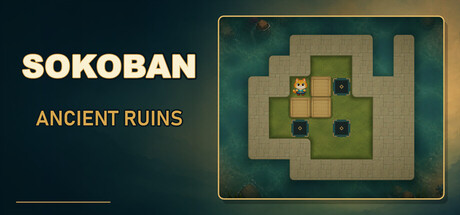
Sokoban: Ancient Ruins is a relaxed 3D take on one of puzzle gaming’s most enduring formats: push every crate onto its matching target, without ever pulling a crate back out of trouble. Set across a range of serene environments inspired by ancient cultivator ruins, it keeps the board readable and the rules familiar—then steadily ramps the complexity until every move feels like a small commitment.
For Mac players who enjoy deliberate, methodical problem-solving, this is the kind of game that’s easy to boot up for a few quick puzzles and equally easy to lose an evening to when a particularly knotty layout demands “just one more attempt.”
Classic Sokoban Rules, Modern 3D Presentation
At its core, the game stays faithful to classic Sokoban:
- You move on a grid-based board with walls, pathways, crates, and target tiles.
- You can push crates one step at a time, but you cannot pull them.
- The level is solved when all crates sit on target spaces.
That “push-only” rule is where Sokoban earns its reputation. A single careless shove can block a corridor, pin a crate against a wall, or lock the entire puzzle into a dead-end state. Sokoban: Ancient Ruins embraces that tension, encouraging you to study the whole board, anticipate traffic flow, and consider how your available space shrinks and expands with every move.
Planning Is the Real Challenge
Even early puzzles teach the fundamentals: keep routes open, avoid pushing crates into corners unless they belong there, and don’t assume the closest target is the right destination for the first crate you move. As levels become larger and more crowded, the “correct” solution often comes down to sequencing:
- Which crate must move first so it doesn’t become boxed in later?
- Which corridors must remain open so you can reach a crate’s other side?
- How much space do you need behind a crate to reposition it safely?
- Where are the irreversible pushes that can instantly create a deadlock?
This is a game that rewards thinking several pushes ahead. There’s no timer pressure, no twitch demands—just logic, foresight, and the satisfaction of watching a complicated layout finally click into place.
900+ Levels: Quick Wins and Brain Burners
Content is a major selling point here: the game includes more than 900 levels. Early stages tend to be compact and approachable, ideal for learning safe movement patterns and common pitfalls. Later, puzzles scale up in size and density, introducing tighter passages, more crates to coordinate, and layouts where a single misplaced push can invalidate several minutes of careful setup.
Some stages are perfect for a short break—finishable in a minute or two. Others invite you to pause before the first move, scan the entire grid, and plan a route like you’re solving a small logistical puzzle.
Irregularly Shaped Crates Add a Smart Twist
While most Sokoban variants either stay purely classic or pile on mechanics, Sokoban: Ancient Ruins takes a focused approach. The primary “new” idea arrives later in the campaign: irregularly shaped crates.
Unlike standard single-tile boxes, these crates can occupy multiple grid spaces in distinct shapes. That seemingly simple change has big implications:
- Narrow corridors that work for a normal crate may be unusable for a larger shape.
- Turning, repositioning, and reserving maneuvering room becomes more important.
- The puzzle remains Sokoban at heart, but adds a fresh layer of spatial reasoning.
It’s an elegant addition because it deepens the planning without drifting away from what makes Sokoban satisfying: committing to pushes and managing space like a limited resource.
Atmospheric Biomes Without Sacrificing Readability
Ancient Ruins leans into 3D scenery for variety and mood, cycling through environments such as island ruins, snowfields, forests, bamboo groves, deserts, lava caverns, crystal caves, ancient temples, and more. Importantly for a grid-based puzzle game, the boards remain clear and readable—walls, paths, targets, and crates are easy to parse at a glance, so the visuals don’t get in the way of decision-making.
Undo/Restart Encourages Experimentation
Sokoban’s difficulty often comes from the permanence of mistakes—until you’re given the right tools to explore alternatives. Here, you can undo moves and restart the level at any time, which makes experimentation feel natural rather than punishing. It’s a friendly approach to a genre that can otherwise feel brutally strict, especially when a deadlock happens ten pushes after the moment you actually made the mistake.
Buy-to-Play, No Filler
Mac gamers tired of puzzle titles built around friction will appreciate the game’s straightforward monetization: it’s a complete buy-to-play experience with no ads, no energy system, and no microtransactions. You buy it once and work through the puzzles at your own pace.
Who It’s For on Mac
- Perfect for: fans of classic Sokoban, players who like thoughtful planning, and anyone who wants a long-lasting puzzle library that works well in short sessions.
- Maybe skip if: you want action-heavy gameplay, rapid variety in mechanics, or puzzles that don’t hinge on “irreversible move” consequences.
Mac System Requirements
Minimum
Minimum:- OS: macOS 11 Big Sur
- Processor: Apple M1 or Intel Core i5
- Memory: 4 GB RAM
- Graphics: Apple M1 integrated graphics or Intel Iris Graphics
- Storage: 2 GB available space
Recommended
Recommended:- OS: macOS 12 Monterey or later
- Processor: Apple M1 or better
- Memory: 4 GB RAM
- Graphics: Apple M1 integrated graphics or better
- Storage: 4 GB available space
Bottom Line
Sokoban: Ancient Ruins delivers exactly what many Sokoban fans want on Mac: faithful crate-pushing logic, a huge supply of levels, and a clean 3D presentation that keeps the focus on planning. With undo/restart support and a single-purchase model, it’s an easy recommendation for puzzle players who love puzzles where every push matters.




Comments
Sign in to join the conversation.
Log in to commentNo comments yet. Be the first to join the conversation.