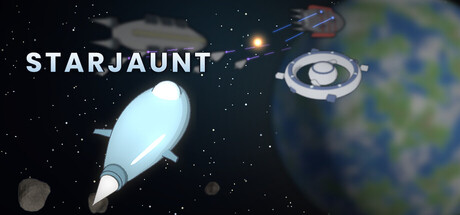

Starjaunt doesn’t begin with a heroic cruiser or a destiny speech. It begins with a shuttle: a small hold, a small tank, and enough range to reach a place that isn’t here. From that first jump forward, the game makes good on a rare promise in space sims—what happens next is genuinely up to you.
Set across 44 star systems and seven regions, Starjaunt is a sandbox with weight. It’s not just that you can choose to be a merchant, miner, bounty hunter, spy, or combat pilot. It’s that the galaxy is already moving, already fighting, already straining supply lines and flipping control—whether you participate or ignore it.
Start small, stay small, or grow into something dangerous
Starjaunt’s best trick is how comfortable it is letting you define your scale.
- Play it quiet. You can spend an entire career hauling grain, dodging trouble, and upgrading gradually from shuttle to freighter. The war still matters—because it chokes routes, changes prices, and makes “safe” systems less safe—but it never demands that you become a soldier.
- Live in the margins. Mine asteroid belts, sell ore to refineries, and treat politics as background radiation. You’ll still feel the economy breathe as blockades and victories reshape what stations need and what they can supply.
- Go looking for trouble. Take combat contracts, push contested systems over the edge, and build the kind of reputation that turns random patrol chatter into active pursuit—or a warm welcome at the next dock.
Most players will drift between roles, because Starjaunt is designed to make “one more job” a meaningful decision: the profitable run might cross a hot border, the spy mission might tank your standing, and the bounty target might flee into a system that has changed hands since you last looked at the map.
Pick a life (or don’t): careers with consequences
Rather than locking you into a class, Starjaunt offers distinct activity loops with their own mission structures and incentives:
- Merchant: Buy low, sell high, and watch prices shift as the war disrupts supply lines. Upgrading cargo capacity changes your entire relationship with risk—suddenly escorts, safe harbors, and faction standings matter more than your aim.
- Miner: Work belts and sell to refineries, keeping your head down while the galaxy argues. It’s a calmer path—until pirates notice your predictable routes.
- Bounty hunter: Pursue targets across a six-part arc that grows more complex the closer you get. The chase is as much about information and timing as it is about firepower.
- Spy: A full set of thirteen intelligence missions—planted evidence, extractions, interdictions, and bribes that hit your ledger as negative pay. It’s work that dirties your hands even when you “succeed.”
- Combat pilot / Fleet commander: Fly for a flag, take systems, and eventually stop flying alone—through companions, paid mercenaries, or true faction trust that results in real berths and command roles.
The connective tissue between all of this is simple: the game tracks what you do, who you do it for, and what it changes. The more you specialize, the more the galaxy responds.
Nine factions, no clean answers
Starjaunt’s political landscape avoids cartoon morality. Each of the nine factions has its own doctrine, ship philosophy, and reasons that sound convincing until you see the collateral.
- The Federation: Order and duty—expressed in slow, armored ships and a tariff schedule for everything.
- The Rebel Alliance: Speed as armor, freedom as grievance, and captured tech held together with conviction.
- The Free Frontier: Farmers, miners, and free ports trying to be left alone while everyone squeezes them. They remember who helped.
- The Helios Combine: A megacorp that profits from conflict and prefers it never ends. Drone swarms, because people are expensive.
- The Artifact Order: Zealots guarding Precursor ruins with a devotion that can turn suicidal.
- The Federation Bastion: Hardliner splinter faction: siege doctrine, scorched earth, and no negotiated peace.
- Pirates, the Merchant Guild, and Independent worlds: Opportunists, pragmatists, and survivors who adapt to whichever banner currently flies.
Progress isn’t just a number. Each faction’s missions unlock their technology one ship at a time, building toward a roster of 54 ships and 43 weapons/outfit systems, most gated behind the groups who manufacture (or hoard) them. The result is a simple motivation loop that feels grounded: if you want to fly their hardware, you need to earn their trust—or at least their tolerance.
A war that moves without you (and markets that actually react)
Starjaunt treats territory as more than a map color. Each system has a live control value, and missions nudge that control in measurable ways. Push a system toward the Rebels and it can flip; when it does, the downstream effects follow:
- Patrols and traffic change (who stops you, who protects you, who hunts you).
- Markets restock from different suppliers.
- Prices shift as supply lines open or collapse.
- Standing and contract availability adjust with the new reality.
Contested systems can spawn both sides at once, letting you watch battles unfold—or tip them—right in front of you. The key detail is that this isn’t a one-time scripted campaign beat; it’s a systemic war that keeps redrawing the galaxy you navigate. Hour forty doesn’t look like hour one.
Pilots that don’t feel scripted: reinforcement learning in the cockpit
Enemy (and civilian) pilots in Starjaunt aren’t following a simple patrol route with a predictable behavior tree. The game’s pilots are driven by a policy trained through reinforcement learning—trained in simulation until pirates learned to hunt and patrols learned to protect.
In practice, that means opponents can feel temperamental in a way that resembles people more than puppets: some commit too hard, some disengage early, some panic, some press an advantage. They make mistakes. They surprise you. In close fights, you start reading them the way you read a human pilot—because tactically, that’s what it feels like.
Docking isn’t a menu: on-foot worlds and grounded routines
When you land, you don’t just click “trade” and disappear. Starjaunt lets you step out on foot across every world you dock at—desert outposts under prefab domes, forested colonies with lakes and lumber, company towns, garrisons, free ports.
It’s not just sightseeing; it reinforces the game’s tone. You find the depot. You argue with the mechanic. You sell at the warehouse. You listen in a bar for what’s profitable next. It’s a small detail that makes the galaxy feel inhabited rather than abstract.
You don’t have to fly alone: companions, mercenaries, and fleets
Starjaunt supports three distinct ways to build support, each with different costs and emotional stakes:
- Make friends: Earn 12 companions through storylines. They fly their own ships, talk during combat, walk beside you planetside, and have their own mission arcs. If they die, they stay dead.
- Hire guns: Pay for wingmen at bars. Veterans, rookies, mercenaries—temporary help until they die or you let them go. Losing one is losing money.
- Earn a fleet: Stay loyal (and effective) long enough and factions stop offering contracts and start offering berths and command—carrier certification, named capital conversions, or command roles you’re granted only after you’ve proven you can be trusted.
This structure pushes you to think about risk differently. Taking a fight when you’re alone is one thing. Taking it when you’ve brought someone whose name is in your ledger is another.
Beyond the last charted jump: the Rift and three endings
Starjaunt’s late-game escalation doesn’t invalidate the faction war—it reframes it. Precursor ruins at Tau Ceti, exotic matter at the fringe, and then the unstable path past Sanctum into the Rift, where something dormant responds when relics are disturbed.
It doesn’t bargain. It doesn’t trade. It doesn’t hate you. It responds.
How you resolve that looming presence is the game’s sharpest, most direct question, culminating in three endings: seal it, wake it, or take it apart and use it.
At a glance
- 44 star systems across seven regions
- 134 missions, including six full faction campaigns that converge on shared battles from opposite sides
- 54 ships and 43 weapons/outfits, many tied to faction progression
- A live faction war that redraws the map, markets, patrols, and contracts
- Pilots driven by reinforcement-learning rather than scripted routines
- On-foot exploration on every world you land on
- 12 companions, hireable mercenaries, and fleets earned through trust (permadeath for companions)
- Three endings
- Platforms: Windows, macOS, Linux
Note: Starjaunt is keyboard only at launch.
Mac system requirements
Minimum:
- OS: macOS 12 Monterey or later
- Processor: Apple Silicon or Intel Core i5
- Memory: 4096 MB RAM
- Graphics: Metal-capable GPU
Why Mac players should care
Starjaunt’s appeal on Mac is the combination of systemic simulation and moment-to-moment flying: a shifting strategic layer (territory and economy), multiple viable non-combat paths, and dogfights that feel less like “solving” an AI script and more like reacting to a pilot’s temperament. If you’ve wanted a space sandbox that respects quiet careers and makes the galaxy’s conflict feel tangible, Starjaunt is built for that middle ground.



Comments
Sign in to join the conversation.
Log in to commentNo comments yet. Be the first to join the conversation.