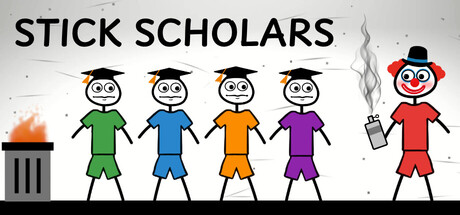

Stick Scholars is the kind of party game that turns a simple goal—make it to school and pass the quiz—into a loud, suspicious mess of failed jumps, wrong answers, and accusations. It mixes three crowd-pleasers into one loop: a goofy 2D parkour sprint, player-specific trivia questions, and a hidden-role saboteur called the Class Clown who’s actively trying to stop the class from graduating.
If your friend group likes games where you’re never quite sure whether someone is genuinely struggling or deliberately throwing, Stick Scholars is built around that exact tension. Every round asks the same question: Are they bad at platforming… or are they lying?
How Stick Scholars Works
The match structure is clean and repeatable, which makes it great for party sessions. Each “quiz day” follows a simple sequence: role assignment → parkour → trivia → vote. Over multiple quizzes, the class either graduates or flunks out.
1) Role Assignment: Scholars vs. the Class Clown
Most players are Scholars, and their win condition is straightforward: collectively earn enough passing quiz results to graduate. One player is secretly the Class Clown, whose job is to prevent graduation by sabotaging the group—without being so obvious that everyone votes to suspend them.
2) Parkour: Get to Class or Auto-Fail
Before every quiz, everyone has to survive a chaotic 2D parkour run to school. Miss the deadline or die on the way, and you automatically fail your part of the upcoming trivia—putting immediate pressure on the team score.
Levels are packed with silly hazards and obstacles (think fiery trash cans and big locks blocking routes), and the social layer is the real spice: a few missed jumps might be honest mistakes, but repeated “accidents” can quickly paint a target on someone’s back.
Sabotage twist: The Class Clown can also make the parkour harder with items—so that one suspiciously perfect fake platform or well-timed chaos moment might not be the map, but the Clown.
3) Trivia: Individual Questions, Group Grade
Players who make it to school answer a trivia question specific to them. The class then gets a collective grade based on everyone’s performance. This is where the Clown can play mind games: they might intentionally answer wrong to drag down the score, or answer correctly early to build trust before throwing later.
The result is a fun dynamic where you’re not only thinking about the question—you’re evaluating how likely your friends are to know it in the first place. If you’ve ever said, “There’s no way you didn’t know that,” this game is designed to turn that moment into a vote.
4) Vote: Suspend Your Suspect
After each quiz result, players vote on who they believe is the Class Clown. The top-voted player is temporarily suspended for the next trivia quiz only. Suspended players don’t participate in that quiz’s answering, which means they also don’t affect the score during that round.
It’s an interesting approach because suspension is temporary—you’re not permanently ejecting someone. That keeps the social deduction moving, but it also creates risk: suspending the wrong person reduces the number of answers contributing to your grade, and it gives the real Clown another round to manipulate the outcome.
Scoring and End Game: Can the Class Graduate?
Stick Scholars is ultimately about the class passing enough quizzes before the total runs out. By default, the Scholars need to pass 6 out of 10 quizzes to graduate. If they don’t hit the requirement, the Class Clown wins.
That multi-round structure is what makes the accusation game work: a single suspicious moment isn’t always enough, but patterns start to show. Or at least, you’ll convince yourself they do.
Custom Game Settings (And Why They Matter)
Not every group has the same platforming skill or trivia comfort zone, and Stick Scholars leans into that with adjustable host settings to tune parkour difficulty and trivia difficulty. If you’re introducing the game to a mixed-skill group, starting with default trivia settings is usually the best balance—hard enough to create doubt, but not so punishing that everyone looks like the saboteur.
Helpful Tips to Know Before Your First Session
Extra Credit: If your group scores 100% on a quiz, you earn 10% extra credit for the following quiz. That can turn a tense round into a “survive the damage” moment where a 50% becomes a pass thanks to the bonus.
Class Clown Items: The Class Clown gets 1 Smoke Grenade and 1 Fake Block per quiz, and unused items stack up to 3 of each. Even if the Clown is suspended, they can still use these items during parkour. By default, item pickup uses Q and E to keep movement fluid (and sabotage subtle).
Variable Jump Height: Jump height depends on how long you hold the jump key. Tapping produces a short hop; holding gives the full jump. If you’re repeatedly coming up short, it may be input timing—not conspiracy.
Tungsten Cubes: Heavy tungsten cubes can be pushed around. If a route suddenly feels blocked or awkward, someone may have “rearranged the furniture.”
Important Multiplayer Notes
No public lobbies: Stick Scholars is designed primarily for groups. You’ll need friends (or a community) to get the full social deduction experience.
Internet required: A good broadband connection is recommended for stable online play.
Solo and co-op options: There’s a single-player practice mode for parkour and trivia (useful for learning mechanics and chasing grades/achievements), plus a 2-player co-op mode where you and a friend try to graduate without a Class Clown in the mix.
Mac System Requirements
Minimum
OS: macOS 11 (Big Sur)
Processor: Intel Core i5 or Apple M1
Memory: 8 GB RAM
Graphics: Metal-capable GPU (Intel Iris / Apple M1 or better)
Network: Broadband Internet connection
Storage: 2 GB available space
Sound Card: Any
Recommended
Recommended requirements: Not specified.
Verdict for Mac Gamers
Stick Scholars hits a sweet spot for Mac party gaming: it’s lightweight on storage, easy to understand, and built around repeatable rounds that create stories—especially the kind where someone insists they “just missed the jump” for the fifth time in a row. If you’ve got a group chat that thrives on blame, banter, and revenge votes, this is one to keep on your Mac rotation.



Comments
Sign in to join the conversation.
Log in to commentNo comments yet. Be the first to join the conversation.