
Overview
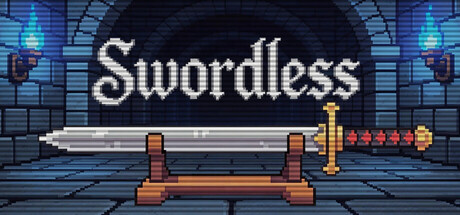
Swordless takes a classic platforming setup—tight rooms, hazards, switches, and precision jumps—and adds a mechanic that immediately reframes everything you know about movement: the ancient divine sword you’re trying to restore has been split in two. To break the curse, you must wield the hilt and the blade separately, controlling both at the same time, and bring them together on a sword stand to reforge what was broken.
The result is a game that feels like a “multiplayer game played solo.” You’re effectively managing two characters/objects simultaneously, coordinating their routes and timing so they can solve each stage as a pair.
Gameplay: One Screen, Two Hands, Constant Coordination
Each level is a single-screen challenge designed around the idea that you are always thinking in pairs. While traditional platformers focus on a single move set, Swordless asks you to plan for two independent positions at all times:
- Dual control: Move the hilt and blade separately, in parallel, using both hands.
- Synchronization puzzles: Hazards and gaps become more complex when you must protect and position two pieces, not one.
- Goal-focused design: Success is about reuniting the hilt and blade by placing both on the sword stand together.
That “two-at-once” control concept creates a learning curve that is less about memorizing enemy patterns and more about building coordination. Early stages teach you the basics—spacing, safe zones, and simple timing—then steadily push into scenarios where your left and right hands must act with intention rather than instinct.
Structure and Challenge
Swordless features 100 levels, and the single-screen format keeps the pacing snappy: fail fast, retry instantly, and iterate until your hands start behaving like a team.
Because the game’s difficulty comes from coordination, the challenge tends to feel “fair” in the best way—when you fail, you can usually identify what went wrong (mistimed movement, poor spacing, or losing track of one half while focusing on the other). That makes progress satisfying, especially once you start clearing rooms cleanly and confidently.
Visual Style: Retro CRT Flavor
The presentation leans into a retro CRT style, giving the game a throwback vibe that suits its bite-sized level structure. It’s not just nostalgia for nostalgia’s sake: the clean, readable look complements the precision of the gameplay, helping you track two controlled pieces at once without visual clutter.
Controls: Keyboard or Gamepad
Since the core premise is controlling two pieces in tandem, comfort matters. Swordless supports keyboard or gamepad (and also lists mouse as part of the input notes). Players who like symmetrical control may prefer a gamepad, while keyboard fans may enjoy the deliberate separation of left-hand/right-hand inputs. Either way, expect the game to feel most natural once you commit to a control scheme and build muscle memory around it.
Mac System Requirements
Minimum
- OS: macOS
- Processor: x86_64 or ARM CPU (Apple Silicon)
- Memory: 500 MB RAM
- Graphics: OpenGL 3.3 support
- Storage: 1 GB available space
- Additional Notes: Keyboard or Gamepad and Mouse
Recommended
- No recommended specs listed.
Who It’s For
- Precision platforming fans who enjoy short, self-contained challenges.
- Puzzle-platformer players looking for something more mechanical than narrative-driven.
- Coordination seekers who like games that test ambidexterity and timing, not just reflexes.
Bottom Line
Swordless is a simple premise executed with a distinctive twist: platforming as a two-hand coordination exercise. With 100 single-screen levels, a retro CRT look, and Mac-friendly requirements (including Apple Silicon support), it’s an easy recommendation for players who want a focused challenge that feels like solo co-op—because, in a way, it is.



Comments
Sign in to join the conversation.
Log in to commentNo comments yet. Be the first to join the conversation.