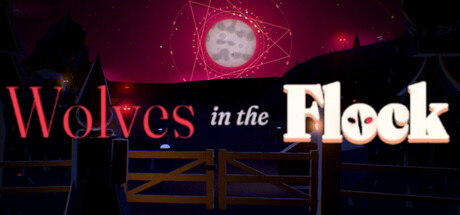

By day, you keep the flock. By night, you keep the gate.
Wolves In The Flock is a farm-life sim that hides a razor-edged social deduction game inside its woolly exterior. Your small farm sits at the end of a dark lane, and each night something knocks—usually a frightened “sheep” pleading to be let in. The problem: it might be a real sheep escaping a predator… or it might be the wolf itself, dressed up and ready to thin your herd from the inside.
The result is a tight, routine-driven loop that feels part cozy management game and part psychological horror: you build trust and learn your flock’s quirks during daylight, then rely on those tiny tells when it’s dark and you’re holding a lantern at the gate.
Core gameplay loop: care, observe, decide
Days are about tending the pen and learning who your sheep are. Nights are about making high-stakes calls with limited information. If you let a wolf in, you’ll feel it in the morning when the headcount comes up short.
- Day phase: get to know your animals, monitor behavior, manage their wellbeing, and gather clues.
- Night phase: stand at the gate with a lantern, interrogate the visitor, and decide whether they enter.
That simple structure creates a surprisingly rich detective rhythm—because the “evidence” isn’t a checklist, it’s the accumulation of small inconsistencies across many days and nights.
Interrogation at the gate: only three questions
Every night brings three knocks. For each visitor, you can choose from 20+ questions—ranging from the obvious (“Say ‘baa’”) to the odd (“What do you think of the moon?”) to the practical (“Show me your feet”). The catch is you only get three questions per visitor, so you’re always balancing breadth (multiple checks) against depth (pushing on a suspicious detail).
This limitation is where Wolves In The Flock shines on a mechanical level. Instead of letting you brute-force certainty, it forces you to:
- Commit to a theory quickly.
- Adapt your questioning based on the current state of your flock.
- Live with imperfect info, which makes every “open the gate” moment feel consequential.
Spotting the wolf: visuals, audio, and behavior
The game encourages you to “look closer” in multiple ways. At night, you raise your lantern and search for physical mismatches—pointy ears, a long snout, or even a suspicious “zip down the back.” You’ll also listen for tells: do the footsteps pad instead of trot? Does the bleat carry a growl?
During the day, the tells become more behavioral. You’re watching for sheep that don’t graze, stare too long at others, or seem oddly out of sync with the flock. One of the cleverest recurring tools is that you can shear one sheep per day—because, as the game puts it, “wool never lies.” The implication is clear: the flock itself is your evidence board, and routine observation is your strongest weapon.
Heart meters: kindness is an information tool
Each animal has a heart meter. Treat your sheep well and it fills; neglect (thirst), trauma (grief), and even an ill-timed cold shearing can drain it. This isn’t just flavor: happy sheep “talk” more—they gossip, reveal more, and produce better wool.
In practice, that means compassion is strategic. Keeping morale high isn’t only about being nice; it directly improves your ability to detect threats and recover from losses. It also adds a welcome ethical pressure: the game tempts you to treat sheep as tools for survival, then punishes you when that attitude reduces the flow of useful information.
Calamities and pressure spikes
Just when you feel like you’ve established a safe routine, something goes wrong. Every few days brings a calamity—thunderstorms, twisters, wildfires, earthquakes, or wolf raids. You’ll receive a warning and a possible countermeasure, but whether you prepare (and what you prioritize) is up to you.
These events are important for pacing: they break predictability, force hard resource decisions, and raise the stakes around the nightly gatekeeping. A well-managed flock can still spiral if you ignore warnings or misread what a crisis is really threatening.
Thirty nights, multiple endings, and a bigger wolf
The campaign runs for thirty nights—a full month at the gate—punctuated by a “bigger” moment every fifth night. Along the way you’ll encounter strangers with stories, escalating mind games, and a very big wolf who understands the rules better than you do.
Importantly, the month can end in more than one way, and the game promises that some outcomes are not what you’d expect from something that initially reads like a charming sheep sim. If you like narrative-driven systems where your choices compound quietly until the ending snaps into focus, this structure is doing a lot of work.
Try it free: demo carries progress forward
If you want to test whether its tone works for you, the demo covers the first five nights, and your save carries into the full game. For a game that relies on subtle pattern recognition, that’s the ideal demo format—it lets you learn the language of its clues without wasting your time if you decide to commit.
Mac performance and requirements
Wolves In The Flock is lightweight on storage and designed to run well on modern Macs, with native support for both Apple Silicon and Intel.
Minimum Mac Requirements
Minimum:
- OS: macOS 13 Ventura
- Processor: Apple M1, or Intel Core i5 (2017 or later)
- Memory: 4 GB RAM
- Graphics: Integrated GPU with WebGL 2 (Intel Iris Plus or Apple M1)
- Storage: 1 GB available space
- Additional Notes: Runs natively on Apple Silicon and Intel
Recommended Mac Requirements
Recommended:
- OS: macOS 14 Sonoma or later
- Processor: Apple M1 or later
- Memory: 8 GB RAM
- Graphics: Apple M1 GPU or better
- Storage: 1 GB available space
Who it’s for
- If you like: deduction games, hidden-role tension, “spot the difference” observation, and narrative systems that punish complacency.
- Expect: uneasy choices, limited interrogation tools, and a management layer where empathy has mechanical value.
- Not ideal if you want: a purely relaxing farm sim—this one is built around suspicion and loss.
Wolves In The Flock is at its best when you’re second-guessing yourself: you’ve noticed something slightly off, you only have three questions, and the knock at the gate is getting impatient. Trust no fleece.



Comments
Sign in to join the conversation.
Log in to commentNo comments yet. Be the first to join the conversation.