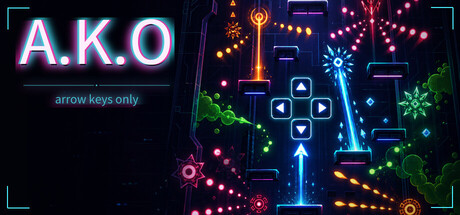

If you’ve got a keyboard, you’re ready
A.K.O – Arrow Keys Only is a vertical roguelike shooter with a constraint so strict it becomes the whole identity of the game: you only use the arrow keys. No mouse aiming. No WASD. No ability hotbar. Your ship fires automatically, and the rest of the run is about positioning, timing, and learning how to make four directions do far more than they should.
On Mac, it’s the kind of design that feels instantly at home: low friction, fast to launch, and built for “one more run” sessions. The real hook is that the simplicity is surface-level only—underneath is a game about reading threats, exploiting weaknesses, and building runs that can swing from careful control to chaotic screen-clearing momentum.
Combat that’s about movement, not aiming
Because shooting is automatic, A.K.O asks you to treat movement as your primary tool. Dodging isn’t a defensive reflex so much as an offensive plan: where you stand determines which enemies get hit, how safely you can maintain damage, and whether you can capitalize on elemental weaknesses.
In practice, the “arrow keys only” rule creates a clean feedback loop:
Scan the room and identify which threats will snowball if ignored.
Route your movement to keep auto-fire consistent while avoiding crossfire.
Swap elements at the right moment to punish weaknesses or control space.
Commit to your build choices and let relic synergies reshape how you survive.
Four elements, four playstyles
A.K.O’s elemental system is the main lever for moment-to-moment decision-making. You tap DOWN to swap elements, and time “hitches” briefly to give you a beat to make the read—an elegant solution that keeps the game fast without making swaps feel twitchy or accidental.
Neutral paints targets to set up follow-up damage.
Fire burns fast and hits hard.
Ice slows and shoves enemies, setting up shatter damage.
Poison leaves clouds that apply pressure over time and weaponize space.
Elemental matchups matter. Lean into an enemy’s weakness and your damage spikes; shoot into resistance and you’ll feel the loss immediately. That relationship encourages quick tactical swaps rather than locking into a single “best” element for the whole run, especially as enemy compositions shift from room to room.
Runs that actually change shape
Roguelikes live or die on whether the build system produces real variety, and A.K.O aims directly at that: 35+ relics that stack into synergies. The promise here isn’t just stat bumps—it’s run-to-run identity.
Examples of the kind of build fantasy A.K.O pushes:
Freeze enemies and convert control into burst with shatter payoffs.
Leave fire trails behind movement for aggressive, screen-sweeping routes.
Turn poison into sustain, shifting from avoidance to attrition-based dominance.
The best roguelike builds do two things: they change how you play, and they change what you value. A.K.O’s relic design is pointed at both—making positioning, element choice, and risk tolerance evolve as your run develops.
Five pilots, five ways to move
With only arrow keys, your “character” needs to matter, and A.K.O leans on pilots to provide distinct movement and survivability profiles. That’s crucial in a game where mobility is your offense, defense, and resource management all at once.
Pick — build your own kit.
Ward — slow, steady, and hard to kill.
Kite — high risk, high damage.
Gaze — fast flight and hardest to control.
Mark — vertical power with strong flexibility.
That variety helps A.K.O avoid the trap of “minimal controls” meaning “one solution.” Different pilots can turn the same room into a different puzzle, especially when layered with relic synergies and elemental matchups.
Five procedural dungeons, bosses, and modifiers for pain seekers
The core climb takes you through five procedural dungeons and their bosses, with additional challenge modifiers that let you dial the run from manageable to punishing. Examples include constraints like no healing, crumbling floors, or half HP.
That approach plays well on Mac for quick sessions: you can do a standard run when you want a straightforward climb, or flip on modifiers when you want a score-chase or a personal endurance test.
All procedural, including the audiovisuals (and it’s only 11 MB)
One of A.K.O’s most unusual flexes is that its visuals, music, and sound are generated from code at runtime, with no traditional assets. That design choice isn’t just a fun trivia detail—it helps explain how the full shipping build lands at a tiny 11 MB.
For Mac players, that’s refreshing in a world of massive installs: A.K.O is lightweight, easy to keep installed, and quick to hop into when you want something responsive and systems-driven.
Dedicated developer and long-term support
The developer notes emphasize frequent updates and long-term support, with an open invitation to reach out and connect. For a roguelike—where balance, relic interactions, and content pacing often improve dramatically over time—active support can be the difference between a neat concept and a game that steadily sharpens into a staple.
Mac system requirements
Minimum:
OS: macOS 10.13 (High Sierra) or later
Processor: any Apple silicon or Intel
Memory: 2 GB RAM
Graphics: Metal or OpenGL 2.1 support
Storage: 50 MB available space
Why A.K.O belongs on a Mac gamer’s radar
A.K.O – Arrow Keys Only takes a one-line gimmick and commits hard enough to turn it into a real design philosophy. Auto-fire pushes you into smarter movement, the elemental system keeps decision-making active, relic synergies reshape runs, and the five pilots give the minimalist control scheme actual breadth. Add the fully procedural audiovisual experiment and the tiny install size, and you’ve got a roguelike shooter that feels purpose-built for quick Mac sessions without feeling small.


Comments
Sign in to join the conversation.
Log in to commentNo comments yet. Be the first to join the conversation.