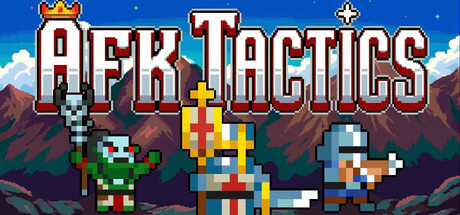

AFK Tactics is an idle autobattler built around a simple loop—collect heroes, assemble a trio, and watch 3v3 tactical battles resolve—then pushes that loop into unusually deep buildcraft. With 200+ units, 30+ factions, and a stat system that rewards careful tuning, it’s the kind of game that can be played in short daily bursts while still offering serious long-term optimization for Mac players who love spreadsheets, synergy hunting, and counter-building.
What AFK Tactics is (and why it works)
At its core, AFK Tactics is about theorycrafting: picking three units whose factions, classes, and kits complement each other, then iterating as you unlock more heroes and hit harder encounters. Battles are automated, but the strategy is front-loaded into preparation—team composition, gear choices, stat priorities, and understanding how to answer specific modifiers or bosses.
The “AFK” part is real: the game is designed for 10–15 minute daily sessions with longer-term progression. The “Tactics” part shows up once you start building around specific mechanics—whether that’s survivability thresholds, damage-over-time stacking, crit scaling, or penetration against high-resistance enemies.
Roster and roles: 200+ units, three slots, endless combinations
AFK Tactics draws from a large pool of fantasy archetypes—Holy Order, Elves, Orcs, Skeletons, Demons, Dwarfs, Bandits, and more—then asks you to solve fights using only a three-hero lineup. That limitation is a feature: it keeps the focus on tight synergy rather than “pile in everything.”
Units span familiar class roles such as Tanks, Warriors, Mages, Assassins, Strikers, and Support, and you’ll often feel the difference between a team that merely has “good units” versus a team that is designed to function as a single machine (initiation, sustain, damage pattern, and finishing).
Factions and class bonuses: the synergy layer
With 30+ factions, team identity matters. Faction synergies and class bonuses shape how your trio performs, and they also influence what you should chase next—some combinations will excel at stage progression, while others are better at boss modifiers or endurance-style content.
Because the game supports so many factions, experimentation is part of the appeal: you’re encouraged to discover which synergies punch above their weight, and which comps exist specifically to counter certain enemy traits.
Deep stats and buildcraft: where the real game lives
AFK Tactics leans into a robust stat model, including concepts like Armor, Magic Resist, Penetration, Crit, Dodge, Tenacity, Ability Haste, and damage-over-time (DoT) interactions. This is supported by equipment, set bonuses, and the ability to tune units for different modes via unlinked skills.
In practice, that means you can build the same hero in multiple directions depending on what you’re trying to solve: durability breakpoints for longer fights, burst windows for bosses, or consistency builds that minimize variance in tougher progression gates.
Modes: multiple ways to play (and reasons to rebuild)
AFK Tactics doesn’t rely on a single ladder. Instead, it offers several modes that reward different approaches and keep your roster relevant:
- Adventure Mode — Progress through biomes and stages as your main campaign climb.
- Eternal Spire — Endgame-style infinite content with random modifiers and broad faction access, designed to stress-test your understanding of the system.
- Roguelite Dungeon — 100-stage independent runs with scaling difficulty and rewards, encouraging adaptive builds.
- Boss Battles — Daily gates with rotating modifiers that push you toward specialized counters.
- Crucible — A 1v1 duel mode where a single best-built hero can shine.
- Training — A low-stakes sandbox to test comps and simulate battles without risking progress.
Idle-friendly pacing, with a hardcore endgame
The game is intentionally approachable in day-to-day play: you can check in, make a few key decisions, and let progression carry forward. But it doesn’t stop there. The hardest stages and bosses are described as content for players who are willing to learn the underlying mechanics and find specific strategies and combos.
If you enjoy the feeling of gradually transforming “a decent team” into “a solved build,” the endgame is where AFK Tactics aims to keep you engaged—less through raw grind and more through refinement, matchup knowledge, and optimization.
Mac performance and compatibility
AFK Tactics is designed to be lightweight and should be comfortable on modern Apple silicon Macs. The developer notes that the game is not heavy, and display may vary depending on screen dimensions.
Minimum Mac requirements
- Requires an Apple processor
- OS: 11
- Processor: Apple M1
- Memory: 4096 MB RAM
- Graphics: Apple M1/M2 GPU
- Storage: 500 MB available space
- Sound Card: Metal
- Additional Notes: The game should run on any devices, not heavy, the display might vary depending on screen dimensions.
Recommended Mac requirements
- Requires an Apple processor
- OS: 13
- Processor: Apple M1
- Memory: 8192 MB RAM
- Graphics: Apple M1/M2 GPU
- Storage: 1000 MB available space
- Sound Card: Metal
- Additional Notes: The game should run on any devices, not heavy, the display might vary depending on screen dimensions.
Who should play AFK Tactics on Mac?
- Players who like idle games but want meaningful decisions beyond timers and upgrades.
- Autobattler fans who enjoy team-building and counterplay more than manual execution.
- Optimization-minded players looking for deep stats, gear tuning, and synergy discovery.
- Anyone who wants a strategy game that fits into a short daily routine while still offering a demanding endgame.
Bottom line: AFK Tactics is an idle autobattler that treats preparation as the main gameplay—collecting, combining factions, leveraging class bonuses, and dialing in stats to conquer increasingly punishing content. On Apple silicon Macs, it’s positioned as a lightweight, easy-to-check-in-on strategy game that can quietly become a long-term theorycraft project.

Comments
Sign in to join the conversation.
Log in to commentNo comments yet. Be the first to join the conversation.