
Apple Business arrives April 14, expanding Apple’s business stack globally
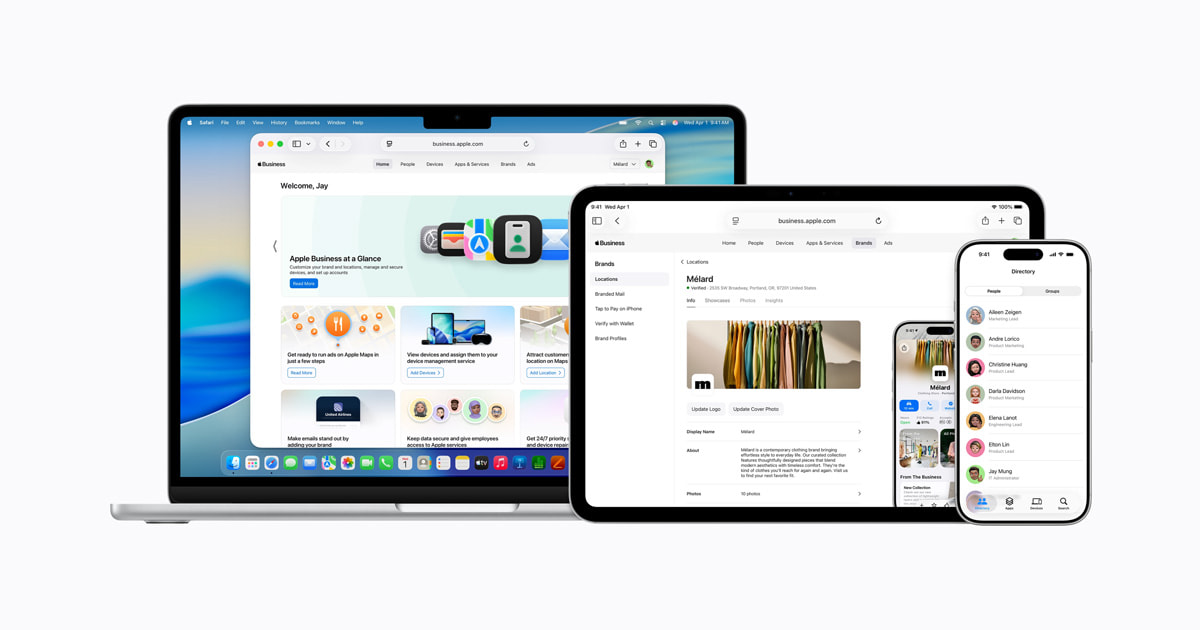
Apple has announced Apple Business, a new all-in-one platform aimed at companies of all sizes, launching April 14 in 200+ countries and regions. The pitch: a unified place to manage Apple devices, set up work identity and communications, and reach customers across Apple services.
This isn’t a gaming feature drop on its own, but it’s meaningful Apple-ecosystem infrastructure. For MacGaming.com readers, the angle is straightforward: anything that reduces friction around Macs in organizations—deployment, security, accounts, app access, and support—also makes it easier for studios, teams, and creators to standardize on Apple Silicon hardware for production, testing, and daily work.
Source: Apple Newsroom (March 24, 2026).
Built-in MDM: fewer hurdles for Mac-based teams
The headline feature is built-in mobile device management (MDM), giving organizations a central view of devices, settings, security, and apps. Apple says Apple Business is designed to make IT easier even for smaller companies that don’t have dedicated IT staff.
From a Mac and Apple Silicon perspective, the big win is repeatability. Consistent setup matters when you’re juggling multiple machines across engineering, art, audio, QA, and build/release roles. When Macs are treated as “first-class managed endpoints,” it’s easier to roll out OS updates, enforce security baselines, and provision the same tooling across a team—without every new hire spending their first day installing dependencies and chasing permissions.
Blueprints and zero-touch deployment: practical value for studios and dev shops
Apple Business introduces Blueprints, described as preconfigured settings and apps that can be applied to devices for consistency and security. Apple also calls out zero-touch deployment, where new Apple products can be ready to go “out of the box.”
For developers (including game developers), this is less glamorous than a new GPU API—but it’s the stuff that keeps pipelines moving. If you’re a studio onboarding a wave of contractors for a milestone, or a small team scaling up, standardized provisioning helps reduce the “snowflake Mac” problem where every machine ends up subtly different. That matters for build reproducibility, tooling compatibility, and avoiding last-minute release surprises tied to environment drift.
Managed Apple Accounts: separation of work and personal data
Apple also highlights Managed Apple Accounts with cryptographic separation between work and personal data on devices. The company says Apple Business can automate account creation for new employees via identity provider integration.
Even outside traditional enterprise, this is relevant to game teams because modern dev work often mixes personal and work contexts: personal Apple IDs, shared test devices, internal builds, TestFlight-style distribution flows, and more. Clear boundaries around accounts and data can make compliance and offboarding cleaner, which in turn reduces risk when devices are used for pre-release content, private builds, or unreleased assets.
Business email, calendar, and directory with custom domains
Apple says Apple Business will let customers set up business email, calendar, and directory services using their own domain name. For smaller teams already living in the Apple ecosystem, this signals Apple continuing to pull more “core ops” services into its own stack.
For developers and creators on Mac, tighter integration can be a net positive if it reduces the number of admin consoles needed to keep a team running. The flip side, as always, will be evaluating how these services fit with existing workflows (Google Workspace, Microsoft 365, Slack/Discord, third-party MDM, etc.). Apple’s announcement frames this as a unified, secure option rather than a requirement.
Maps discovery and local ads: not gaming-specific, but notable platform motion
Apple Business also aims to help companies reach customers across Apple Maps, Mail, Wallet, Siri, and more. Apple teased a new option coming this summer that would allow businesses in the U.S. and Canada to place local ads in Maps during key search and discovery moments.
That’s not directly about Mac gaming, but it’s part of a broader trend: Apple continuing to productize “discovery surfaces” inside its ecosystem. For game businesses, the comparable question is where and how Apple expands discovery for software and content over time—App Store search and featuring remain the core for games, but Apple clearly sees value in giving businesses more ways to appear contextually across its apps.
Companion app, iCloud upgrades, and AppleCare+ for Business
Apple mentions options to purchase upgraded iCloud storage and support with AppleCare+ for Business, plus a companion Apple Business app that lets employees install work apps, view colleague contact information, and request support on the go.
Again, it’s not a frame-time boost—but if you’re running Macs as production machines (or maintaining fleets of iPads/iPhones for testing, capture, community, or events), streamlined support and device services can reduce downtime. For small teams, fewer hours lost to device wrangling is effectively “more dev time,” which is always the scarce resource.
What to watch next (from a MacGaming.com lens)
Apple Business is fundamentally an IT/operations play, but it intersects with the Mac developer ecosystem in a few concrete ways:
First, broader and simpler management tools make it easier for organizations to adopt Macs at scale—important for Apple Silicon’s long-term presence in professional workflows, including game development and related creative production.
Second, account and device standardization tends to improve reliability for dev environments and test labs, where consistent OS versions, permissions, and security posture matter.
Third, Apple’s continued investment in ecosystem “surfaces” (Maps, Wallet, Siri) signals that Apple wants businesses to treat its platform as an end-to-end channel. While this announcement doesn’t add game discovery features, it reinforces Apple’s direction: integrating services so businesses can operate and market within Apple’s ecosystem more directly.
Read the original announcement
Apple’s full details, availability notes, and feature breakdown are in the Apple Newsroom post: Introducing Apple Business — a new all-in-one platform for businesses of all sizes.




Comments
Sign in to join the conversation.
Log in to commentNo comments yet. Be the first to join the conversation.