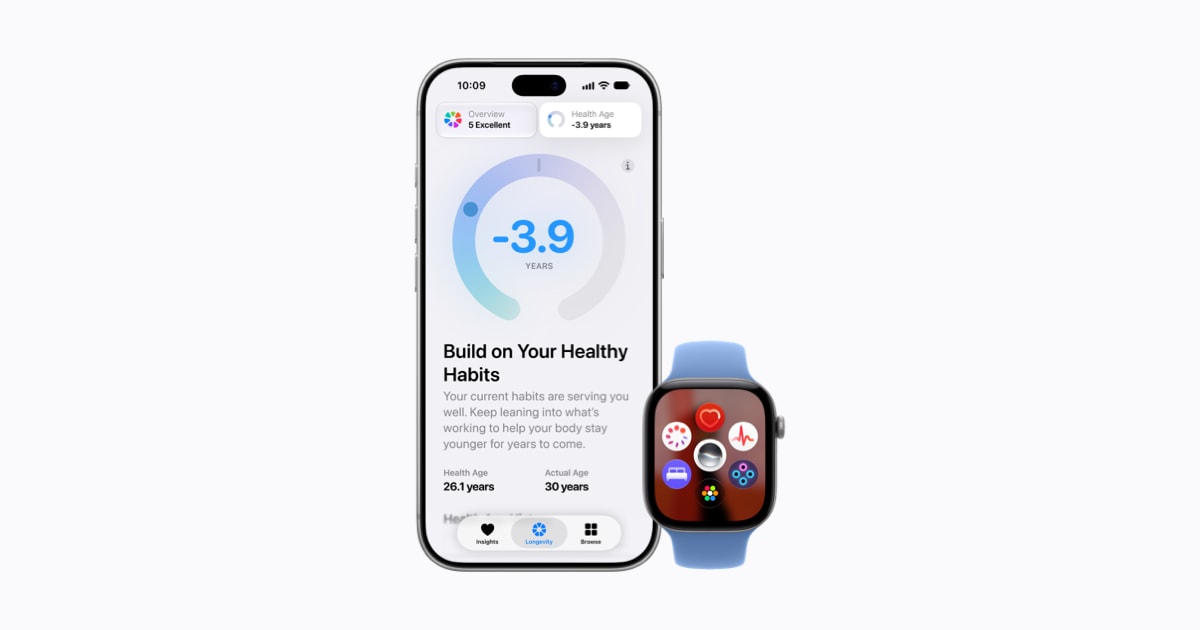

Apple doubles down on “intelligent, science-based” health — with Apple Intelligence in the loop
Apple used today’s Apple Newsroom announcement to position its next health and fitness wave as a marriage of new Apple Watch sensing hardware and Apple Intelligence-driven interpretation in the Health app on iPhone. On paper, this is a Watch + iPhone story. In practice, it’s also an ecosystem story — and that matters to anyone building for, buying into, or simply living inside the Apple Silicon era (including Mac gamers who want their devices to play nicely together without turning into a data vacuum).
Apple says Apple Watch Series 12 and Apple Watch Ultra 4 introduce a new “Health Sensing System” featuring updated optical and electrical heart sensors, while the iPhone Health app gets a redesign later this year with new insights powered by Apple Intelligence. Apple’s framing is consistent: translate complex biometrics into clearer guidance, while keeping personal health data private, secure, and under user control.
Source: Apple Newsroom (press release, September 9, 2026).
What was announced: new Watch sensing cadence, HRV frequency, and a readiness score
The headline hardware change is accuracy and frequency. Apple claims the new system delivers the “most accurate heart rate sensing in a wearable,” backed by a study of over 1,000 participants comparing Apple Watch to “leading wearables.” The practical upshot is a more continuous stream of heart-rate and heart-rate-variability (HRV) data feeding Apple’s metrics and dashboards.
Key points Apple highlighted:
Apple Watch Series 12 and Ultra 4 can now measure heart rate every five seconds throughout the day, using larger and more power-efficient green LEDs on the optical sensor.
HRV measurement increases dramatically — Apple says as often as every five minutes (described as 24x more frequently) — and appears in a new section of the Heart Rate app.
A new readiness score is introduced, intended to reflect the body’s capacity to take on the day, alongside an expanded Vitals overview that now includes HRV.
An updated Heart Rate app and new watch face complications are positioned as the UI layer for these higher-frequency signals.
Why this matters to Mac and Apple Silicon readers: the ecosystem is becoming more “sensor-native”
No, this isn’t a “Mac gaming feature drop.” But it does fit a pattern Mac users and developers should watch: Apple is steadily expanding the set of first-party, privacy-sensitive, high-signal data flows that move between devices — and then layering Apple Intelligence on top to summarize, contextualize, and recommend.
For Apple Silicon platform watchers, the subtext is that Apple wants on-device intelligence and secure data handling to be the default expectation across experiences. If Apple can sell readiness, recovery, and longevity insights as understandable outputs from continuous data streams, it reinforces the broader platform story: sensors and local ML aren’t niche; they’re foundational.
For developers, that usually translates into two realities: users increasingly expect high-quality system integrations (not siloed dashboards), and Apple will keep raising the bar on privacy posture and “explainability” when sensitive data is involved. Even if your app is adjacent — say, training, posture, wellness, accessibility, or focus tools that users pair with work and play — Apple’s approach shapes what “normal” looks like in the ecosystem.
Apple Intelligence in the Health app: a familiar playbook, applied to biometrics
Apple says the redesigned Health app coming later this year to iPhone will offer a more holistic view of long-term health, plus new health and longevity insights powered by Apple Intelligence. The company is again emphasizing privacy and user control.
From a platform perspective, it’s worth noting what Apple is not doing in this announcement: it’s not positioning health insights as a cloud subscription, and it’s not asking users to hand their biometrics to a third-party chatbot. Apple is trying to make “intelligence” feel like a built-in, system-level feature that sits on top of trusted data sources and device security.
That direction matters for the Apple ecosystem as a whole because it conditions consumer expectations around where sensitive computation should happen (ideally on-device) and what permissions should look like (ideally granular and revocable). That’s the same set of arguments Apple has used for years in areas like system privacy prompts, app tracking transparency, and on-device processing — now brought to health with higher stakes.
The MacGaming.com angle: not gaming news, but it’s ecosystem gravity
If you mainly come to Apple hardware for games, this announcement won’t suddenly change frame rates or unlock new ports. But it does reinforce Apple’s current competitive moat: tightly integrated hardware, sensors, OS features, and first-party apps that keep users invested across devices. Ecosystem gravity influences everything from how likely someone is to upgrade their iPhone (and thus maintain access to newer OS-level frameworks) to whether they stay on Apple Watch, which in turn shapes the “default stack” developers target.
And at a practical user level, “readiness” and recovery insights can also change how people schedule workouts, sleep, and screen time — which, for better or worse, affects how they use their Macs and when they game. That’s not a feature for games, but it is a feature that nudges behavior across the devices many of us use for games.
What to watch next
The most important missing pieces for developers and power users are the availability details: which iPhone models support the Apple Intelligence-powered Health features, what data stays on-device versus encrypted sync, and whether Apple exposes any new APIs or HealthKit/WatchKit capabilities tied to readiness or higher-frequency HRV.
Apple’s announcement focuses on first-party experiences today, but history suggests platform hooks tend to follow once Apple establishes the user-facing narrative and privacy model.
Read the original announcement
Apple’s full press release is available via Apple Newsroom. For the official details, including Apple’s claims around heart-rate accuracy studies and the redesigned Health app powered by Apple Intelligence, see:
https://www.apple.com/newsroom/2026/09/apple-advances-health-and-fitness-capabilities-using-apple-intelligence/



Comments
Sign in to join the conversation.
Log in to commentNo comments yet. Be the first to join the conversation.