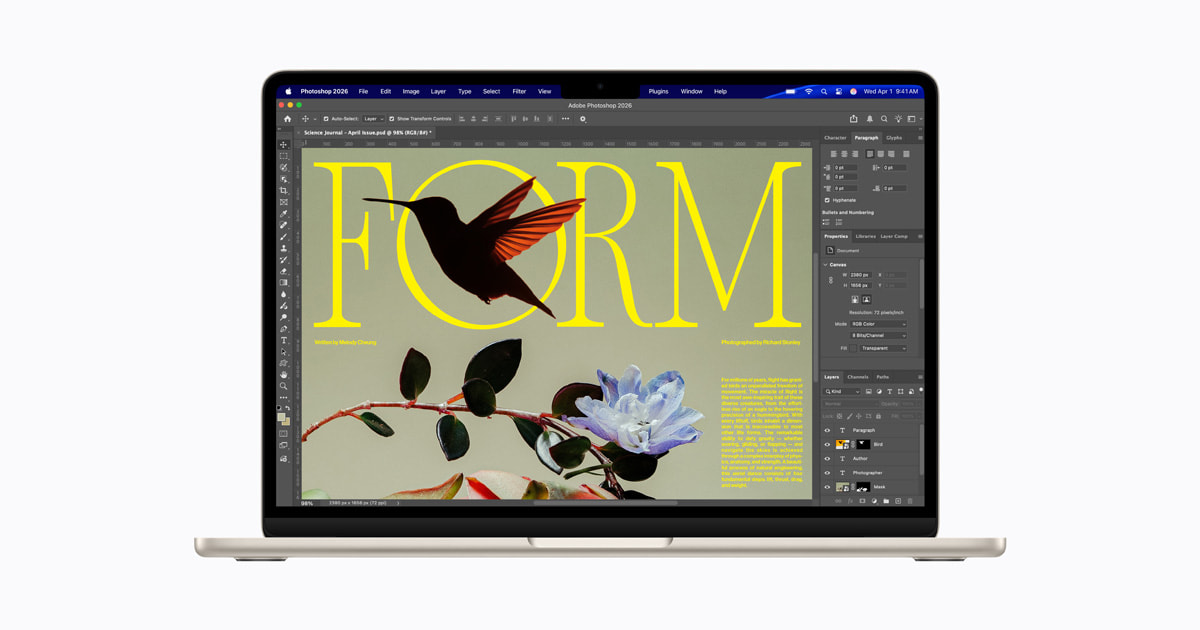

Apple refreshes MacBook Air with M5
Apple has unveiled the new MacBook Air with M5, positioning it as a sizable step forward in performance and “expanded AI capabilities,” while keeping the familiar thin-and-light formula that makes the Air the default Mac for a lot of people. The update also bumps the base storage to 512GB, improves wireless connectivity with Wi‑Fi 7 and Bluetooth 6 via Apple’s N1 wireless chip, and keeps features like the Liquid Retina display, 12MP Center Stage camera, and up to 18 hours of battery life.
From a MacGaming.com perspective, the Air remains the machine many players actually own—especially students, first-time Mac buyers, and portability-first users—so even “non-gaming” MacBook Air updates tend to ripple into the real-world Mac gaming audience quickly.
M5: the headline upgrade, with implications for Apple Silicon optimization
Apple says M5 brings a faster CPU and a next-generation GPU, plus a “Neural Accelerator in each core” aimed at speeding up AI tasks. While Apple’s press release isn’t a gaming-focused technical breakdown, an Air-class chip refresh typically matters most in two ways for games and game-adjacent workflows:
First, it moves the performance baseline for the most popular Mac laptop. That’s important because developers targeting Apple Silicon generally care about the floor as much as the ceiling—how a game runs on the machines people have, not just on Max/Ultra desktop configurations.
Second, any generational GPU update tends to improve the viability of higher resolutions, more stable frame pacing, and more aggressive settings in modern engines—assuming the rest of the system (thermals, memory configuration, and the game’s own Metal pipeline) cooperates. Apple hasn’t provided game-specific figures in the announcement, so we’ll be watching for independent benchmarks and developer notes before drawing conclusions.
512GB base storage is the sleeper win for actual players
Apple is doubling the starting storage to 512GB and says the Air uses faster SSD technology, with configurations up to 4TB. For Mac gaming, this is arguably the most practical part of the entire update:
Modern game installs are big, and “Apple Silicon gaming” frequently overlaps with large creative toolchains too—Xcode, assets, capture footage, compatibility layers, and multiple storefront libraries. A 512GB baseline reduces the immediate pressure to micromanage installs or lean on external storage, and it can make a base-model Air feel less like a compromise for anyone who mixes games with school/work.
Wi‑Fi 7 + Bluetooth 6: better connectivity, fewer headaches
Apple’s N1 wireless chip brings Wi‑Fi 7 and Bluetooth 6 to the new Air. That’s not a frame-rate feature, but it can still matter to gaming experiences in a few obvious places: lower-latency home networking conditions (when paired with a Wi‑Fi 7 router), more reliable downloads and updates, and potentially smoother peripheral connectivity for controllers and headsets.
As always, real-world results depend on your network and devices, but seeing the Air step forward here is a good sign for the broader Mac laptop lineup adopting newer wireless standards.
External displays and ports: the “docked Air” reality
Apple says MacBook Air includes two Thunderbolt 4 ports and supports up to two external displays. For Mac gamers, that matters because the Air often ends up as a hybrid machine: portable during the day, then plugged into a monitor at night. Two external displays also aligns with the way many players use Discord (or other chat), guides, and tools alongside a game—though performance will still depend on the specific game and chosen resolution.
macOS Tahoe and Apple Intelligence: ecosystem direction, not a gaming promise
Apple frames the new Air as being particularly strong when combined with macOS Tahoe and Apple Intelligence. For gaming and developer readers, the key takeaway isn’t that “AI makes games faster” (Apple doesn’t claim that here), but that Apple continues to steer the platform toward on-device ML workflows. That may influence how tools, assistants, content pipelines, and even store experiences evolve on macOS—especially for developers who already rely on Apple Silicon’s unified architecture and Metal.
Pricing, colors, and availability
Apple says the new MacBook Air with M5 comes in 13- and 15-inch models, in sky blue, midnight, starlight, and silver. Pre-orders begin March 4, with availability starting March 11.
Source and what we’re watching next
Source: Apple Newsroom (press release, March 3, 2026).
We’ll be watching for third-party benchmarks, real-world thermals under sustained GPU load, and developer commentary on how M5’s GPU changes affect Metal performance across popular engines. For Apple’s full announcement, details, and quotes, read the original post on Apple Newsroom:
https://www.apple.com/newsroom/2026/03/apple-introduces-the-new-macbook-air-with-m5/



Comments
Sign in to join the conversation.
Log in to commentNo comments yet. Be the first to join the conversation.