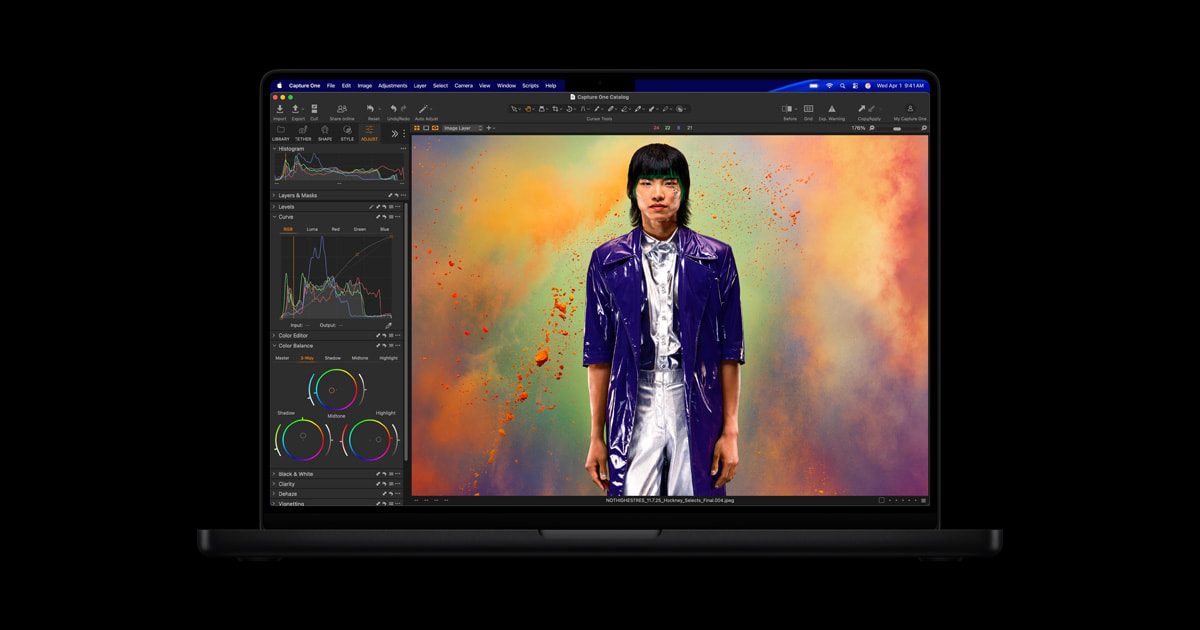

Apple announces M5 Pro and M5 Max MacBook Pro
Apple has published a new Newsroom press release announcing updated 14-inch and 16-inch MacBook Pro models featuring the all-new M5 Pro and M5 Max. While the headline is aimed at “pro” workflows, the spec mix Apple is emphasizing—CPU uplift, a reworked GPU design with on-device AI acceleration, faster storage, and next-gen wireless—also lands squarely in the conversation Mac gamers and game developers care about: sustained performance, asset streaming, and the continued evolution of Apple Silicon as a platform target.
According to Apple, the new MacBook Pro lineup brings a new CPU design, a next-generation GPU with a Neural Accelerator in each core, higher unified memory bandwidth, up to 2x faster SSD performance, and higher base storage (1TB starting on M5 Pro configurations, 2TB on M5 Max). Apple also says the new models add an Apple-designed N1 wireless chip enabling Wi‑Fi 7 and Bluetooth 6, alongside Thunderbolt 5, up to 24 hours of battery life, and macOS Tahoe with Apple Intelligence features.
Why Mac gamers should care (without reading too much into it)
This isn’t a “new gaming Mac” announcement, and Apple doesn’t frame it that way. But the ingredients it’s calling out track directly to the pain points and bottlenecks that show up in modern games on any platform: CPU throughput for simulation and draw-call-heavy scenarios, GPU throughput for high-resolution rendering and advanced effects, memory bandwidth for feeding the GPU, and storage speed for asset-heavy worlds.
Apple’s focus on a next-generation GPU and increased unified memory bandwidth is the part to watch for games, because Apple Silicon’s integrated approach typically lives or dies on how well the system can keep the GPU fed. If Apple’s bandwidth and GPU architecture changes are as meaningful as the marketing suggests, it could help both native Metal titles and compatibility-layer workloads in the broad sense (while noting that individual game performance still depends heavily on engine, API usage, and developer optimization).
On-device AI, the GPU “Neural Accelerator,” and what it implies for developers
Apple’s press release leans hard into AI: it claims up to 4x AI performance versus the previous generation and up to 8x versus M1 models, enabled in part by Neural Accelerators in each GPU core. For game developers, the immediate takeaway isn’t “games will suddenly run faster,” but that Apple is continuing to fuse AI throughput into mainstream GPU architecture rather than treating it as a separate, niche block.
That matters for tooling and workflows (think on-device content processing, local assistants, faster iteration loops, and potential AI-adjacent runtime features). It also matters for the platform story: Apple wants developers to assume local AI acceleration is a baseline capability of modern Macs, and to build experiences that can live on-device rather than depend on the cloud. Whether that translates into game-facing features at scale will depend on engines and middleware adopting Apple’s preferred pathways on macOS Tahoe and beyond.
Storage: faster SSDs and higher base capacity are practical wins
Apple says the new MacBook Pro delivers up to 2x faster SSD performance and raises the starting storage to 1TB on M5 Pro and 2TB on M5 Max. For gaming, this is refreshingly concrete: AAA installs keep growing, and higher baseline capacity reduces the “which two games do I keep installed” shuffle—especially for players juggling large libraries across Steam, the Mac App Store, and launcher-based titles.
Faster SSD throughput can also support smoother asset streaming and shorter load times in games designed to take advantage of it, though real-world gains will vary wildly by title and how it’s built.
Connectivity: Wi‑Fi 7, Bluetooth 6, and Thunderbolt 5
Apple is also introducing N1, its Apple-designed wireless networking chip, bringing Wi‑Fi 7 and Bluetooth 6. For Mac gaming, the upside is less about peak speed on a spec sheet and more about reliability: cleaner wireless performance can matter for online play, local streaming, and controller/headset stability in busy RF environments.
Thunderbolt 5 is another noteworthy bullet point for the ecosystem. Mac gaming doesn’t benefit from external GPU support in the way Windows users might expect, but Thunderbolt is still important for docks, high-speed external storage, capture setups, and multi-display configurations—common “desk gaming” accessories for Mac power users who treat the MacBook Pro as a portable desktop.
macOS Tahoe and Apple Intelligence: ecosystem momentum, not a single feature
Apple positions the new MacBook Pro alongside macOS Tahoe and Apple Intelligence. For MacGaming.com readers, the bigger story is the ongoing consolidation of Apple’s platform direction: Apple Silicon hardware capabilities, OS-level features, and developer expectations are moving in lockstep. That can be a good thing when it results in clearer performance baselines and more predictable feature availability across active Mac generations.
But it’s also a reminder that Mac gaming progress tends to be ecosystem-driven: GPUs and CPUs set the ceiling, while developer tooling, engine support, and platform priorities determine how often games actually approach that ceiling.
Release timing
Apple says the new MacBook Pro is available to pre-order starting March 4, with availability beginning March 11, in space black and silver.
Source
This article is based on Apple’s official Newsroom press release published on March 3, 2026.
For the complete announcement and Apple’s full set of claims and configuration details, read the original post on Apple Newsroom: Apple introduces MacBook Pro with all-new M5 Pro and M5 Max.




Comments
Sign in to join the conversation.
Log in to commentNo comments yet. Be the first to join the conversation.