
Apple’s next pro chips arrive: M5 Pro and M5 Max
Apple used its Newsroom press release today to introduce M5 Pro and M5 Max, the new top-end Apple Silicon options for the MacBook Pro. The headline pitch is squarely “pro workflows,” but the details matter for anyone tracking where Mac performance baselines are heading — including game developers, engine teams, and players watching the platform mature.
According to Apple, M5 Pro and M5 Max are built with a new Apple-designed Fusion Architecture, described as an approach that connects two dies into a single system on a chip (SoC). Apple positions this as a way to scale CPU, GPU, media, memory, Neural Engine, and I/O capabilities while retaining the characteristics that have defined Apple Silicon so far: performance-per-watt and unified memory.
Fusion Architecture: why Mac developers should care
Apple’s “two dies as one SoC” description is the big platform story here. For Mac developers, large shifts in chip packaging and memory behavior can influence how performance scales under heavy mixed workloads — the exact scenario game development is full of: running an editor, compiling shaders, baking lighting, crunching assets, testing builds, and capturing footage all on the same machine.
Apple says the SoC integrates the CPU, scalable GPU, Media Engine, unified memory controller, Neural Engine, and Thunderbolt 5 capabilities. Thunderbolt bandwidth matters less for in-game FPS than it does for the broader ecosystem: fast external storage for giant project folders, external capture devices, and high-resolution displays — all common parts of a modern Mac game-dev or content-creation setup.
CPU changes: build times and iteration loops
Apple claims M5 Pro and M5 Max feature a new 18-core CPU architecture with six “super cores” (its highest-performing core design) alongside 12 performance cores tuned for power-efficient, multithreaded work. Apple also claims up to a 30 percent CPU performance boost for pro workloads.
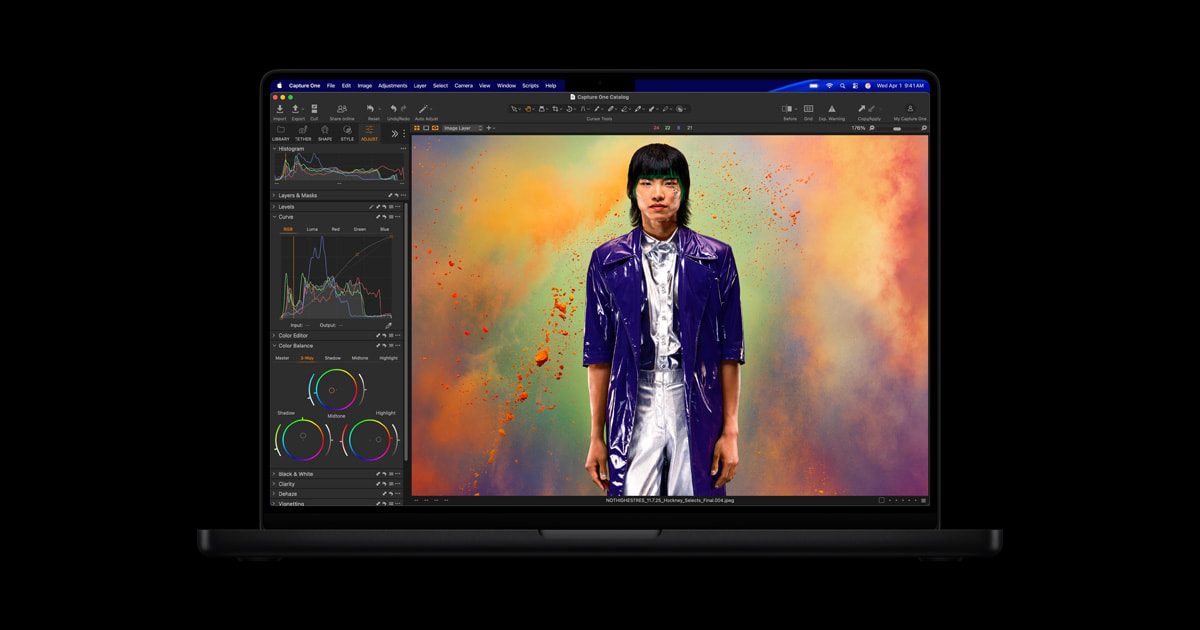
For gaming-specific workflows, the real-world impact is often felt in the iteration loop: quicker C++ compiles, faster engine rebuilds, shorter cook/package times, and smoother multitasking while running tools. Apple explicitly calls out accelerated compilation and on-device “agentic coding” in Xcode. Even if your target is not Mac-only, faster local builds on MacBook Pro can meaningfully improve day-to-day productivity for teams shipping cross-platform titles.
GPU changes: ray tracing, bandwidth, and AI-adjacent tooling
On the GPU side, Apple says M5 Pro and M5 Max scale the next-generation GPU architecture introduced in M5 up to an up-to-40-core GPU. Apple also highlights a Neural Accelerator in each GPU core and higher unified memory bandwidth, claiming over 4x the peak GPU compute for AI compared to the prior generation.
This is not a “new games announcement,” and Apple’s release is framed around professional use. Still, the gaming-adjacent relevance is clear: GPU feature progress plus bandwidth improvements can raise the ceiling for rendering complexity and content pipeline tooling on portable Macs. Apple also claims graphics gains of up to 35 percent for apps using ray tracing compared with M4 Pro and M4 Max — a data point that will interest engine teams evaluating ray-traced effects and performance budgets on Apple Silicon laptops.
It’s also worth noting the “AI compute” emphasis. Whether you call it AI, ML, or simply modern tooling, development pipelines increasingly include upscalers, denoisers, procedural generation helpers, animation/rig assists, asset tagging, and code assistance. Apple is clearly telling developers that more of those workloads can run on-device at higher throughput — but the practical impact will depend on frameworks, engine integration, and how vendors map workloads across CPU/GPU/Neural Engine.
Availability and what to watch next
Apple says the new MacBook Pro with M5 Pro and M5 Max will be available for pre-order starting tomorrow, with availability beginning Wednesday, March 11.
For MacGaming.com readers, the immediate takeaway isn’t “this changes gaming overnight.” It’s that Apple continues to push the high-end MacBook Pro platform forward with bigger CPU/GPU headroom and (by Apple’s description) a new way of scaling the SoC. The things we’ll be watching are the usual ones: sustained performance under long sessions, GPU scaling across real engines, ray-tracing performance and compatibility, and how developers translate new headroom into shipping targets — especially for ports and day-one Mac releases.
Source
This article is based on Apple’s press release published on Apple Newsroom on March 3, 2026.
For Apple’s full announcement and detailed claims, see the original post: Apple debuts M5 Pro and M5 Max to supercharge the most demanding pro workflows.




Comments
Sign in to join the conversation.
Log in to commentNo comments yet. Be the first to join the conversation.