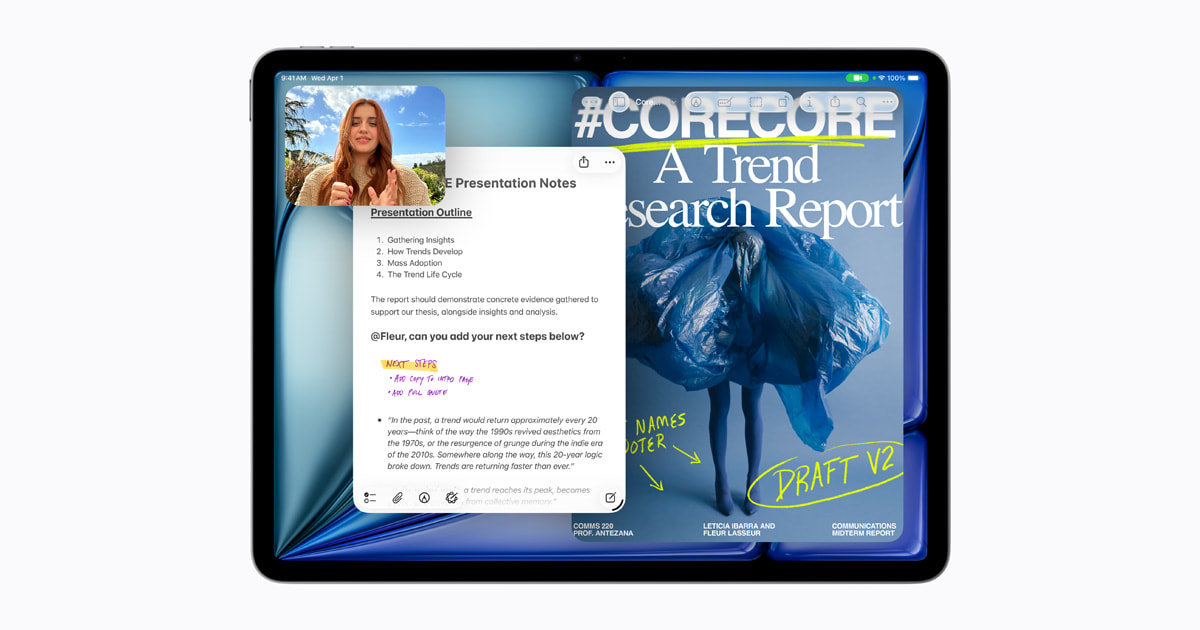

New iPad Air: M4 arrives in the “mainstream” iPad tier
Apple has announced the new iPad Air, now powered by M4, and positioned it as a major performance and versatility upgrade at the same starting prices: $599 for the 11-inch model and $799 for the 13-inch model (education pricing starts lower). Pre-orders begin March 4, with availability on March 11.
On paper, this is an iPad story. In practice, it’s also an Apple Silicon story — and Apple Silicon is increasingly the common denominator that ties together iPad, Mac, and Apple’s broader gaming and graphics roadmap.
Why MacGaming.com readers should care
Apple’s message is clear: M4-class graphics features are no longer confined to the top of the stack. The new iPad Air uses an M4 with an 8-core CPU and 9-core GPU, and Apple says it’s up to 30% faster than iPad Air with M3 and up to 2.3x faster than iPad Air with M1. Apple also highlights “50 percent more unified system memory than the previous generation,” plus higher memory bandwidth and a faster Neural Engine — all of which matter to games that are increasingly memory-hungry on high-resolution displays.
Even if you never plan to play a “AAA iPad port,” this shift impacts the ecosystem: the more devices in the wild with modern GPU features, the easier it becomes for developers to justify building (and keeping) advanced rendering paths on Apple platforms.
Graphics features: ray tracing and mesh shading go wider
Apple specifically calls out M4’s support for second-generation hardware-accelerated mesh shading and ray tracing, and frames it as delivering more accurate lighting, reflections, and shadows for realistic experiences. For developers shipping Metal-based renderers, this is one of the more consequential parts of the announcement: it expands the audience for more modern pipelines without requiring “Pro” branding.
For players, the practical takeaway isn’t “every game will suddenly look next-gen.” It’s that the baseline capabilities of the iPad Air tier keep moving closer to the same architectural features Apple is pushing across its Silicon lineup — which helps reduce the fragmentation that makes multi-device optimization painful.
Memory and performance tiers: the quiet story behind portable gaming
Apple’s mention of more unified memory is especially relevant for gaming workloads. Unified memory is where textures, geometry, compute workloads, and system tasks all share the same pool, and Apple’s own framing emphasizes that iPad Air is better suited for heavier creative and AI tasks. Games benefit from the same underlying improvements: bigger and faster memory budgets generally mean fewer compromises in texture quality, streaming behavior, and stability — particularly in large open environments or shader-heavy scenes.
For developers, the ongoing challenge is tiering: supporting older iPads while scaling upward to M4-class features. As M4 devices proliferate, we expect to see more games offering differentiated settings, optional RT effects, and more aggressive asset targets — but only when devs can do it without ballooning download sizes and QA time.
Connectivity: Wi‑Fi 7 and Apple’s new connectivity chips
Apple says the new iPad Air includes its latest Apple silicon connectivity chips, N1 and C1X, plus support for Wi‑Fi 7. For cloud streaming, remote play, and big day-one patches, better wireless matters — though the real-world experience will still depend on router quality, network congestion, and how game services behave under varying latency.
It’s also another example of Apple tightening the vertical integration loop: not just CPU/GPU, but the surrounding platform pieces that shape the day-to-day experience of “gaming on Apple hardware,” whether native or streamed.
iPadOS 26: platform features that can influence games indirectly
Apple also frames iPad Air as benefiting from “game-changing iPadOS 26 features.” While Apple’s Newsroom post leads with broad productivity/versatility language, OS-level changes can affect games in subtler ways: input behavior, multitasking constraints, background resource policies, and how developers design interfaces for 11-inch versus 13-inch screens. If iPadOS 26 further refines how apps share resources or how controllers and accessories integrate, that can become a meaningful quality-of-life upgrade for players even without a single frame-per-second increase.
Where this sits in the Apple ecosystem
The most important Mac-adjacent implication is strategic: Apple is continuing to align its platforms around a shared Silicon and Metal feature story. The iPad Air moving to M4 widens the addressable market for advanced Metal rendering features and helps normalize higher performance expectations on Apple devices that aren’t “Pro.” That’s good for developers considering Apple platform support — and it’s good for players who want fewer “this device can’t run the modern path” compromises over time.
Source and further reading
This coverage is based on Apple’s press release published in Apple Newsroom on March 2, 2026.
For Apple’s full announcement and additional details, visit the original source: Apple introduces the new iPad Air, powered by M4.



Comments
Sign in to join the conversation.
Log in to commentNo comments yet. Be the first to join the conversation.