
More languages, same direction: on-device intelligence across Apple platforms
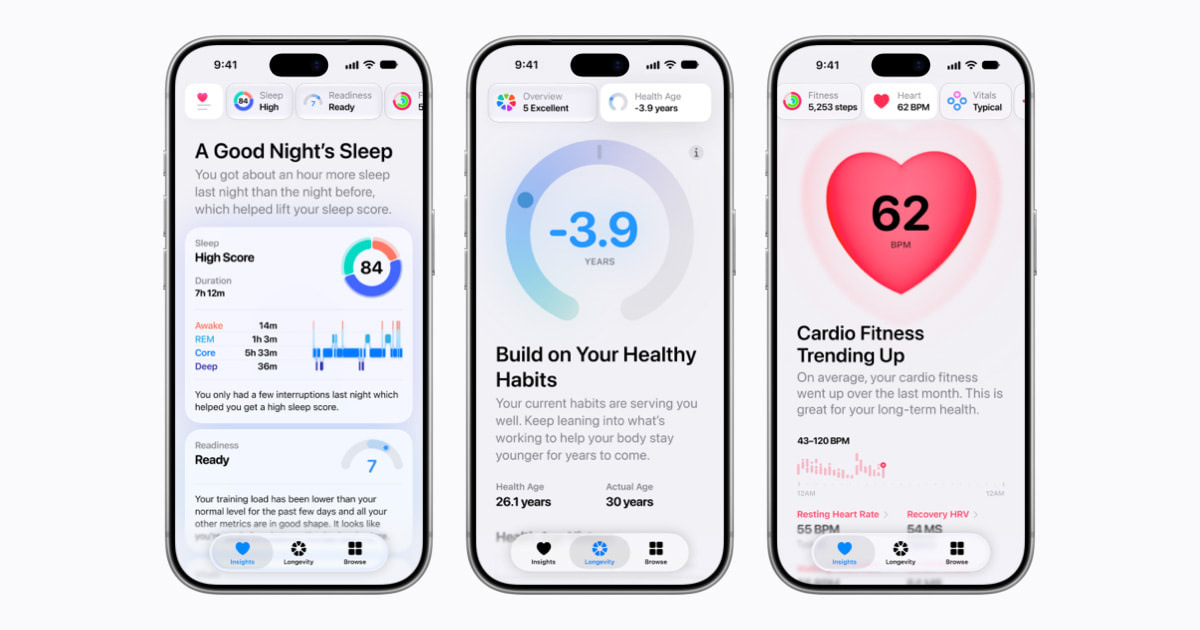
Apple has announced expanded language support for its redesigned Health app, adding global English, Chinese (Simplified and Traditional), French, Japanese, Korean, Norwegian, Portuguese, Spanish, Turkish, and Vietnamese. The company frames the update as a way to bring personalized health insights to “millions of people worldwide,” with Apple Intelligence at the center of the experience.
This isn’t a gaming headline, but it is meaningful Apple-platform news: it’s another example of Apple pushing first-party, on-device intelligence features that scale globally — and it reinforces the direction developers should expect across iOS, iPadOS, and the broader ecosystem that Mac increasingly shares DNA with.
What Apple changed: Insights, “For You,” and Longevity
According to Apple, the redesigned Health app introduces a new Insights tab that surfaces summaries across heart, sleep, readiness, fitness, vitals, and cycle tracking throughout the day. There’s also a dedicated “For You” section for recommendations tailored to daily habits, like adjusting a wind-down routine after multiple nights of interrupted sleep.
The other big addition is a Longevity tab built around longitudinal trends across heart health, sleep, mental wellbeing, movement, metabolic health, hearing, and nutrition. Apple highlights “Health Age” as a core feature, translating Apple Watch data (including VO2 max, resting heart rate, sleep, and heart rate variability) into a metric that compares where your body tracks relative to your chronological age. Apple also says users can incorporate clinical lab data like A1c and LDL cholesterol to enrich the long-term picture.
On-device movement evaluations: the developer-relevant detail
The most platform-significant part of the announcement may be the at-home movement evaluations. Apple says users can use an iPhone camera and Apple Watch to assess flexibility, strength, balance, movement mechanics, and VO2 max with real-time audio and visual feedback.
Importantly, Apple claims this is powered by on-device vision-based AI models, developed with clinical experts, and runs entirely on device — with no video recorded, stored, or shared. For ecosystem watchers (and yes, for game and app developers who care about Apple’s rules of the road), this is consistent with Apple’s ongoing bet: richer “AI” experiences that are privacy-forward, hardware-accelerated, and designed to live within Apple Silicon-era performance envelopes.
What this means for Mac and Apple Silicon readers (even if you never open Health)
MacGaming.com readers don’t need a new Health feature to enjoy better games, but these first-party rollouts do matter in three practical ways:
First, language expansion is a reminder that Apple’s “AI-powered” features are being productized globally, not just demoed. That tends to coincide with a steadier cadence of frameworks, OS updates, and behavior changes developers must keep up with across the App Store ecosystem.
Second, Apple continues to validate a design pattern that’s showing up everywhere: on-device models, tightly integrated sensors, and hardware-accelerated processing. Even when features ship on iPhone and iPad first, the same philosophy (and often the same underlying technologies) informs Apple’s tooling and platform expectations that Mac developers eventually feel.
Third, the privacy posture here is deliberate. Apple is effectively drawing a line: sophisticated vision-based analysis can happen without cloud processing and without storing sensitive raw media. That stance shapes user expectations — and it influences the competitive bar for any app that touches cameras, sensors, or personal data.
Availability
Apple says the redesigned Health app is available in the iOS 27.3 developer beta now, and will roll out to users later this year as a free software update. The company also notes it will continue expanding language support over time.
Source
Source: Apple Newsroom.
For Apple’s full announcement and the complete list of details, read the original post here:
https://www.apple.com/newsroom/2026/11/redesigned-health-app-expands-language-support/





Comments
Sign in to join the conversation.
Log in to commentNo comments yet. Be the first to join the conversation.