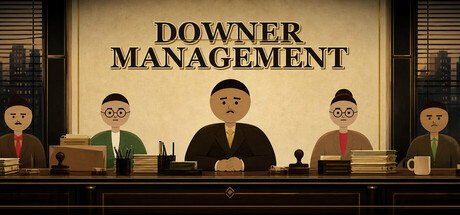

Upper management is a real downer
Downer Management is a 3-vs-3 autobattler set in a corporate purgatory where every conflict is settled through positional politics instead of swords and spells. Your “party” is a three-person department seated at three desks—Upper, Middle, and Entry—and you face off against other departments in battles fought with paperwork: memos, motions, clipboards, and grudges.
The twist is simple and mean: you don’t control the fight—you control where people sit. The action plays out automatically once the round starts, but between beats you’ll juggle the org chart in real time: promote someone upward, demote a star performer to soak a hit, swap in a benched coworker, and spend limited authority to push your plan through. The result is a tactics game about timing, triage, and the small joys of watching a room full of middle managers cite policy at one another until somebody snaps.
How it plays: three desks, endless consequences
Downer Management’s combat is built around its three-desk formation. Upper, Middle, and Entry positions carry different modifiers to damage and resilience, so moving an employee isn’t cosmetic—it’s the entire strategy layer. A promotion can save someone who’s about to be “terminated,” while a demotion can turn your best contributor into an emergency shield when the enemy department spikes damage.
Because it’s an autobattler, the best moments come from planning around what your team will do on its own. You’re not aiming skillshots; you’re designing a small workplace disaster and then trying to survive the chain reaction.
Departments, bench auras, and the real metagame
Beyond the active three, your bench matters. Downer Management features six departments, and each benched employee projects their department’s aura onto the active row in the same position. That means bench composition becomes a puzzle of its own: who you keep on standby can be as important as who’s currently taking hits.
Department identity is loud and useful. Examples include:
- HR supporting the team with healing tools like Coffee Run.
- IT disrupting enemies with effects like Phishing Hooks that can silence key targets.
- Marketing applying pressure by flagging opponents and shaping tempo.
The game’s satire lands because the mechanics commit to the bit: unlike reality, every employee is useful—at least as a piece on the board.
Paperwork as weaponry (and status effects with HR approval)
Forget fireballs. In Downer Management, “spells” are forms: Memos, Audits, Cold Calls, Performance Improvement Plans, Hostile Takeovers, and occasionally something blunt like a Wrench Smash. Every action generates more actions, more triggers, and more tedious consequences—exactly as intended.
Status effects are equally on-theme: flagged, silenced, on probation, delayed, fast-tracked. It’s a toolbox of control and tempo manipulation that rewards you for understanding how long a unit needs to survive in a given seat—and what kind of bureaucratic suffering you can inflict before the next reshuffle.
Procedural personnel and a revolving door of regret
Employees are procedurally generated from a shifting applicant pool. Each hire has a department, role, skill loadout, and a small, exhausted personality. They will be “terminated,” and you’ll replace them. The replacements will also be terminated. It’s a grim loop, but it’s also the engine of replayability: new synergies, new aura setups, and new formation problems to solve every run.
The Theme Machine: a surprisingly catchy layer of style
Before taking on a building, you file a Department Theme: a procedural 80s-corporate aesthetic generator that builds a themesong (and variants) used across the game, including battles. It’s a clever way to make each push feel like its own weird corporate saga, complete with certified bops that somehow make the suffering go down easier.
No live service, no microtransactions—just one complete filing
Downer Management positions itself as a full, self-contained release: no microtransactions and no live service. Departments, decorations, and content are unlockable in-game. The only currencies required are patience, pain tolerance, and the willingness to solve problems caused by your own promotions.
Is Downer Management for you?
This game is for you if…
- You’ve ever been in a meeting that should have been an email.
- You’ve ever been in an email that should have been a meeting.
This game is not for you if…
- You expected a happy ending.
- You expected to leave on time.
Mac system requirements
Minimum
- OS: macOS 10.13 High Sierra
- Processor: Intel dual-core 2.0 GHz or Apple Silicon
- Memory: 2 GB RAM
- Graphics: Metal-capable GPU (standard on modern Macs)
Recommended
- Not specified by the developer.
Bottom line for Mac gamers
If you like autobattlers that emphasize formation and tempo over twitch control—and you have a tolerance for bleak workplace comedy—Downer Management looks built for clever repositioning, bench-synergy tinkering, and runs defined by the employees you’re forced to work with. It’s office satire where the punchline is always the org chart.
Comments
Sign in to join the conversation.
Log in to commentNo comments yet. Be the first to join the conversation.