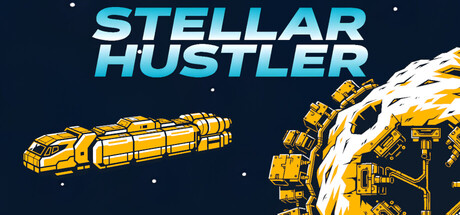

Stellar Hustler: the space-trader where time is the real currency
You owe The Syndicate. A lot. And in Stellar Hustler, the problem isn’t just making money—it’s making it fast. You start as a desperate cargo runner with a second-hand ship and a debt that compounds 3% every day. You have 60 days to clear it before an enforcer shows up to “collect.”
That ticking clock shapes everything: the route you plot across the star map, the risk you take on contraband, the jobs you accept (or fail), and whether you gamble on one big score in Dark Space or grind safer margins in the Core Systems.
Trade across 20 stations, but the market fights back
At its heart, Stellar Hustler is about reading price movement and moving cargo efficiently. You’ll trade across 20 space stations and a catalog of 12 commodities—ranging from legal scrap to grey-market ship parts to high-risk contraband—plus 6 rare signature goods that only appear at a handful of locations.
The economy is deliberately reactive. Prices shift every day based on supply and volatility, and they respond to what you do: dump too much of a commodity into one station and the local price will sag. If you’ve played other trading sims where you can endlessly loop one route, Stellar Hustler pushes you to adapt, diversify, and keep moving.
Routing matters because travel costs days
Stations sit on a real star map, and travel takes 2 to 6 days depending on the jump. That means “best profit per unit” is rarely the whole story; you’re also chasing “best profit per day.” A route with smaller margins but faster turnarounds can beat a high-profit haul that eats a week of travel time—especially with debt compounding daily.
Three tiers of space: safer laws, riskier margins
The sector is split into three broad tiers:
- Core Systems: safer routes, heavier customs, more scrutiny.
- Fringe stations: looser rules, more opportunity, more trouble.
- Dark Space: the biggest profits and the biggest dangers.
It’s a clean risk ladder. You can play conservatively and stay near regulated systems, but you’ll often feel the pressure of the clock. Push deeper and you’ll find the kind of margins that can erase days of debt—if you survive the trip.
Jobs Board contracts add structure (and consequences)
Each station can post contracts via a Jobs Board: deliver a sealed crate by a deadline, track down a specific cargo for a premium, or escort valuable goods through pirate space. Every job comes with both a payout and a failure penalty.
These contracts do two important things: they provide a predictable income option when markets are cold, and they create forced routing decisions. A lucrative delivery doesn’t mean much if the jump eats too many days—or if you’ll be traveling with a hold full of goods that customs would love to find.
Encounters: pirates, customs, breakdowns, and luck
Every jump is a roll of the dice. You’ll face pirates demanding tribute, customs scans, engine failures, and the occasional lucky find drifting in wreckage. Encounters aren’t just flavor: you’re given choices—talk, bluff, bribe, run, or open fire—and some situations can escalate into round-by-round combat.
The game also tracks your Heat. Smuggle too aggressively and you’ll draw more attention, increasing the odds of customs scans and Syndicate interest. It’s a simple pressure system that makes “one more contraband run” feel like an actual decision rather than a default play.
Pick your ship (and your difficulty)
Stellar Hustler offers three ships with meaningful trade-offs:
- Heavy Freighter: roomy cargo capacity for strong trading plays.
- Fast Courier: nimble and time-efficient, ideal for tight deadlines.
- Syndicate Contact: a harder bargain with a rare payoff for players who want to lean into risk.
Difficulty options include Normal for the intended hustle, plus Easy and Very Easy for a softer learning curve.
Run-based structure with sector-wide “conditions”
Each cycle begins with one of seven sector conditions that bend the rules—customs crackdowns, pirate wars, market booms, fuel shortages, and more. You can see the condition before you launch, which turns the start of a run into a planning phase: do you spec for speed, for stealth, for combat readiness, or pure cargo capacity?
It’s a strong roguelite lever: the broad objective stays the same (beat the debt clock), but the sector’s personality changes enough to reshape what “good play” looks like.
Upgrades you earn now, progression you keep later
Within a run, you’ll upgrade your ship with practical improvements: expand cargo, boost engines, reinforce hull, fit shields, and mount weapons. But Stellar Hustler also includes a longer arc: risky successes can drop Ship Parts, and you keep those even if a run ends badly.
Ship Parts feed into permanent upgrades across five tracks per ship, letting a favorite hull gradually become “yours” over multiple cycles. It’s a nice balance for Mac players who want a game that works in short sessions but still rewards long-term mastery.
Intel is for sale (and sometimes it’s a lie)
You can buy market tips from informants, but not every tip is trustworthy. The game lets you pay extra to probe intel and potentially catch a lie before you stake your entire cargo hold on it. It’s a small feature that adds an enjoyably grimy texture to the trading fantasy: information is power, but it’s also another way to get hustled.
Daily and weekly challenges for leaderboard-minded traders
Stellar Hustler supports Daily and Weekly Challenges built around shared conditions: same ship, same market, same sector modifier, and a dedicated leaderboard. Permanent upgrades are disabled for these runs, so the competition focuses on decision-making and execution. Winning earns Ship Parts, tying the competitive modes back into progression without making them mandatory.
Mac features and platform notes
- Clean sci-fi terminal presentation
- Full controller support (Unity Input System)
- Cloud saves and online leaderboards (internet required for these features)
- Offline play supported (local saves only, no leaderboards)
- Steam Deck Verified (useful as a general indicator of controller-first UX)
- 12 achievements and 13 languages
Mac system requirements
Minimum
- OS: macOS 11.0 (Big Sur)
- Processor: Apple Silicon, or Intel dual-core 2.0 GHz
- Memory: 2 GB RAM
- Graphics: Any Metal-capable GPU
- Storage: 300 MB available space
- Additional Notes: Internet connection required for cloud saves, leaderboards, and account features. Offline play supported (local saves only, no leaderboards). Controller support on all platforms via Unity Input System.
Recommended
- OS: macOS 13.0 (Ventura) or newer
- Processor: Apple Silicon, or Intel quad-core
- Memory: 4 GB RAM
- Graphics: Any Metal-capable GPU
- Storage: 300 MB available space
- Additional Notes: Internet connection required for cloud saves, leaderboards, and account features. Offline play supported (local saves only, no leaderboards). Controller support on all platforms via Unity Input System.
Why Stellar Hustler works on Mac
Stellar Hustler’s strengths are its clarity and pressure: a strict timeline, readable trade-offs, and a reactive market that punishes autopilot routes. If you like the fantasy of space trucking but want it compressed into brisk, replayable runs—with enough progression to keep improving between attempts—this is a strong fit for macOS, especially given its low storage footprint and Metal-capable GPU support.
Just remember the rule the game is built around: the debt never sleeps, and neither can your route planning.





Comments
Sign in to join the conversation.
Log in to commentNo comments yet. Be the first to join the conversation.