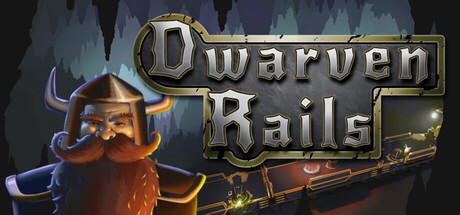

Dwarven Rails drops you into a very dwarven problem: the transport tunnels are overrun, the rails are contested, and the only thing standing between your fortress and total collapse is a rolling slab of steel bristling with guns. You command a dwarven gun train with a clear priority—protect the egg of a forge dragon. Survive long enough for it to hatch, then keep it alive as it grows into a tunnel-purging weapon of legend.
What is Dwarven Rails?
At its core, Dwarven Rails is a combat-forward, upgrade-heavy run structure built around a single central idea: your build is literally a train. Each trip through the tunnels is a series of choices, fights, resource stops, and escalating threats, with your train’s layout and loadout acting as the main expression of strategy.
The fantasy sells itself immediately: dwarves, machinery, tight underground corridors, and waves of enemies (including plenty of bugs) that exist primarily to be shot, splattered, and squished.
The Hook: Rearrange Your Train for Optimal Firepower
Most games ask you to tweak a loadout; Dwarven Rails asks you to engineer a moving fortress. As you unlock and install different turret types, your train becomes a modular weapons platform—one where placement matters. Rearranging cars to maximize coverage and damage is part puzzle, part tactics, and part “what if we simply add more guns?”
That focus on layout creates the game’s signature decision-making loop: you’re not only choosing what to equip, but also where it goes and how the whole machine functions as one coordinated system.
Upgrade Loop: Retrofit, Reinforce, Repeat
Progress is driven by upgrades and retrofits. Between the turrets you mount and the modifications you bolt onto the chassis, Dwarven Rails leans into the satisfaction of incremental improvement—turning early skirmishes into later stomps through better planning and stronger hardware.
This is also where Mac players who enjoy buildcrafting will find the most to chew on: runs don’t just end with “you died,” they end with new knowledge about what layouts and toolsets work best for your style of tunnel warfare.
Mining and Economy: Fund the War Effort
Combat isn’t the only job on the rails. You’ll also mine ore and sell it to finance your upgrades. That economic layer gives the action a purpose beyond survival: every decision to gather resources versus pushing ahead becomes a question of tempo. Do you invest in power now, or gamble on surviving with less so you can reach better opportunities later?
The Dragon: From Mission Objective to Mobile Cleanup Crew
The forge dragon isn’t just flavor text. Your mission begins as an escort job for an egg—fragile, precious, and absolutely central to success. Once it hatches, the tone shifts: the dragon becomes a growing presence in your run, getting stronger as you progress.
That growth adds a second arc to each run: your train’s power curve matters, but so does the dragon’s. Protecting it early pays off later when it can help purge the tunnels with increasing effectiveness—an escort objective that evolves into a core part of your offensive plan.
Roguelite Navigation and Run Structure
Dwarven Rails features a rogue-lite navigation system, framing each expedition as a route of choices rather than a single linear corridor. This helps keep runs from feeling identical, and it emphasizes adapting your train build to what the tunnels throw at you—enemy density, resource opportunities, and the kinds of fights you’ll need to win to keep the egg (and later the dragon) safe.
Key Features
- Multiple turret types to unlock and install on your train
- Train modifications you can retrofit for added advantages
- Rogue-lite navigation that shapes each run through choices and routes
- Loads of bugs to shoot, splatter, and squish
- A dragon—starting as an egg, ending as a growing force of destruction
Who Is It For on Mac?
If you like the idea of roguelite runs but want your “build” to feel physical and engineered, Dwarven Rails hits a satisfying niche. It’s for players who enjoy:
- weapon-platform tinkering and layout optimization
- upgrade-driven progression and run-to-run experimentation
- combat that rewards planning as much as reflexes
- a strong theme (dwarves + rails + heavy guns + dragon escort)
Mac System Requirements
Minimum
- OS: MacOS Sierra - 10.12.6
- Processor: 2.7 GHz Intel Core i5
- Memory: 4 GB RAM
- Graphics: Nvidia GeForce GT 640M
- Storage: 4 GB available space
Recommended
- Memory: 4 GB RAM
- Storage: 4 GB available space
Bottom Line
Dwarven Rails is a punchy, upgrade-driven tunnel campaign built around a fun premise: your base is a train, your job is to keep it lethal, and your most valuable cargo is a forge dragon that turns from liability to powerhouse. If the idea of rearranging a rolling gun fortress between fights sounds like your kind of Mac game, this one belongs on your radar.



Comments
Sign in to join the conversation.
Log in to commentNo comments yet. Be the first to join the conversation.