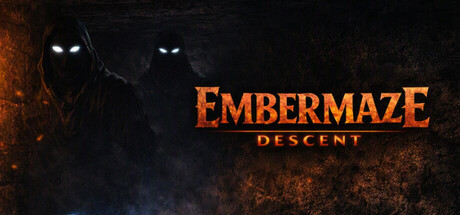

Embermaze: Descent drops you beneath a forgotten kingdom into the Embermaze: a shifting ritual labyrinth carved by ancient magic to judge anyone who dares seek passage into the underworld. You enter with the Ember Torch, a relic whose light reveals hidden routes and weakens the spirits bound to the corridors. The maze doesn’t just test your navigation—it tests your nerve, your planning, and how well you can keep moving when the safest choice is rarely the obvious one.
Premise: A Ritual Trial That Refuses to Stay Mapped
Every descent is a voluntary step into an old challenge “older than memory,” but the Embermaze treats each challenger the same: as fuel for its legend. Ghosts of past entrants now stalk the halls, and each new level shifts toward deeper darkness and greater spiritual pressure. The objective is deceptively straightforward—collect fragments, unlock the rite, escape—but the maze is procedural, the light is scarce, and the rules bend as you descend.
Gameplay Overview: Keys, Chest, Elevator—And a Lot of Running
Embermaze: Descent is a first-person survival-horror maze game with procedural generation and tight resource management. Each run spawns a new labyrinth layout, changing the routes, dead ends, and hiding places you’ll rely on when things go wrong.
Your core loop in every run:
- Find three coloured keys hidden throughout the maze.
- Use them to unlock the central chest and obtain the final key.
- Return to the elevator before the ghosts catch you.
Early floors may offer a little mercy—ambient light, a few wall torches, the occasional brazier—but that comfort fades fast. As you push deeper, the Embermaze becomes more hostile, more visually oppressive, and harder to read at a glance. Even experienced players will find that familiar tactics don’t always translate cleanly between runs because the labyrinth itself refuses to be consistent.
The Ember Torch and the Spell-Shot Economy
Light is not just mood in Embermaze: Descent; it’s survival information. Your torch defines what you can safely interpret: intersections, distant movement, and the subtle differences between a navigable corridor and a panic-inducing dead end.
To keep you from relying purely on stealth or sprinting, the game gives both you and the ghosts a limited pool of spell shots. These can be used to:
- Cancel incoming ghost spells.
- Temporarily banish ghosts.
- Create brief moments of safety to reposition, re-route, or commit to an objective.
The catch: recharge pads are rare, and ghosts can use them too. That turns every encounter into a layered decision—do you spend a shot now to guarantee an escape route, or do you risk holding your last counterspell in case the maze funnels you into something worse?
Progression & Difficulty: The Descent Turns the Screw
Progression in Embermaze: Descent is all about compounding pressure. As you descend, the maze becomes:
- Darker — less ambient light and fewer torches/braziers to stabilize your bearings.
- More dangerous — more ghosts, with less predictable patterns.
- More atmospheric — colour themes shift through dusty brown, sickly green, mystical purple, and blood-red until darkness dominates.
Difficulty modes adjust key factors like starting ghost numbers, lighting conditions, and behaviour patterns. The result is scalable horror: approachable if you want a tense maze crawl, punishing if you want the full “every mistake is expensive” survival-horror rhythm.
Procedural Mazes: High Replayability, Low Comfort
The procedural generation is the heart of the replay value. Each run changes your knowledge advantage: you can improve your decision-making and route discipline, but you can’t memorize a map. This keeps the fear grounded in uncertainty—especially when you’re one key away from the chest and realize the maze is steering you into longer, darker corridors.
You can also choose your starting maze size, with progression tracked independently for each maze size and difficulty. That structure encourages experimenting with different run lengths and risk profiles, from shorter “learn the loop” attempts to bigger mazes where navigation becomes its own endurance challenge.
Ghost AI: A Threat That Competes for Resources
Many horror games make enemies scary by making them invincible. Embermaze: Descent takes a different approach: ghosts are scary because they participate in the same resource ecosystem. When a ghost can cast spells, pressure you off safe paths, and even recharge at pads you desperately need, encounters become tactical. You’re not just avoiding a patrol—you’re negotiating a shifting battle over time, space, and your remaining options.
CRT Mode and the Retro-Horror Flavor
If you want a more old-school feel, an optional Classic 90s CRT Mode adds retro-horror styling with CRT emulation, scanlines, distortion, and a moodier palette. It’s a smart fit for the game’s inspiration—classic 8-bit horror sensibilities filtered through modern lighting and procedural tension—without forcing that aesthetic on players who prefer a cleaner look.
Who It’s For on Mac
Embermaze: Descent is best for Mac players who like:
- First-person horror built on atmosphere rather than jump-scare spam.
- Procedural exploration where route planning matters.
- Survival-style resource constraints (limited shots, rare recharge opportunities).
- Games that reward calm decision-making under pressure.
If you’re the kind of player who enjoys mapping spaces in your head, committing to risky detours for key items, and making the elevator run with everything on the line, this descent is designed for you.
Mac System Requirements
Minimum
- OS: macOS 12.0 (Monterey) or later
- Processor: Intel Core i5 2.0 GHz (Quad-Core) or Apple M1
- Memory: 4 GB RAM
- Graphics: Metal-capable GPU (Intel Iris Plus Graphics 640, AMD Radeon Pro 500 series, or Apple M1 integrated GPU)
- Storage: 1 GB available space
- Sound Card: CoreAudio compatible audio output
- Additional Notes: Metal graphics API support required. Keyboard & Mouse or Gamepad required. Atmospheric audio and directional sound cues are best experienced with headphones.
Recommended
- OS: macOS 12.0 (Monterey) or later
- Processor: Apple M1 / M2 / M3 (or 3.0 GHz Quad-Core Intel Core i7)
- Memory: 8 GB RAM
- Graphics: Apple M1 GPU (8-core) or AMD Radeon Pro 5500M / Radeon RX 5600M
- Storage: 1 GB available space
- Sound Card: CoreAudio compatible output (Headphones or 3D Spatial Audio headset strongly recommended)
- Additional Notes: Metal 3 support recommended for optimal post-processing and frame rates. Keyboard & Mouse or Gamepad required. Atmospheric audio and directional sound cues are best experienced with headphones.
Final Take
Embermaze: Descent is a focused survival-horror experience where procedural design and limited magical defense tools push you into constant micro-decisions: explore or retreat, spend or save, fight for space or run for certainty. With escalating darkness, increasingly aggressive spirits, and a clean objective loop that’s easy to understand and hard to execute, it’s an excellent fit for Mac players looking for tense, replayable horror built around navigation and pressure rather than pure combat.
Survive. Unlock. Descend.





Comments
Sign in to join the conversation.
Log in to commentNo comments yet. Be the first to join the conversation.