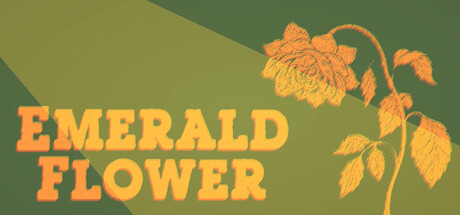

Emerald Flower is a bleak, story-driven pixel-art RPG built around survival after catastrophe. You play as a 17-year-old boy who has lost everything to war and is searching for a reason to keep going. It’s not a power fantasy: the world is intimate, hostile, and filled with people whose intentions you can’t take at face value.
On Mac, Emerald Flower is also refreshingly modest in system demands—meaning nearly any modern Mac (Intel or Apple Silicon) can run it—while the game itself leans hard into atmosphere, narrative weight, and a steady drip of unsettling world-building.
What Kind of Game Is Emerald Flower?
At its core, Emerald Flower blends classic 2D exploration with RPG-style progression, crafting, and tactical combat decision-making. The hook is how these systems are framed by the setting: a civilization shattered by war and the lingering fear of the Emerald Flower—an organism whose very existence turns ordinary human behavior into a potential death sentence.
- Survival-minded exploration: scavenge what you can, because resources matter and the world does not provide comfort.
- Crafting and inventory management: turn materials gathered from the environment into useful items via a dedicated crafting/inventory loop.
- Combat that rewards observation: rather than button-mashing, you’re pushed to identify weak points and strike deliberately.
- Character-driven progression: relationships are not window dressing; people you meet can help, mislead, or harm you, and the game expects you to pay attention.
Combat: Read the Enemy, Not the Button Prompts
Emerald Flower’s combat is pitched as “find the weak point and strike there,” and that design philosophy fits the game’s broader theme: certainty is rare, and mistakes are expensive. You’re encouraged to treat fights like problems to solve instead of obstacles to brute-force.
That tension extends beyond enemies in the traditional sense. The game repeatedly emphasizes distrust—those you assume are allies may not be, and the safest path often involves sizing people up before committing to them.
Crafting: Small Systems With Big Narrative Weight
Crafting here isn’t framed as an endless optimization treadmill; it’s a practical survival tool. You gather materials from the environment and convert them into items that keep you moving—whether that means restoring resources, improving readiness for combat, or simply making it through another stretch of road.
Because the story is about someone who has lost everything, the act of building something useful from scraps naturally reinforces the tone: survival isn’t heroic, it’s procedural.
Relationships and NPCs: Everyone Has a Story (and an Angle)
One of Emerald Flower’s strongest promises is that the people you meet matter—from a passerby offering advice to someone as unassuming as a janitor. The game’s world is defined by collapse and fear, so even minor characters can carry crucial context, moral ambiguity, or consequences you only recognize later.
If you enjoy games where dialogue and observation are part of the challenge (not merely exposition), Emerald Flower leans in that direction. It asks you to analyze every character—not just for lore, but for survival.
Pixel-Art Presentation: Intimate, Retro, and Unforgiving
Visually, Emerald Flower goes for a 2D retro pixel-art style that suits its tone: stark, readable, and capable of making quiet places feel dangerous. The atmosphere is less about spectacle and more about proximity—tight spaces, vulnerable travel, and the sense that the world has already ended for many people… it just hasn’t finished ending for everyone else.
The Lore Hook: The Emerald Flower Project (Damlama Archive Records)
Where Emerald Flower becomes especially distinctive is in its “secret archive” framing—documents that read like official records slowly sliding into panic. The Emerald Flower (Stapelia Smaragdina) is described as a parasitic plant subspecies that reproduces by infecting mammals, using scent to lure victims and microscopic seeds to attach to the olfactory nerve. From there, it infiltrates the brain, spreads roots through critical regions, and can ultimately take control of instincts and behavior.
The lore escalates through dated “edits,” charting a progression from containment and supposed extinction to theft, political tension, and finally open war. By the time the narrative reaches the later entries, the scientific voice breaks down into raw survival testimony—underscoring the game’s core theme: institutions collapse, and ordinary people are left trying to remain human in inhuman conditions.
Mac Performance and System Requirements
Emerald Flower is lightweight on storage and RAM, and it supports both Apple Silicon and Intel Macs. If you’re running macOS Catalina or later, you’re in the clear on OS version.
Minimum
Minimum:
- OS: macOS 10.15 (Catalina) or higher
- Processor: Apple Silicon (M1/M2/M3) or Intel Core i3
- Memory: 2 GB RAM
- Storage: 400 MB available space
Recommended
Recommended:
- OS: macOS 10.15 (Catalina) or higher
- Processor: Apple Silicon (M1/M2/M3) or Intel Core i3
- Memory: 2 GB RAM
- Storage: 400 MB available space
Who Is This For?
- Players who want story-first RPGs with unsettling lore and a grim tone.
- Fans of pixel-art worlds that prioritize mood over flash.
- Anyone who enjoys crafting as survival and combat that rewards paying attention.
- Mac gamers looking for something low-spec friendly without feeling “small.”
Verdict
Emerald Flower aims for emotional heaviness and paranoid tension: a coming-of-age story in a world where trust is dangerous, hunger is real, and the past isn’t finished infecting the present. If you’re in the mood for a narrative-driven pixel RPG that treats survival as both a mechanical system and a moral problem, Emerald Flower is worth a look on Mac.





Comments
Sign in to join the conversation.
Log in to commentNo comments yet. Be the first to join the conversation.