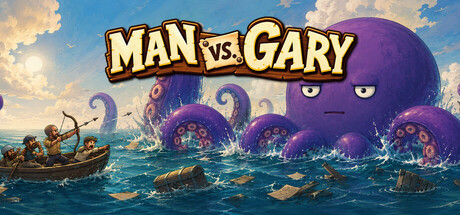

There is a monster in the bay. His name is Gary.
Man vs. Gary takes a premise that’s deliberately lopsided—one person, one small boat, one bow versus a sea monster roughly the size of a district—and commits to the bit with uncommon confidence. Gary is bored. You are outmatched. The ocean is not impressed. And yet the job must be done, one arrow (and one drowning) at a time.
Framed as an idle comedy boss-siege, the loop is simple: you row out, you fire, Gary responds with overwhelming violence, and you inevitably drown. But here’s the hook: Gary’s damage persists. His health bar doesn’t reset, your progress is cumulative, and the game treats death less like failure and more like administrative process.
Failing is the mechanic (and the punchline)
In most games, death is a hard stop or a setback. In Man vs. Gary, death is a form. The game leans into the absurdity with “Maritime Incident Reports” and bureaucratic framing that makes each run feel like another stamped entry in a long, grimly cheerful ledger.
- Lose, professionally: drowning isn’t a fail state—it's part of the progression. Every attempt chips away at the monster.
- Persistent boss HP: your worst run still mattered; the monster remembers the damage.
- Deadpan narration and commentary: the tone sells the concept, with monsters who talk back and a world that treats your repeated demise as routine.
Idle systems that respect your time
This is an idle game that doesn’t demand constant babysitting. The crew keeps working while you’re away—rowing, shooting, drowning, and advancing the long war of attrition without needing you to stare at the screen.
That makes it especially well-suited to Mac play sessions that happen between work, study, or anything else: check in, collect progress, buy upgrades, and send the next doomed expedition back into the bay.
The harbor is your shop (and your recovery room)
Between runs, you return to the harbor—effectively the game’s upgrade hub. The quay becomes a walking checklist of better gear and better help: a stronger bow, a sturdier boat, and a crew that ranges from practical to delightfully unnecessary (including, as described, things like a motivational parrot and a man who writes things down).
The upgrades aren’t just about raw numbers; they reinforce the storybook tone of a world where heroism is mostly persistence and paperwork.
Seven bosses, one escalating grudge
Gary is the headline act, but Man vs. Gary promises a roster of escalating sea-wrongs, each framed with its own comedic identity. Alongside Gary the kraken, you’ll face threats like Ignatius (who is on fire and knows it), Kevin & Kevin (a two-headed argument), THE BARONESS (who owns the seabed), and THE COMMITTEE (incapable of violence without a motion)—plus, inevitably, SWOLE GARY.
It’s not just a sequence of damage sponges; it’s a parade of personalities designed to keep the long-form progression entertaining.
Retirement that feels like a promotion, not a reset
When progress slows and the wall feels too high, the game offers a prestige-like system with a strong narrative wrapper: Retire the Captain. Rather than “starting over,” you hand the boat to someone even angrier. Your successor inherits the accumulated history—your grudge, your statue, and every way you’ve died—while earning a permanent damage bonus that stacks with each retirement.
It’s a smart way to make long idle arcs feel intentional: you’re not erasing progress, you’re institutionalizing it.
The Drowning Board: a leaderboard for the truly committed
If you enjoy leaderboards, THE DROWNING BOARD ranks players globally by how many times they’ve drowned. It’s an on-brand metric that turns repeated defeat into a bragging right—because in this world, the most experienced sailor is the one with the thickest file.
Presentation: a hand-illustrated storybook with bite
The game’s “storybook” look pairs well with its tone: whimsical, clean, and built to deliver jokes without undercutting the sense of steady progression. A day-night cycle keeps the bay feeling alive—the sun sets, lanterns come on, and the fight continues because, apparently, nobody asked it to stop.
There’s also a strong sense of authorial voice throughout, aided by the promise that it’s built by one person. The pitch is refreshingly straightforward: no microtransactions, no energy timers, no nonsense—just the loop, the writing, and the long, slow victory.
Mac performance and requirements
Man vs. Gary supports Mac on Apple Silicon. If you’re on an M1 or later, you’re in the minimum spec range, and M2 or later is recommended for extra headroom.
Minimum Mac Requirements
- Requires an Apple processor
- OS: macOS 11+
- Processor: Apple Silicon (M1 or later)
- Memory: 4 GB RAM
- Graphics: Apple Silicon integrated GPU (M1 or later)
- Storage: 2 GB available space
Recommended Mac Requirements
- Requires an Apple processor
- OS: macOS 12+
- Processor: Apple Silicon (M2 or later)
- Memory: 8 GB RAM
- Graphics: Apple Silicon integrated GPU (M2 or later)
- Storage: 2 GB available space
Why it belongs on a Mac gamer’s radar
Man vs. Gary is ideal if you want an idle game with actual jokes, a progression model that doesn’t waste your time, and a central conceit that stays funny because the mechanics support it. It’s a boss fight stretched into an entire game—less about perfect execution and more about the slow satisfaction of turning an impossible task into routine.
The monster dies mid-sentence. That is a promise.




Comments
Sign in to join the conversation.
Log in to commentNo comments yet. Be the first to join the conversation.