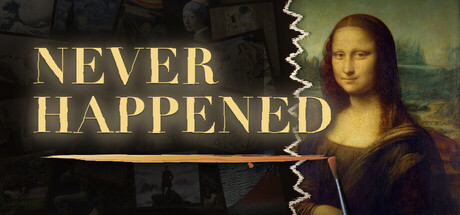

“If nobody notices, it’s art history.” That’s the grim little mantra at the center of NEVER HAPPENED, a game about restoration, deception, and the fine line between preserving culture and covering up a very expensive mistake. You play as Vince Lang: a painter who spent a decade making art nobody stopped to look at, now employed moving fine art for a living—where the rule is simple: never leave a single scratch.
Of course, hands slip. And when they do, your job becomes less “museum professional” and more “panic-stricken miracle worker.” The company’s tradition, passed down for generations, is as blunt as it is absurd: paint over it. Make it never happened.
Gameplay: three minutes, one painting, zero room for error
Each restoration run is built around a ticking clock: 180 seconds until the inspector. In that short window you’ll:
- Mix your own colors on a palette (by eye, not by formula).
- Study what remains of the original and identify what’s missing.
- Retouch only the damaged area, matching color and value as closely as possible.
The hook is that the technique mirrors real restoration in spirit: the “skill check” isn’t brush gymnastics so much as seeing. Can you correctly judge warmth vs. coolness, saturation, shadow depth, and subtle shifts in tone—fast?
100 real masterpieces (not replicas)
NEVER HAPPENED doesn’t hide behind “inspired by” lookalikes. It uses 100 public-domain masterpieces presented as high-resolution scans of the genuine originals. The canvas you’re working on isn’t a game artist’s imitation—it’s art history, treated as a puzzle surface with a very specific challenge: repair the damage so convincingly that nobody can tell it was ever there.
Inspection: machine scoring, match rate, and a heatmap of your mistakes
Once time’s up, the game leans into its most satisfying (and sometimes humiliating) feature: the inspector’s report. Your restoration is:
- Scored against the original as a match rate (percentage).
- Visualized with a heatmap that highlights where you drifted from the true image.
- Displayed side-by-side as “original,” “just after the accident,” and “your restoration.”
It’s the kind of feedback loop that makes you immediately want to retry—whether you nailed it and want to flex, or botched it and want to laugh (or spiral) at exactly how far off your color read was.
Daily Challenge and multiplayer showdowns
If you like your calm visual work with a competitive edge, NEVER HAPPENED includes modes designed for comparison and bragging rights:
- Daily Challenge: everyone gets the same one-shot restoration for the day.
- Worldwide leaderboard: see where your match rate lands.
- Online rooms (up to 4 players): head-to-head sessions to settle who covered it up best.
Sharing and streaming policy (creator-friendly)
The developers explicitly allow streaming and video content. You can publish livestreams, VODs, clips, and Shorts, and you can monetize them (ads, memberships, tips, and similar). No permission or notice is required, and there are no spoiler restrictions. The key limitation: don’t redistribute or sell the game’s assets on their own outside the context of coverage.
Mac performance and compatibility
NEVER HAPPENED is Apple Silicon-only on macOS. If you’re on an older Intel Mac, it’s not supported.
Minimum Mac requirements
- Processor: Apple M1 or later
- OS: macOS 12 Monterey or later
- Memory: 4 GB RAM
- Graphics: Apple GPU (integrated M1 or later)
- Storage: 500 MB available space
Recommended
- Requires an Apple processor
Who is NEVER HAPPENED for?
- If you love precision puzzles that test perception more than reflexes, this is a great fit.
- If you’re into art, the use of real, high-resolution public-domain works adds a unique thrill (and pressure).
- If you like compact, replayable challenges, the 180-second structure and post-run scoring make it easy to “just do one more.”
- If you want a streamable game, the side-by-side reveals and heatmaps are perfect for audience reactions.
NEVER HAPPENED turns restoration into a high-stakes, time-boxed act of visual detective work—equal parts craft, cover-up, and comedy of errors. On an Apple Silicon Mac, it’s a fresh kind of “puzzle game”: not about matching shapes, but matching history.


Comments
Sign in to join the conversation.
Log in to commentNo comments yet. Be the first to join the conversation.