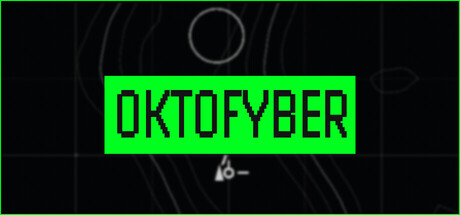

OKTOFYBER is not a power fantasy about being a hero on the ground. It’s a control-room war game about being the operator: one human at a console directing a robotic force through a dependency-laced kill chain where every link can fail, every signal can be jammed, and every “truth” you see is only what a sensor managed to claim.
TASK // KILL THEM ALL.
That blunt mission statement frames the entire experience—then immediately complicates it. Because in OKTOFYBER, success is rarely about raw firepower. It’s about building and maintaining a functional system: spotting a contact, maintaining comms, selecting the right effectors, and confirming actions fast enough to matter without revealing yourself or wasting munitions on stale data.
On Mac, the kill chain is the game
OKTOFYBER’s core idea is that modern combat isn’t one unit versus another—it’s a chain of dependencies. A satellite pass births a contact. Artillery suppresses. A fiber-optic FPV drone slips under jamming and finishes the job. Ground UGVs push in. A logistics mule drags shells under fire. A tethered relay keeps the network alive. Each element is powerful, but none is sufficient alone.
The game organizes this into 13 branches of unmanned forces—recon, interceptors, mortars, C-RAM, EW dome, minesweeper, heavy bomber, and more—each with roles and constraints that force you to think like a systems operator, not a trigger-puller.
Communications are geography (and terrain is network)
One of OKTOFYBER’s most distinctive mechanics is that orders only travel where a link physically exists. Radio horizon matters. Terrain blocks. Relays extend. Jamming creates dead zones. Fiber optics provide alternate paths. This makes the map feel less like a battlefield diagram and more like a living network topology—because it is.
The practical result: you don’t just move units and call strikes. You plan connectivity. If your comms go dark, your “best” unit might as well not exist. If you overextend without relays, your kill chain snaps. If you rely too heavily on one channel, the enemy can learn to target it.
No omniscience: every screen tells its own sensor’s truth
OKTOFYBER refuses the comfort of an all-seeing tactical map. Instead, it commits to sensor-truth recon. The map shows knowledge, not reality: optics may identify a silhouette; thermal may report a signature; direction-finding may only give a bearing. Contacts can age, drift, and go stale—so if you strike old coordinates, you may get a blunt answer from the system:
COORDINATES EXPIRED.
Even your tools have consequences. Turn on radar and it may illuminate the battlefield—while simultaneously making you easier to detect. In OKTOFYBER, emission is a decision. The game’s tension often comes from choosing between awareness and exposure, speed and certainty, confidence and silence.
Eight channels, thirteen branches, and a queue that outgrows you
OKTOFYBER is built around deliberate input: every strike waits for your confirmation. Early operations might ask for a manageable number of decisions. Later ones can demand hundreds—eventually pushing into territory that’s “physically beyond any human” to confirm individually.
That pressure is not a difficulty spike—it’s the point. The game introduces a delegation system through OKTAVA: a ladder from packet confirmations to permanent auto-classes and beyond. Each step trades human judgment for machine speed, and each step is irreversible. Autonomy doesn’t shoot straighter than you. It simply doesn’t wait for permission.
This is where OKTOFYBER becomes narrative without cutscenes: you feel the moment when the war stops fitting inside your hands, and the system asks whether you will remain the decider—or become the overseer of an automated process.
An enemy operator that studies you
OKTOFYBER’s campaign doesn’t just pit you against scripted scenarios. It profiles how you fight: how often you light up radar, how quickly you confirm, how heavily you depend on satellite coverage, where you tend to over-commit. Then the enemy “operator” adapts and builds counter-rules against your habits.
Losses persist between operations. Your mistakes don’t vanish at mission-end. And the war log records everything—every choice, including the ones you’d rather memory-hole. The game doesn’t moralize; it documents. Any verdict is postponed until the credits.
Campaign plus an endless, deterministic simulator
For structure, OKTOFYBER includes a 7-operation campaign plus a playable epilogue. Alongside it is an endless defense simulator focused on escalation and endurance: defend the command post against waves that test your networking, sensor discipline, and delegation thresholds.
Crucially, the simulation is deterministic: seeded runs and bit-exact replays across OSes. Same seed, same war. That makes performance comparisons meaningful and replays useful for learning, optimizing, and verifying that a win wasn’t just luck.
Vector visuals, procedural sound, and keyboard-first control
OKTOFYBER leans into a cold-war instrument aesthetic: pure vector graphics that evoke phosphor scopes, edges, and noise—less “pretty battlefield,” more “operational display.” It pairs that with a standout technical flex: all audio is synthesized live. There are no audio files—everything you hear is generated in real time.
Input-wise, the keyboard is the console. Left hand handles verbs, right hand handles direction, and Space confirms. In the terminal phase you can even take direct control of an FPV drone and fly it yourself, briefly collapsing the strategic layer into a tense, hands-on finish.
Who should play OKTOFYBER on Mac?
- Systems-minded strategy players who enjoy managing dependencies, comms, and information rather than just unit stats.
- Sim and mil-tech curious players who want a game where jamming, emissions control, and sensor limitations aren’t flavor—they’re the rules.
- Players who like mechanical storytelling, where the narrative emerges from what you delegate, what you automate, and what you choose to personally confirm.
If you’re looking for a traditional RTS with perfect intel and frictionless commands, this will feel hostile. If you want a game that treats uncertainty, latency, and overload as first-class mechanics, OKTOFYBER is laser-focused on that experience.
Mac system requirements
Minimum:
- OS: macOS 10.13 High Sierra
- Processor: Intel Core M 2012+ or Apple M1/M2/M3/M4/M5
- Memory: 4 GB RAM
- Graphics: internal
- Storage: 300 MB available space
Recommended:
- (Not specified)
OKTOFYBER is the fourth game in the COMMUTATOR series, but no prior knowledge is required. The task fits in one line. The campaign is about who—or what—ends up executing it.

Comments
Sign in to join the conversation.
Log in to commentNo comments yet. Be the first to join the conversation.