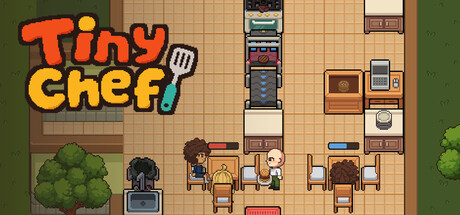

Tiny Chef is a restaurant management game built around one simple truth: once the doors open, you’re already behind. Orders stack up, customers arrive in groups, equipment breaks your flow at the worst possible time, and somewhere in the middle of plating a table you’ll realize nobody has washed a single dish in days. It’s a co-op game at heart, but it’s just as happy to let you run the kitchen alone—if you can keep up.
One kitchen. Ten hours. Four cooks who won’t stop moving the stove.
At its core, Tiny Chef is about moment-to-moment service: take orders, prep ingredients, cook, plate, and run food out to customers—then sprint back to start the next ticket. The rhythm is familiar if you love games like Overcooked-style coordination, but Tiny Chef leans harder into management simulation: your restaurant persists, your choices between shifts matter, and the space itself evolves over time.
The shift: a real clock, real pressure
Each day runs on a real-time clock. Demand rises and falls with the hours, meaning the lunch rush is a fundamentally different problem than the slow stretch mid-afternoon. Guests show up solo or in parties of up to four, sit together, order together, and—crucially—lose patience together. If you’re late to the table, the whole party can walk, turning one mistake into a cascading loss of time and income.
And the kitchen isn’t a fixed puzzle box. Tiny Chef encourages you to treat the restaurant like a living workspace:
- Pick up key stations (like a chopping board) and move them where your flow makes sense.
- Buy a second stove via phone and wait for delivery—then unload it yourself.
- Deal with hazards like fires that can spread if you don’t respond quickly.
The result is a kitchen that feels less like a static level and more like a place you’re constantly adapting—especially once multiple cooks start reorganizing mid-service.
Between services: HQ, upgrades, expansion, and consequences
The shift is only half the game. Between services you return to HQ, decide how long to sleep, and spend what you earned. This downtime layer is where Tiny Chef separates itself from “pure” arcade co-op.
Between days you can:
- Order appliances and gadgets by phone and unload the delivery truck yourself.
- Learn new dishes, then decide what stays on the menu (and what’s too slow or too chaotic for your current setup).
- Run ad campaigns to increase customer volume—sometimes beyond what you’re actually equipped to handle.
- Hire contractors to knock out walls, move doors, and change the floor plan.
- Buy the empty lot next door and expand the building.
- Book a cleaning crew when the sink becomes a moral failing.
Do well enough and you can open additional restaurants—then scale up again. But failure has teeth: miss enough orders in a single day and the health inspector can shut a location down, and reopening gets more expensive the longer you’ve been in business. It’s a smart pressure valve that makes your “bad days” matter without instantly ending a run.
Your cook is yours: persistent progression
Tiny Chef uses a character progression system that’s simple and surprisingly sticky. You create a cook (face, clothing, and style) and take them anywhere. Skills range from 1 to 99 and only increase by doing the work:
- Chop enough ingredients and you chop faster.
- Put out enough kitchen fires and you become less rattled by disasters.
That progression persists across saves and even carries into other players’ games, giving co-op sessions a long-term sense of identity: this isn’t just “Player 2,” it’s a cook you’ve built.
Co-op that actually shares the kitchen
Tiny Chef supports online co-op through Steam and local co-op (two players on one screen) with controllers. The key design choice is that everyone truly shares the same space and authority:
- Everyone can cook.
- Everyone can buy things.
- Everyone can move furniture—even while you’re standing on it.
- There’s one phone, and whoever grabbed it first is using it.
This creates the best kind of co-op friction: not artificial “only the host can manage” limitations, but authentic workplace chaos where communication and division of labor matter—and where one teammate redecorating during a rush can be both hilarious and catastrophic.
Yes, you have to sleep (and drive)
Tiny Chef leans into the mundane in a way that makes the world feel grounded. You drive to work. You sleep. And you will, at some point, open the restaurant only to be told you can’t start the shift because one dirty plate is still sitting on a table. The game’s message is clear: operations aren’t just about cooking—they’re about maintaining the whole machine.
Mac requirements
Here are the system requirements for playing Tiny Chef on Mac:
Minimum
- OS: macOS 11.0 Big Sur
- Processor: Apple Silicon or Intel Core i5
- Memory: 4096 MB RAM
- Graphics: Metal-capable GPU
- Network: Broadband Internet connection
- Storage: 500 MB available space
- Sound Card: Any
- Additional Notes: Controller recommended for local co-op
Recommended
- (No recommended specs listed.)
Why Tiny Chef belongs on your Mac co-op shortlist
If you want a game that captures both the immediate panic of service and the long-term satisfaction of building a restaurant, Tiny Chef hits a sweet spot. It’s intense without being purely twitchy, strategic without turning into spreadsheets, and it understands that the funniest co-op moments often come from shared systems: one kitchen, one phone, one disaster, and four cooks trying to pretend this is fine.





Comments
Sign in to join the conversation.
Log in to commentNo comments yet. Be the first to join the conversation.