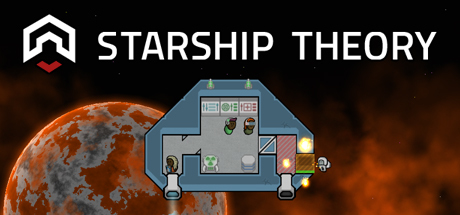

Starship Theory is a ship building survival game. You begin with 4 survivors lost in unknown space. From that simple premise, it becomes an ongoing balancing act between engineering ambition and harsh reality: every new room, system, and weapon you add creates new possibilities—and new ways to fail.
I'M GIVIN' HER ALL SHE'S GOT, CAPTAIN!
At its heart, Starship Theory is about designing a functional spacecraft while actively living in it. You’re not just placing cosmetic modules; you’re planning a working layout where crew movement, system access, and survivability matter.
- Build a starship your own way: decide how your ship is shaped and organized, from compact and efficient to sprawling and specialized.
- Construct upgrades: expand capabilities as you acquire materials, turning a fragile starter vessel into something that can take a hit.
- Research new technology: unlock systems and improvements that open up new strategies for exploration and combat.
- Maintain complex components: systems require attention—neglect can spiral into emergencies at the worst time.
- Emergency response tools: even oxygen becomes a lever you can pull—venting oxygen to extinguish fires can save the ship, but it can also endanger your crew if mismanaged.
The satisfying part is seeing your design choices play out under pressure. A well-placed corridor or a thoughtfully arranged set of rooms can be the difference between a controlled recovery and a cascading disaster.
MAKE IT SO
Survival depends on what you can extract, trade for, or take. Space is full of opportunity, but rarely without risk.
- Mine asteroids: break them apart for resources, feeding the constant demand for construction and repairs.
- Trade with neutral ships: turn a fortunate encounter into critical supplies or tech progression.
- Social pressure is a tool: sometimes you can threaten opponents, bribe them, or otherwise manipulate situations to avoid worse outcomes.
- Salvage wrecks: pick through the remains of destroyed ships to claim minerals and keep your momentum going.
This mix of mining, negotiation, and salvage gives the game a scrappy frontier feel: you’re building a future from whatever you can scavenge out of the void.
LIVE LONG AND PROSPER
Your ship is only as effective as the people holding it together. You start with four survivors, and their growth—and survival—becomes the anchor of the campaign.
- Train crew skills: develop agility, endurance, intelligence, engineering, and combat to match the challenges you’re facing.
- Keep the crew functional: they need to be fed, rested, and happy to perform well, especially during long stretches of crisis management.
- Ship hygiene and life support: keeping the ship clean and properly oxygenated isn’t flavor—those fundamentals directly support stability and performance.
As your vessel grows more complex, crew priorities become harder choices. Do you train for long-term capability, or focus on immediate survivability? Do you assign your best engineer to research, repairs, or combat readiness? The game’s tension often comes from those trade-offs.
RESISTANCE IS FUTILE
When diplomacy fails or predators find you, combat is more than exchanging shots. Starship Theory emphasizes system-level conflict where smart targeting and ship management can decide the fight.
- Target specific components: disable key enemy systems rather than simply chewing through generic health.
- Unlock new weapons: expand your offensive options as you progress.
- Manage heat levels: pushing systems too hard can create new failure points, forcing you to balance aggression with stability.
- Environmental hazards: avoid asteroid collisions and endure extreme heat when passing close to a star.
- Warp jump to escape: sometimes the best victory is survival—hitting the warp at the right moment can save an otherwise doomed run.
The result is combat that feels intertwined with the rest of the simulation: damage changes how you live, not just how you fight. A compromised system can turn an encounter into a desperate scramble to keep oxygen flowing, fires contained, and the crew alive long enough to get out.
Mac System Requirements
- Processor: Intel Core i3 or equivalent
- Graphics: GeForce GT 640 or equivalent
- Storage: 500 MB available space
Who Starship Theory Is For
If you enjoy building systems under pressure—where layout decisions, crew training, and resource planning matter as much as weapons—Starship Theory is built around that loop. It’s part ship designer, part survival management, and part tactical space combat, tied together by the constant question: can your crew keep this ship running one more day in the unknown?





Comments
Sign in to join the conversation.
Log in to commentNo comments yet. Be the first to join the conversation.