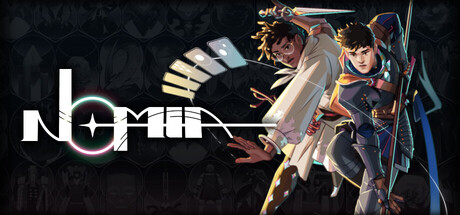

NOMIA on Mac: a tactics roguelike with two faces
In NOMIA, your world is split between the present and the Dream: a realm “anchored” by a Tower, where forgotten sorrows gather and the past must be fought to protect the now. On the surface, society has supposedly moved beyond scarcity and war. Underneath, something is rotting at the foundation, a hero has vanished, and the people left behind are running out of time.
That premise sets the tone for a story-rich tactics roguelike that leans just as hard into its narrative mystery as it does into sharp, readable combat. You’ll guide two heroes—a warrior and a wizard—through expeditions into the Dream, building their capabilities run by run and uncovering the truth behind the crisis threatening home.
Core gameplay: grid tactics meets deckbuilding
NOMIA’s battles play out on a grid, but it’s not simply about trading hits. The game pushes you to think in terms of space, terrain, and sequencing. Repositioning matters, knockback matters, and the environment can be just as deadly as raw damage if you line things up correctly.
Where it gets especially interesting is how NOMIA marries tactics movement with card play. Instead of a single unified hand, NOMIA’s system is built around the idea that your hand has two halves, each supporting a different kind of decision-making.
Your hand has two halves: Actions and Gambits
NOMIA divides what you can do into:
- Actions: persistent tools that remain available between turns, balanced by charges and cooldowns.
- Gambits: cards drawn from your deck each turn that are discarded when played.
This creates a satisfying rhythm. Your Actions give you a dependable backbone for setup—movement control, repeatable utility, or key defensive options. Meanwhile, Gambits are where you find your explosive turns: the perfect draw that converts a careful setup into a decisive swing.
The result is combat that rewards both planning (setting up turns in advance with persistent tools) and adaptation (pivoting when your Gambits present a new opportunity).
Two-hero party design: a warrior and a wizard that truly co-op
NOMIA is built around coordinating two distinct heroes in the same fight. Their asymmetry is clear:
- The Mighty has more Actions, leaning into reliable, repeatable plays.
- The Magical has more Gambits, leaning into draw-driven spikes and flexible turn-to-turn tactics.
Each hero has a large personal card pool (with decks described as expressing their personality and fighting style), and both can tap into a broader set of upgrade-like options called Memories, including unique and shared choices designed to create synergies. The emphasis isn’t just on building two separate characters—it’s on building the connection between them, enabling combo lines where one hero’s positioning or pressure sets up the other’s payoff.
Between expeditions, you’ll also see the characters’ bonds strengthen and witness story moments, reinforcing the game’s focus on narrative progression alongside roguelike replayability.
Readable enemies, clever counterplay
If you enjoy tactical games where you can make informed decisions rather than guess, NOMIA is explicit about enemy behavior. Enemy intents and incoming damage are shown before you commit any movement, letting you plan defenses and counterplays with confidence.
This design supports a more “chess-like” feel to each encounter. You can:
- Move precisely to deny an enemy’s best line.
- Defend efficiently when you know exactly what’s coming.
- Protect one hero by pulling enemy attention with an attack.
- Turn positioning into offense—sometimes the correct play is simply knocking a foe into a pit.
Because information is clear, the tension comes from optimization: sequencing your persistent Actions, choosing when to spend cooldowns, and using the right Gambits at the right time.
A winding path through five realms
Runs take you through five distinct realms, each with its own monsters, items, and terrain to learn. Expect the kind of roguelike variety that forces you to keep adjusting: mechanically different enemies, new environmental considerations, and bosses that test whether your build is cohesive or merely powerful on paper.
Across these expeditions, NOMIA’s central mystery stays in focus: a disappearance, a “stone-eating” scourge, and a society that can’t maintain its utopian promise much longer. The Dream isn’t just a dungeon—it’s a narrative engine, feeding you revelations as you push further.
What NOMIA feels like at its best
NOMIA shines when all its pillars meet in a single turn: you read a telegraphed enemy strike, reposition to bait it, chain an Action that sets spacing, then drop a perfectly drawn Gambit that converts the setup into a swingy combo—maybe finishing with a knockback that removes a threat without ever needing to out-stat it.
It’s a game for players who like:
- Turn-based tactics with positioning that matters.
- Deckbuilding that creates identity and combo routes, not just raw numbers.
- Roguelike structure with story and character relationships threaded through the loop.
- Transparent combat info that rewards planning and clean execution.
Mac system requirements
Minimum (Mac):
- OS: Big Sur 11 or newer
- Processor: Apple Silicon, x64 architecture with SSE2
- Memory: 1 GB RAM
- Graphics: Metal capable Intel and AMD GPUs
- Storage: 2 GB available space
Bottom line
NOMIA’s hook is simple to describe but rare to nail: a two-hero tactics roguelike where your turn is driven by a clever split between persistent Actions and deck-drawn Gambits. Add in readable enemy intents, environmental kills, and a story about a fractured utopia and a predatory Dream, and you’ve got a Mac-friendly strategy game that aims for both tactical clarity and narrative weight.

Comments
Sign in to join the conversation.
Log in to commentNo comments yet. Be the first to join the conversation.