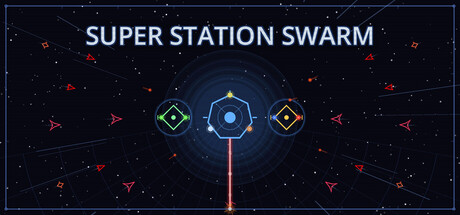

Super Station Swarm is what happens when you take the readability and swagger of classic vector-arcade shooters and push it into modern, system-driven chaos. There are no sprites here—just raw geometry: enemies traced in hard lines, bullets drawn as clean vectors, shield arcs and explosions rendered like an oscilloscope having a great (violent) day.
The premise is simple and immediately legible: defend a space station against infinite waves. Your turrets will fire on their own. Your satellites will orbit and contribute damage and utility. And everything that slips through the cracks—positioning, target priority, mid-wave adjustments, and build direction—lands on you.
Vector Carnage That Gets Hectic Fast
The first thing you notice is clarity. Even as the screen fills with threats, Super Station Swarm leans on its vector presentation to keep shapes distinct and motion readable. The second thing you notice is that the game wastes no time turning that clarity into pressure. Runs tend to land in the 10–20 minute range, there’s no “ending” to reach, and the wave counter keeps climbing until your station finally can’t.
It’s survival scoring, not campaign progression—designed for repeated attempts, fast learning, and constant “just one more run” energy.
The Auto-Aim Is Good, but It’s Not Good Enough
Super Station Swarm understands that modern arcade survival lives or dies on flow. So yes—your weapons generally select the nearest target and fire. That keeps the baseline action moving and lets you focus on higher-level decisions.
But the game also makes sure auto-aim can’t carry you forever:
Fast flyers can orbit your station and slip past simplistic targeting, especially when leading becomes important.
Tanks can drift into coverage gaps where satellites aren’t positioned well.
Elite/armored threats can soak fire while smaller enemies seed the arena with hazards (like mines) behind them.
Weapon behavior matters. Missiles and lasers track targets. Cannons are different: you rotate the entire station to aim them, and you can toggle cannon aim modes between assisted, auto, and fully manual lead. That single system creates real skill expression—knowing when to let the game clean up fodder, and when to take over because the “nearest target” is absolutely not the priority.
Upgrade Cards: Powerful Choices With Real Tradeoffs
Progression during a run is handled through a clean card system: level up, choose 1 of 3 upgrade cards. The hook is that cards often apply to specific weapon mounts rather than your entire loadout. Buffing damage on your flak cannon doesn’t magically improve the launcher mounted next to it. You’re not just building “a ship,” you’re building a set of individual tools that must work together under stress.
It gets more interesting once a satellite’s weapon slots fill up. At that point, strong new weapon offers can become replacement offers. That shiny railgun might be real—but it may require you to sacrifice a weapon you’ve already invested in. With 17 upgrade types across 9 weapon classes, the game constantly asks you to commit: double down on what’s working, pivot into a new plan, or accept a swap that changes your entire defensive geometry.
There’s also a “pity timer” style system to ensure appealing options show up—so the tension isn’t whether the game will offer something good, but whether you can actually afford the opportunity cost.
Meta-Progression Where Dying Still Pays—With a Catch
Super Station Swarm is built around repeat attempts. Every kill across every run feeds a shared XP pool that unlocks permanent upgrades: starting weapons, extra satellites, more shields, thicker hull, stronger bombs, and more. The skill tree has prerequisites and branching paths—push hull upgrades to unlock repair swarms, invest in satellites to reach satellite shields, and so on.
But it’s not a mindless power climb. Every permanent upgrade you buy adds 3% to enemy wave budgets, meaning the game scales to your long-term investment. You get stronger—and the swarm gets richer. A fully equipped station can feel unstoppable right up until a later wave arrives with a threat budget calibrated to your new baseline.
The Real Joy: Picking a Lane and Owning It
The best arcade survival games create build identity, and Super Station Swarm leans into that. You can:
Go tall: stack damage and fire rate on one satellite weapon until it does the work of three.
Go wide: maximize satellites, layer shields, and build a rotating perimeter of coverage.
Go panic-button: invest heavily in bombs and use them to reset the screen when density turns unfair.
Go combo hunting: chase the streak system and let momentum become a weapon.
That combo lane is especially spicy. At 40 consecutive kills you can trigger a high tier that ramps the spectacle and the power: a 4x score multiplier, boosted fire rate across all weapons, screen-clearing shockwaves, and phantom echo targets that help keep your streak alive between waves. The flip side is brutal: miss the kill window and the whole structure collapses back to zero. It’s a risk-forward playstyle that rewards aggression and fast threat evaluation.
Filters, Difficulty, and the “One More Run” Lifestyle
Presentation customization is refreshingly simple: cosmetic filters that change the vibe without changing the mechanics. Choose a CRT look with scanlines and chromatic aberration, an 8-bit green palette, a reduced-color “Retro” mode, or keep it crisp and clean with pure vector visuals.
On the challenge side, you’ve got three difficulty tiers with separate local leaderboards. Hard mode is described as genuinely hostile, featuring increased elite spawns, frequent bosses, and tougher scaling—perfect for players who want the game to stop being polite and start being a problem.
The result is a compact, repeatable arcade loop: short runs, meaningful build decisions, meta-progression that respects your time, and difficulty that can be tuned from “lunch break run” to “I will not be humbled by triangles today.”
Mac System Requirements
Minimum
OS: macOS 12 (Monterey)
Processor: Apple M1 or Intel Core i3
Memory: 4 GB RAM
Graphics: Integrated
Storage: 200 MB available space
Recommended
OS: macOS 13 (Ventura) or later
Processor: Apple M1 or later
Memory: 8 GB RAM
Graphics: Integrated
Storage: 200 MB available space
Verdict
Super Station Swarm is a focused, high-clarity bullet-hell survival game that gets its hooks in through smart automation, meaningful manual overrides, and upgrades that force you to commit. If you miss the Geometry Wars era of pure vector intensity—but you also want modern roguelite decision-making and persistent progression—this is the kind of swarm that’s worth stepping into.




Comments
Sign in to join the conversation.
Log in to commentNo comments yet. Be the first to join the conversation.