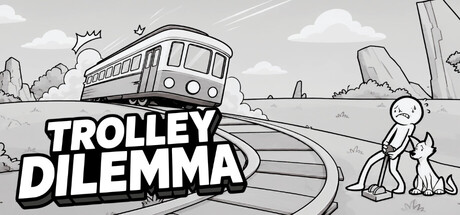

Trolley Dilemma takes the familiar philosophical “trolley problem” and stretches it into a full narrative experience: a relentless forward motion where you rarely get the luxury of perfect information, and where each decision echoes beyond the immediate outcome. You’ll face escalating, often uncomfortable trade-offs, meet an eccentric cast of characters, and discover that the real question isn’t just who survives—it’s what your choices turn you into.
What kind of game is Trolley Dilemma?
At its core, Trolley Dilemma is a choice-driven narrative game built around branching consequences. The game frames your decisions as literal and metaphorical “switches,” pushing you into situations where you must decide who to trust, who to protect, and when (or if) ends justify means. It’s less about finding a “correct” answer and more about living with outcomes in a world that remembers.
A cast designed to test you
One of the game’s biggest hooks is its roster of 30+ side characters—people you can save, sacrifice, recruit, lose, or regret. Some are fleeting encounters that exist to probe your values under pressure; others can reappear later, either as allies who change your odds or as living reminders of earlier calls you made in haste.
The result is a constant tension between:
- Immediate survival (what happens right now if you pull the lever?)
- Long-term fallout (who remembers, who returns, and what they demand)
- Self-image (what story are you telling yourself about why you did it?)
Conflict that shifts with your alliances
Trolley Dilemma doesn’t treat encounters as static puzzles. The game emphasizes that each fight or challenge can change depending on who stands with you and who stands against you. This makes your relationships feel mechanical as well as narrative: saving someone might later open a new option, change the difficulty of a confrontation, or reshape the entire context of a decision.
In practical terms, your earlier moral choices can function like a build—except instead of stats, you’re investing in people, factions, and reputations.
Multiple paths, no “right” playthrough
Rather than nudging you toward a single heroic route, Trolley Dilemma leans into roleplaying through consequence. The game invites you to side with different power centers and ideologies, including:
- Outlaws, who may offer freedom, shortcuts, and risky loyalty
- Scientists, who may promise solutions with a price attached
- Your conscience, if you try to minimize harm even when it costs you
- Power, if you decide outcomes matter more than methods
Because the trolley “keeps moving,” the game’s most effective moments come when it forces you to commit—often before you’re ready. That forward momentum makes replaying especially appealing: a second run isn’t just about different dialogue, but about testing whether you can actually live by a different code when the pressure hits.
Mac performance and system requirements
Trolley Dilemma’s listed requirements are friendly for modern Macs, including Apple Silicon. Here’s what you’ll want to know before you download:
Minimum (Mac)
- OS: macOS 12 Monterey or later
- Processor: Apple M1 or Intel Core i3 or equivalent
- Memory: 4 GB RAM
- Graphics: Metal compatible graphics card
- Storage: 800 MB available space
- Sound Card: Any
Recommended (Mac)
- OS: macOS 13 Ventura or later
- Processor: Apple M1 or Intel Core i5 or equivalent
- Memory: 8 GB RAM
- Graphics: Metal compatible graphics card
- Storage: 800 MB available space
- Sound Card: Any
Why Mac gamers should keep an eye on it
If you enjoy narrative-heavy games where choices don’t just alter dialogue but reshape future challenges, Trolley Dilemma aims directly at that sweet spot. Its focus on consequence-driven relationships, a large pool of side characters, and branching moral routes makes it a strong fit for players who like replaying to explore alternate outcomes—or to see whether they can do better the second time.
Note: Trailer music is credited as “Hall of the Mountain King” by Kevin MacLeod, licensed under CC BY 4.0.


Comments
Sign in to join the conversation.
Log in to commentNo comments yet. Be the first to join the conversation.