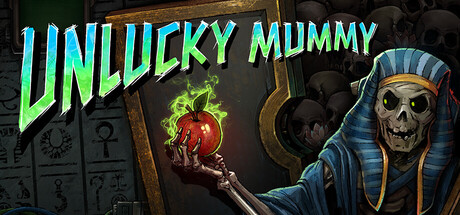

Unlucky Mummy is a game built around a single, nerve-wracking decision: open the sarcophagus again, or stop while you’re ahead. It wraps that choice in a clever theme—Ancient Egyptian relics filtered through the language of quantum mechanics—then asks you to stare down one of the harshest risk/reward loops you’ll see in a small indie game.
Premise: superposition, but make it cruel
In front of you sits a sarcophagus containing a mummy and 12 relics of the ancient gods. In the game’s fiction, the mummy (and the relics) exist in a kind of superposition: they both exist and don’t exist as long as the sarcophagus remains closed. The moment you open it, the universe “decides” what you get.
The core rule: 25% progress, 75% wipe
Every time you open the sarcophagus, one of two outcomes occurs:
- 25% chance: you find a new relic (progress).
- 75% chance: the sarcophagus is empty, and all relics you’ve found so far disappear (reset).
That means the game’s headline challenge—finding all 12 relics in a row without getting wiped—has odds of 1 in 16,777,216 under the base rules. The design is intentionally stark: there’s no elaborate combat system to master or puzzle to solve. The drama comes from pure escalation—each successful relic makes the next click feel more valuable, and therefore more terrifying.
Why it works: tension you can feel in a single button press
Unlucky Mummy’s loop is simple, but the psychology is sharp:
- Greed vs. safety: every win raises the emotional cost of the next loss.
- Runs are short, consequences are huge: progress can happen quickly, but so can disaster.
- The “just one more” effect: the game thrives on the player’s belief that the next open will be the lucky one.
If you enjoy games where the primary opponent is your own risk tolerance (and your ability to keep going after a brutal reset), this is exactly that—distilled.
Upgrades: bending probability (a little) in your favor
Unlucky Mummy isn’t only a coin-flip simulator—there’s a progression layer designed to reward persistence. Each time you successfully discover a relic, you earn golden scarabs. These can be spent on upgrades such as:
- Increased chance of success (your most important lever against the 75% wipe rate).
- Faster sarcophagus opening (less downtime between attempts).
- Increased base reward from relics (accelerates future progression).
In practice, upgrades give the game a longer arc than the raw odds suggest. Even when a run implodes, you’re not only walking away with frustration—you’re often walking away with enough meta-progression to feel like the next attempt is meaningfully improved.
Six endings and permanent Glyphs
The game features 6 unique endings, each peeling back more of the story. Importantly, each ending rewards you with a powerful Glyph that permanently alters future playthroughs. This is the hook that turns an apparently impossible challenge into a longer-term climb: you’re not just hoping for a miracle; you’re building a run structure where miracles become less absurd over time.
How it feels on Mac
Because the gameplay is fundamentally focused on quick interaction loops, Unlucky Mummy is a natural fit for Mac players who like:
- Low-commitment sessions (play a few attempts, step away, return later).
- Roguelike-style resets without sprawling systems.
- Probability and meta-progression more than reflex-heavy mechanics.
It’s also the kind of game that’s easy to run alongside other things—great for a second-screen vibe—while still delivering occasional spikes of genuine, palms-sweaty tension when you’re deep into a streak.
Mac system requirements
Minimum:
- OS: macOS Ventura or later
- Processor: M1 or Intel equivalent
- Memory: 4 GB RAM
- Graphics: M1 or Intel equivalent
- Storage: 600 MB available space
Who should play Unlucky Mummy?
- Play it if: you like high-stakes RNG, incremental upgrades, and games that test persistence more than precision.
- Skip it if: losing accumulated progress feels unacceptable, or you want your success to be primarily skill-driven rather than probability-and-planning-driven.
Unlucky Mummy is, as advertised, a test of luck and perseverance. You might find the 12 relics in minutes, or you might never see a clean streak—because the sarcophagus answers only to randomness. The question is whether you can keep opening it anyway.



Comments
Sign in to join the conversation.
Log in to commentNo comments yet. Be the first to join the conversation.