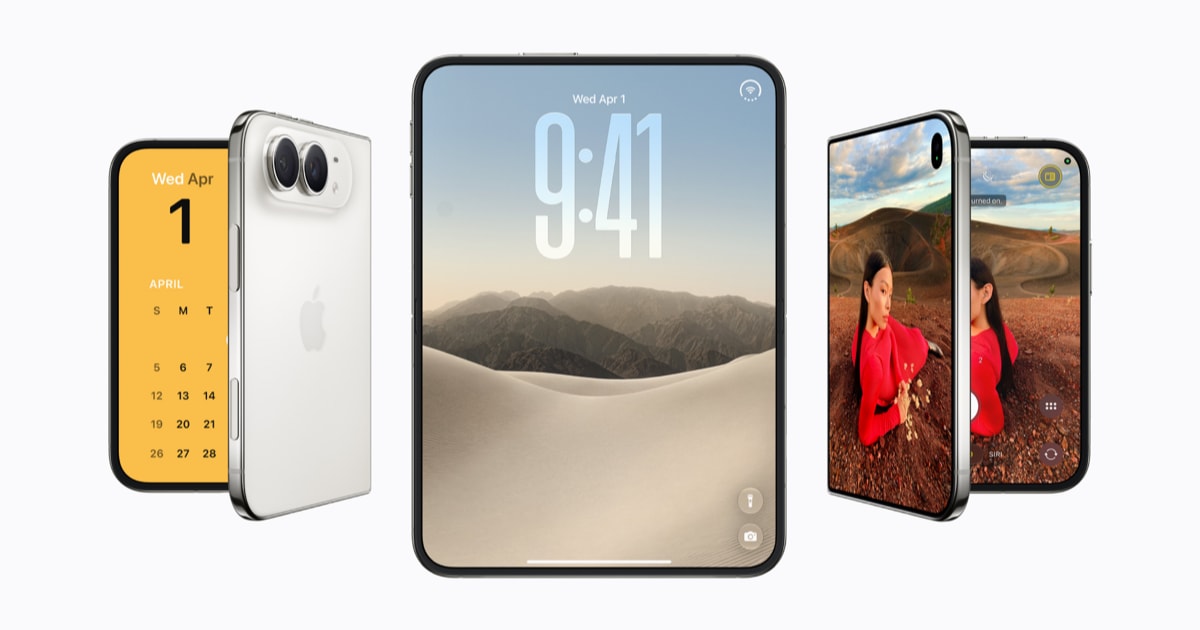

Apple’s foldable iPhone is here (and it’s an ecosystem story, not just a phone story)
Apple has officially announced iPhone Duo, its first foldable iPhone, with pre-orders starting Friday, October 16 at 5 a.m. PT via apple.com and the Apple Store app. The headline feature is straightforward: a foldable design that aims to deliver Apple’s largest iPhone display ever when opened, while still offering a compact outer screen when closed.
From a MacGaming.com perspective, this isn’t a “new AAA game launches on iPhone Duo” kind of announcement. But it is a meaningful signal about where Apple’s platforms are heading—especially around large-format iPhone UI, multitasking expectations, performance targets, and the developer assumptions that tend to flow from iPhone into iPad and, increasingly, the Mac ecosystem.
Display + form factor: a bigger canvas that nudges UI expectations
According to Apple, iPhone Duo’s inner display is 50% larger than iPhone 18 Pro Max, positioning it as a much bigger canvas for “viewing content, gaming, and multitasking.” Closed, Apple says the 5.4-inch outer display delivers 90% of the screen area of iPhone 18 Pro—so the device is meant to stay usable without constantly unfolding.
Why this matters to platform and game developers: foldables are less about raw resolution and more about state changes. Any app that has distinct “phone mode” and “mini-tablet mode” layouts needs to be robust across aspect ratios, UI density changes, and rapid transitions between sizes. That work is very likely to reinforce Apple’s broader push toward responsive layouts, scalable HUDs, and input/interaction patterns that survive rotation, resizing, and multitasking.
A20 Pro and battery: performance headroom is the point
Apple says iPhone Duo is powered by A20 Pro and uses a dual-battery architecture for all-day battery life. While Apple didn’t position this as a gaming silicon reveal, this matters for the ecosystem in a familiar way: iPhone performance targets often become the baseline for cross-platform planning, especially for studios shipping on iPhone/iPad with an eye toward scaling on Apple Silicon Macs.
For developers, “more headroom” typically translates to one of two strategies: push higher fidelity within the same frame-time budget, or keep visuals similar and reduce power draw/heat for steadier sustained performance. Neither outcome is guaranteed by a spec sheet, but A-series capability and thermal behavior have an outsized impact on what mobile engines consider “normal” a year or two later.
iOS 27 “reimagined”: the software angle is the bigger story
Apple frames iOS 27 as “reimagined” for Duo—remaining familiar while adapting to more versatile interaction modes. That phrase is doing a lot of work, and it’s the part Mac and ecosystem readers should watch most closely. Foldables push OS-level requirements: windowing behaviors, continuity of app state across size changes, gesture consistency, and the way apps cooperate with multitasking.
Even if Duo-specific APIs or behaviors start on iPhone, Apple historically spreads successful interaction patterns across the product line. If iOS 27 introduces new expectations for adaptive UI or multitasking, it’s a safe bet developers will feel that pressure across iPadOS and—indirectly—macOS workflows when building shared codebases and shared asset pipelines.
Siri AI and Apple Intelligence: capability vs. constraints
Apple also highlights “Siri AI,” powered by Apple Intelligence, describing it as an intelligent personal hub built around privacy and security. For creators and developers, the key questions are less about marketing language and more about boundaries: what models run on-device, what capabilities require network access, and what tooling Apple exposes for third-party integration.
We’re not going to pretend this is an immediate gameplay revolution. But as more Apple devices lean into Apple Intelligence-era features, developers will face new design considerations—how users expect system-level assistance to work, how content creation flows change, and what “smart” UX patterns become normal across iPhone, iPad, and Mac.
Pre-orders, buying options, and trade-in details
Apple says iPhone Duo pre-orders begin October 16 at 5 a.m. PT, with customers able to shop online or in-store and connect with Apple Specialists for setup advice and purchasing options. Apple is also emphasizing leasing/financing, carrier deals, and Apple Trade In. In the announcement, Apple states trade-in credits range from $175 to $885 for eligible iPhone 13 or newer devices (credit applied toward monthly payments depending on the chosen program).
Source and what to read next
This news comes via Apple Newsroom, published October 15, 2026. Apple’s post focuses on iPhone Duo’s foldable design, A20 Pro performance, iOS 27 changes tailored for the new form factor, and purchasing/trade-in options.
To see Apple’s full announcement and the exact wording around displays, iOS 27, and pre-order timing, read the original source here: https://www.apple.com/newsroom/2026/10/open-up-to-new-possibilities-with-iphone-duo/


Comments
Sign in to join the conversation.
Log in to commentNo comments yet. Be the first to join the conversation.