
Foldable iPhone, familiar Apple playbook: bigger screens, better APIs, clearer merchandising
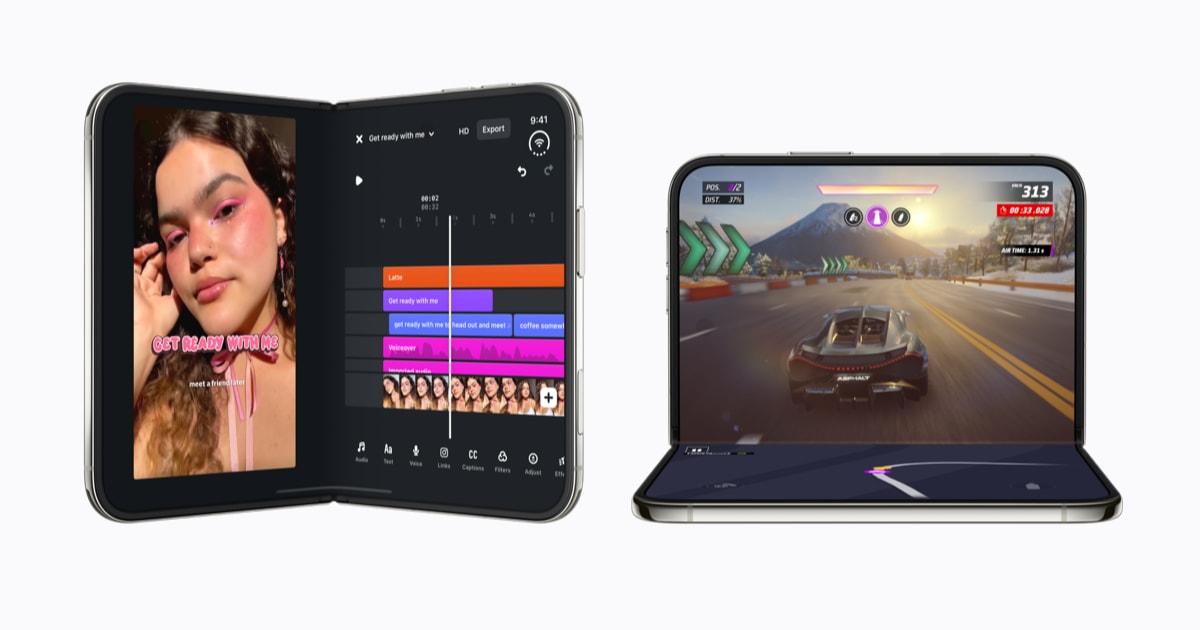
Apple has published a new Newsroom feature highlighting early developer support for iPhone Duo, the company’s first foldable iPhone. The headline is broadly about “new app experiences,” but for platform watchers (and anyone invested in Apple Silicon gaming), the interesting bits are the signals: how Apple wants apps to scale across form factors, how it plans to surface optimized titles on the App Store, and which device capabilities it’s choosing to emphasize from day one.
According to Apple, iPhone Duo’s inner display is 50% larger than iPhone 18 Pro Max, and both the outer and inner displays share the same aspect ratio. Apple says this helps apps transition smoothly from outer to inner screen and “scale proportionally,” letting users continue exactly where they left off.
That may sound like generic UX talk, but it’s crucial for games and game-adjacent apps: predictable scaling and consistent aspect ratios reduce the edge cases that can break HUD layouts, touch targets, and camera framing when moving between displays.
Split View on iPhone Duo: multitasking comes to the phone tier
Apple also calls out new iPhone capabilities — including Split View — alongside the “breakthrough performance” of A20 Pro. While Apple’s story isn’t framed as a gaming technical brief, Split View is the sort of feature that changes how users expect software to behave on a pocket device with tablet-like screen real estate.
For gaming, that doesn’t automatically mean “play in one pane, Discord in the other” (Apple doesn’t claim that here), but it does suggest a stronger push toward multiwindow-aware UI, more robust background activity handling, and more iPad-like interaction patterns on iPhone-class hardware. Those same expectations often carry over to iPadOS and, increasingly, to macOS design decisions when Apple wants a cohesive ecosystem story.
App Store discoverability: “Made for iPhone Duo” badge and curated collections
From an ecosystem perspective, the merchandising strategy is the loudest part of the announcement. Apple says new editorial collections for iPhone Duo apps and games will go live on the App Store this Friday, and that Duo-optimized apps will be easy to spot thanks to a “Made for iPhone Duo” badge on product pages.
For developers — including studios shipping premium mobile titles — this is a practical incentive: if Apple is going to run dedicated collections and provide storefront badging, there’s a tangible marketing upside to doing the work required to support foldable layouts, new multitasking modes, and whatever input/pose behaviors Duo enables.
And for players, it should reduce the usual early-adopter friction: fewer “works, but feels weird” installs and more software that’s been intentionally tuned for the new form factor.
What Mac and Apple Silicon readers should take away
This is iPhone-first news, but it matters to the broader Apple gaming conversation in three ways:
First, Apple continues to grow device classes without abandoning UI continuity. The same-aspect-ratio message reads like a developer-friendly move to reduce fragmentation — which is exactly what you want if you’re trying to ship across iPhone, iPad, and potentially bring experiences to Mac where it makes sense.
Second, Apple is leaning on performance plus platform features (A20 Pro + Split View) rather than one-off gimmicks. That’s consistent with Apple Silicon’s broader pitch: power headroom paired with OS-level capabilities that developers can adopt over time.
Third, Apple is again using editorial and badges to steer developer behavior. For games, visibility is often as important as raw hardware capability, and Apple clearly wants Duo-optimized titles to be discoverable fast.
Entertainment example: Netflix highlights outer-to-inner continuity
Apple’s story includes Netflix as an example of Duo-aware design: browsing “Clips” on the outer display, then opening the device to continue on the larger inner display with seamless switching between vertical and horizontal views. While Netflix isn’t a gaming case study, it’s a good illustration of the kind of state continuity and layout responsiveness that games also need to feel native on foldables.
Source and where to read more
Source: Apple Newsroom (published October 22, 2026).
Apple’s full post includes additional context about Duo’s displays, App Store collections, and early partner quotes. You can read it here: https://www.apple.com/newsroom/2026/10/developers-bring-incredible-new-app-experiences-to-iphone-duo/





Comments
Sign in to join the conversation.
Log in to commentNo comments yet. Be the first to join the conversation.