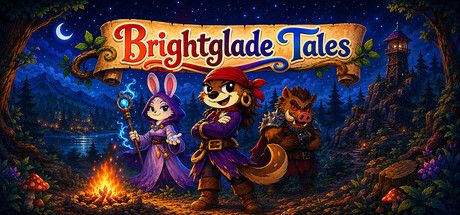

BrightGlade Tales is a fast-paced, two-player card game focused on a single idea: conflict is more interesting when both players can directly interfere with each other’s engine. Matches are designed to be short and sharp (roughly 15–30 minutes), and the winning line is rarely a peaceful optimization puzzle. Instead, you’re constantly weighing whether to improve your own position or use the next play to steal, bribe, or demolish something your opponent was counting on.
What BrightGlade Tales Is
Set in the land of Brightglade, each match plays like a self-contained skirmish for influence. You assemble a crew, pursue missions, and fight over three locations drawn from the deck and laid out on the table. The key hook is that the game expects interaction: your opponent isn’t an obstacle on the side of the board—they are the board.
The Win Condition: Seize a Location
At the center of every game are three contested locations. To win, you must be the first player to seize control of one location. Doing that requires two things:
- Dominance Points (your core scoring pressure)
- A crew with the right composition to actually take and hold what you’re contesting
It’s a simple goal with a nasty twist: your opponent has access to the same categories of tools you do, and many critical choices are constrained by a shared market. If you see a perfect resource or crew card appear, so do they—and the decision of whether to grab it now or gamble on something better can shape the entire tempo of the match.
Core Cards and the Gameplay Loop
BrightGlade Tales revolves around three main card types that form the rhythm of each turn:
- Resources — acquired from the market and spent to fuel your actions
- Crew — recruited to execute plans and meet the requirements to seize locations
- Missions — the main source of Dominance Points and disruptive effects
In practice, the game becomes a sequence of tactical pivots: draft what you need, deploy crew efficiently, then time missions to either convert your position into Dominance or tear down whatever advantage your opponent just built.
Missions: Where the Game Gets Personal
Missions are the game’s pressure valves and its story engine. They don’t just help you score—they enable the kind of direct interference that defines BrightGlade Tales. Depending on what you draw and how you sequence your plays, missions can let you:
- Steal and destroy your opponent’s resources
- Intimidate, eliminate, bribe, and take over their crew
- Train new recruits and recover members from discarded cards
- Sacrifice your own crew for additional Dominance Points
- Destroy the very locations you’re both contesting
That last option is especially spicy in close games. If a location is about to slip out of your hands, the ability to remove it entirely can function like a reset button—at a cost. BrightGlade Tales often rewards the player who can recognize when to abandon a “fair” plan and make a move that changes the entire shape of the board.
No Script, Just Consequences
BrightGlade Tales positions itself as a game where the narrative emerges from play rather than cutscenes. Each match becomes its own little tale of opportunism: the recruit you bought purely to meet a requirement, the mission you held back for the perfect moment, the resource theft that left your opponent one step short of a decisive turn.
If you enjoy games where the most memorable moments come from reading your opponent—predicting what they need next, denying it, and then capitalizing immediately—this is the kind of design that can produce stories naturally, round after round.
Game Modes
- Local play against AI — for learning matchups, testing lines, and practicing timing
- Online PvP multiplayer — the main event, where mind games and adaptation matter most
Who It’s For (and Who It Isn’t)
BrightGlade Tales is a good fit for Mac players who want:
- Short, repeatable competitive matches (15–30 minutes)
- High interaction and direct disruption
- A shared market that forces meaningful draft tension
If you prefer solitaire-style deckbuilding where opponents mostly race in parallel, BrightGlade Tales may feel harsher than expected. Here, getting hit is part of the plan—and learning when to hit back (or when to pivot) is a core skill.
Mac System Requirements
Minimum:
- OS: macOS 12
- Processor: i5
- Memory: 4 GB RAM
- Graphics: Intel HD Graphics 6000
- Storage: 2 GB available space
Bottom Line
BrightGlade Tales delivers a compact competitive card experience where victory comes from more than efficient building—it comes from timing, denial, and the willingness to play dirty when the board demands it. If you’re looking for a Mac-friendly PvP card game that embraces sabotage as a first-class mechanic, BrightGlade Tales is built to create those “you did what?” moments that keep a rivalry going.





Comments
Sign in to join the conversation.
Log in to commentNo comments yet. Be the first to join the conversation.