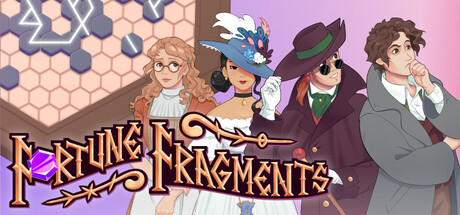

Fortune Fragments is a story-forward puzzle game that asks a deceptively big question: what does it mean to “help” someone when you can see the road ahead? Set in the modern-fantasy city of Clearcastle, you play as a newly opened Foreteller—a shopkeeper of prophecy who reads customers’ souls, assembles fate through rune magic, and makes the kind of decisions that quietly (or loudly) change lives.
On Mac, it’s a great fit for players who like their narrative choices served with a side of spatial reasoning. The conversations are personal and character-driven, but the game continually pulls you back to the board—where your power to forecast the future is expressed as satisfying, sometimes brutal, hex-tile puzzles.
Premise: A Foreteller’s Shop in a City Full of Secrets
Clearcastle is bustling, contemporary, and just magical enough that a storefront prophecy business feels plausible. People come to you burdened with doubts, conflicts, and half-spoken fears. Your job isn’t merely to listen—it’s to guide. You’ll decide whether to console someone or confront them, whether to encourage a dream or confirm a nightmare, and those choices don’t sit in a vacuum. Branching storylines mean your reads and recommendations ripple outward, shaping how clients act and what they become.
The game’s framing does a good job of making “a day at the shop” feel like an ongoing relationship with the city rather than a sequence of isolated appointments. As you dig deeper, the personal dramas start to link up with larger mysteries, and Clearcastle begins to feel like it’s keeping its own counsel.
Core Gameplay: Hex-Tile Rune Building That Actually Feels Like Magic
Fortune Fragments’ standout hook is its rune-building puzzle system. You place fragments on a hex grid to form runes that channel your foresight. Each board presents constraints—limited turns, limited redraws, and puzzle-specific goals—so “just experimenting” quickly turns into “experimenting with a plan.”
- Spatial, brain-twisting challenges: You’ll be thinking in rotations, adjacency, and efficient coverage rather than simple match-3 patterning.
- Goal-driven boards: Some puzzles focus on gathering energy from board aspects; others ask you to reveal what’s hidden in darkness or navigate obstacles formed by a client’s soul.
- Learning through iteration: Certain sides of the board aren’t obvious at first glance, encouraging smart retries as you understand how the board reacts to your actions.
Progress isn’t only narrative. As you practice your craft, you unlock new fragments and more powerful runes, expanding the tactical possibilities and keeping later puzzles from feeling like repeats. It’s the kind of system where a small new rule can make you reevaluate everything you thought you knew about placement and tempo.
Choices With Teeth: Who Are You to Your Clients?
Many choice-based games ask you to pick a “nice” option or a “mean” option. Fortune Fragments positions your decisions more like interpretations—what you believe a person needs, what you’re willing to risk, and how honest (or manipulative) you choose to be. That tone pairs well with the fortune-telling premise: you’re not just selecting dialogue, you’re setting someone on a track.
If you enjoy narrative games where roleplaying is less about being a hero and more about being a professional with power—limited by ethics, intuition, and consequences—this one is built for that headspace.
The Citizens of Clearcastle: A Cast Built for Ongoing Drama
Clearcastle’s clients aren’t throwaway quest dispensers. The game introduces a sizable cast with distinct voices and problems that feel grounded even when the setting turns mystical. A few you’ll meet:
- Agatha: Your cheery landlady and local gossip network, helping you settle in—and likely knowing more than she lets on.
- Basil: Eccentric, bright, and naïve in an endearing way; the sort of person whose good intentions can still cause chaos.
- Leo: A distressed stranger who draws you in. Trust is optional—and the game treats that choice seriously.
- Crow: A character introduction that is, on its face, pure comedy—yet feels like the kind of “joke” that might circle back later.
- Matheus: Rugged and kind, struggling at work and needing a push—though the direction of that push is up to you.
- Catherine: On hard times and difficult to read; her honesty (and your response to it) becomes part of the tension.
- Julian: A romantic tangled in his own hangups, offering lighter moments that still connect to real stakes.
- Amelia: Shy, kind, and being pulled in multiple directions—an ideal setup for branching guidance.
- Carmen: Nobility with ambition, asking favors and testing how you handle power dynamics.
The best part is how these character threads can serve double duty: intimate story beats on the surface, and puzzle motivation underneath. When a board is framed as someone’s soul—its obstructions, its hidden corners, its limited “moves”—solving it feels like more than abstract logic.
How It Feels on Mac
Fortune Fragments is the kind of game that suits Mac play sessions well: read a few clients, tackle a handful of puzzles, then come back later with fresh eyes. The hex-grid challenges reward careful thinking, while the visual-novel structure keeps progression clear and welcoming even when the puzzles start to bite back.
Mac System Requirements
Minimum:
- OS: Mojave 10.14+ or Big Sur 11.0
- Processor: Apple M1
- Graphics: Apple M1
Who It’s For
- Fans of visual novels who want gameplay that’s more involved than clicking through dialogue.
- Puzzle players who like spatial reasoning, experimentation, and optimizing under constraints.
- Anyone who enjoys choice-driven stories where “helping” can mean multiple, morally messy things.
If you’re looking for a Mac game where your brain gets worked in two different ways—empathy in conversation, precision on the hex board—Fortune Fragments is shaping up as a compelling read.


Comments
Sign in to join the conversation.
Log in to commentNo comments yet. Be the first to join the conversation.