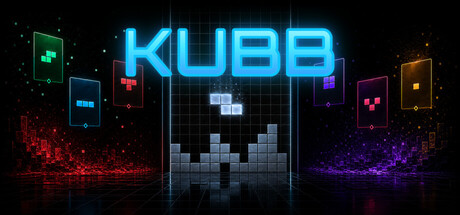

KUBB is a roguelike block-stacking game built around a simple idea: start with recognizable shapes and familiar expectations, then steadily introduce new systems that change what “good play” even means. On Mac, it lands as a compact, run-based puzzle game that mixes the spatial pressure of stacking with the forward-planning of deckbuilding—and the chaos of a world that doesn’t wait for your strategy to catch up.
The hook is right there in its tagline: Stack blocks. Build a deck. Bend the rules. You’re not just trying to keep your board clean; you’re constructing a build. And as your build grows, the game increasingly “talks back” through modifiers, disasters, and dimensional detours that can turn a comfortable run into a tense improvisation.
Gameplay: Familiar stacking, run-based escalation
At the start, KUBB feels comfortingly readable: place pieces, manage space, clear lines. But it quickly becomes about shaping your run’s identity. Each decision you make—what to take, what to risk, what to protect—echoes across the next levels. The result is a puzzle game where tactics matter in the moment, but long-term planning matters across the run.
Your deck, your strategy
Every few levels, you’ll choose a new card, and that choice is the core of KUBB’s roguelike structure. Cards can introduce destructive effects that shatter portions of the board, defensive tools that protect your position, or odd rule-changers that force you to rethink how you value space. Your “deck” becomes a personalized toolbox: it can encourage aggressive clears, careful survival, or score-focused play that rewards keeping certain relics alive.
The game also makes it clear that the run has a mind of its own. Randomness isn’t just in the pieces—you’re reacting to the way your tools combine, when the game offers certain options, and how well your chosen kit handles the unexpected.
Disasters don’t ask permission
KUBB’s pressure system comes in the form of disasters: intrusive conditions that appear mid-run and stick around until you address them. One moment you’re cruising through clean clears; the next, you’re dealing with a snowstorm that buries columns, a parasite that eats away at your best card, or a speed-up that raises the execution demand immediately.
Importantly, disasters aren’t merely “gotcha” moments—they’re sustained constraints. Some can be cured, others must be endured, and both outcomes push you into adapting your deck and your placement style. That’s where KUBB’s roguelike pacing shines: it’s less about perfect play and more about resilient play.
Dimensions: high-risk detours that rewrite the board
If disasters are KUBB’s persistent pressure, dimensions are its big swings. Step into a portal and the rules can flip: gravity changes, the board shrinks, blocks become invisible, sand starts shifting, and more. These are presented as high-risk, high-reward side paths—survive the detour and return stronger; fail and the run ends.
With 18 different dimensions, KUBB leans into experimentation. Even when you know your deck, you don’t fully know the conditions you’ll be asked to perform under, which keeps the mid-to-late run from becoming rote.
Progression and replayability
KUBB is designed to make failure informative rather than final. Each game over teaches you something about your deck, your thresholds, and your risk tolerance. Achievements unlock new blocks, which in turn unlock new strategies—expanding the option space without requiring a huge time commitment per run.
It’s a clean loop: learn the systems, unlock more toys, discover new synergies, and occasionally watch your brilliant plan collapse in a spectacular way. The game embraces that collapse as part of the story each run writes.
Controls, presentation, and audio
KUBB supports both keyboard and gamepad, and includes 14 languages. The soundtrack accelerates with you, reinforcing the sense of rising stakes as the run intensifies.
Mac performance and requirements
KUBB is a small install and should be friendly to most modern Macs, as long as you have Metal support and meet the baseline OS requirements.
Mac system requirements
Minimum:
- Requires an Apple processor
- OS: macOS 10.12 (Sierra) or later
- Processor: Intel or Apple Silicon (Universal binary)
- Memory: 4 GB RAM
- Graphics: Metal-capable
- Storage: 200 MB available space
Who is KUBB for?
If you like the clarity and tension of block-stacking games but want runs that evolve into something stranger—where your choices define your tools and the game actively challenges your assumptions—KUBB is a strong fit. It’s approachable in its basics, but its real appeal is in the way it keeps changing the question: not just “can you clear lines,” but “can you clear lines when the rules stop behaving?”
Watch. Evolve. Collapse.



Comments
Sign in to join the conversation.
Log in to commentNo comments yet. Be the first to join the conversation.