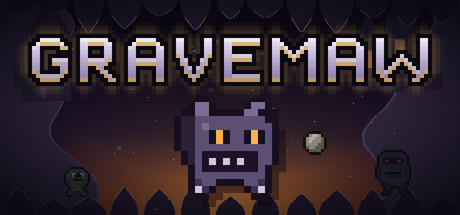

Gravemaw on Mac: the maw ate the kingdom—now it wants you to stop moving
Gravemaw opens with a perfect bit of horror-fantasy clarity: a living grave split the realm open and swallowed the whole civilization—cathedral, crown, court, and all. Only one thing didn’t go down easy: the stone gargoyle perched on the roof. You’re that gargoyle, the indigestible remnant, falling through strata of a kingdom that’s still alive enough to bite back.
On Mac, Gravemaw plays like a distilled action roguelite built for speed and repeat runs: 50 hand-built single-screen arenas stand between you and the pulsing heart at the bottom. Each room is a compact problem—enemy patterns, platform geometry, and the constant pressure of a timer that ensures there are no safe corners.
Core loop: clear, draft a gift, descend
Each arena is a self-contained fight. You enter, you survive, you eliminate everything that moves, and then you’re offered one of three dark gifts—a roguelite drafting choice that shapes your build on the way down. The rhythm is immediate and readable: play aggressively, make a decision, drop to the next screen, repeat.
What keeps the loop sharp is that the game refuses to let “cautious” turn into “comfortable.” When the stage timer expires, the maw starts taking hearts. Waiting out patterns isn’t a viable strategy—you have to learn them, commit to a route, and finish the job.
Combat and movement: spit stone, use space as a weapon
Gravemaw’s signature is its simple-but-demanding kit:
- Three-direction aiming: you can throw stone forward, but also hold up or down to angle shots. That makes platform height and enemy elevation meaningful in every room.
- Geometry matters: walls and platforms block your projectiles. Positioning isn’t just defense—it’s offense. The best angles often require you to step into danger to line up a clean shot.
- Evade dash: a short burst of invulnerability built around timing and commitment. It’s not a “panic roll”; it’s a tool for reading an attack, passing through the threat, and punishing during the opening.
The result is a game that feels closer to an arena micro-duel than a typical room-clearing brawler. You aren’t just dodging; you’re constantly negotiating line-of-sight, projectile denial, and the fastest way to convert a risky position into a winning angle.
Five strata and a real bestiary: variety with rules you have to learn
The descent is structured into five acts—stone, ash, blood, hollow, and gold—each representing a different layer of the swallowed kingdom. Every stratum comes with its own visual palette and its own set of threats, totaling 20 monster species.
Importantly, the pitch here isn’t “more enemies,” it’s “different enemies.” The game emphasizes distinct movement and behavior across the roster, forcing you to adapt your spacing and dash timing per act rather than relying on one universal solution.
Boss design: five kings, five silhouettes, five problems
At the bottom of each stratum waits a king—five unique boss fights that aim for contrast in shape, motion, and attack language. The game calls out examples that highlight how different the fights can be:
- The Stone King turns the arena into a hazard zone with rockfall.
- The Hollow King blinks away from pressure and answers with radial fire.
- The Crypt God levitates above you, alternating fan patterns and even weaponizing the ceiling.
In a single-screen format, bosses live or die on clarity and constraint. Gravemaw’s approach—unique silhouettes and movement rules—helps each king feel like a different exam of the same fundamentals: position, timing, and decisive aggression.
Roguelite progression: die, bank souls, build permanence
Runs feed a persistent meta layer built around souls. The souls you manage to carry out don’t just vanish with a death—they become currency for the Sanctum, which offers long-term upgrades and unlocks:
- Permanent unlocks such as new cards entering the drafting pool
- Gargoyle skins and other cosmetics
- Practical boosts like an extra starting heart
- An Eternal Altar stat tree designed to remain relevant over many clears
And when you finally reach the bottom, the game doesn’t politely end—it escalates. New Game+ loops with tougher enemies and richer rewards for as long as you can maintain control of the chaos.
Controls and accessibility notes for Mac players
Gravemaw includes full controller support (including name entry) and rebindable keys, which is particularly welcome in a precision-heavy, dash-timing-centric game. Language support is broad as well, with twelve languages available: English, 한국어, 简体中文, 繁體中文, 日本語, العربية, Español, Русский, Português (BR), Deutsch, Français, Polski.
Mac system requirements
Minimum
Minimum:
- OS: macOS 11.0 (Big Sur) or later
- Processor: Apple Silicon or Intel Core i3
- Memory: 4 GB RAM
- Graphics: Integrated graphics
- Storage: 1 GB available space
Recommended
Recommended:
Who Gravemaw is for
If you like your roguelites compact, fast, and skill-forward—where positioning is as important as raw reflex—Gravemaw’s single-screen arenas and timer-driven pressure are the point. The drafting choices and persistent soul economy add long-term texture, but the heart of the game is the same on every run: spit stone, dodge with intent, and keep descending before the maw remembers you’re there.





Comments
Sign in to join the conversation.
Log in to commentNo comments yet. Be the first to join the conversation.