
Available today: Apple refreshes its desktop lineup
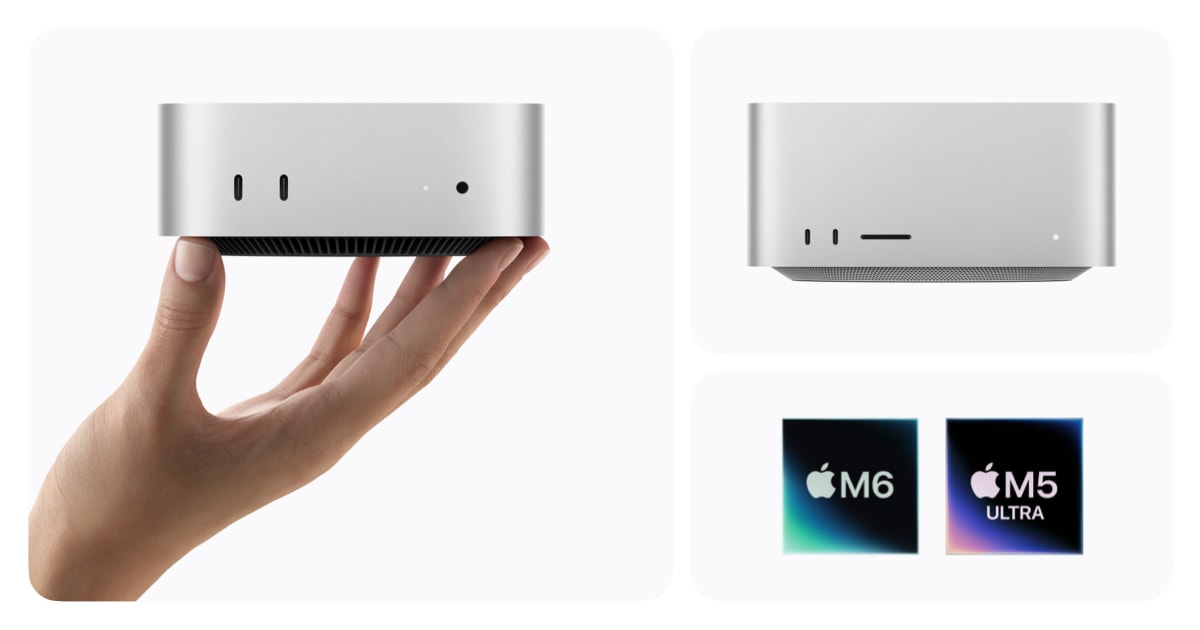
Apple has posted an update to its Newsroom announcing that the new Mac mini and Mac Studio are available today through Apple Store locations, online, and in the Apple Store app. The Mac mini now comes with M6 or M5 Pro configurations, while Mac Studio steps up with M5 Max and the new M5 Ultra.
This isn’t a “new game announced” kind of story, but it is directly relevant to the Mac gaming ecosystem: these machines are the hardware baseline for developers building, profiling, and shipping Mac-native titles, and they’re the boxes many players pick when they want macOS performance without the price and footprint of a full desktop tower.
Why this matters for Mac gaming: GPU + unified memory + on-device AI
Apple’s framing leans heavily on next-generation GPU features and on-device AI performance. For gaming, the practical takeaway is that Apple continues to design its chips around a tight GPU/CPU/Neural integration model backed by unified memory. That matters because many Mac games (and game tools) are sensitive to memory bandwidth and total memory capacity, especially when you’re pushing higher-resolution textures, heavy shader workloads, large worlds, and modern content pipelines.
Apple also highlights “Neural Accelerators” in GPU cores and updated Neural Engine capabilities, paired with macOS 27 and Apple Intelligence features. While that doesn’t automatically translate into better frame rates, it does reinforce Apple’s direction: more local compute for assisted workflows, content creation, and potentially new categories of in-game features and tooling over time—especially on the developer side (build systems, asset processing, testing automation, and AI-assisted iteration).
Mac mini: M6 for value/performance, M5 Pro for heavier projects
From a MacGaming.com perspective, the Mac mini remains the most approachable “serious Mac” for players and hobbyist developers. Apple says the M6 model brings major uplifts to AI performance, graphics, and CPU speed compared to prior generations, and positions it as a versatile machine for everything from everyday multitasking to more advanced workflows.
The M5 Pro option is the more interesting line item for teams or individuals doing real production work: Apple explicitly calls out game development as one of the complex workloads that benefits from the Pro-tier configuration. That generally maps to the realities of modern dev—running the editor, tools, builds, profilers, and test clients can be as demanding as the game itself.
Mac Studio: M5 Max and M5 Ultra target the high end
Mac Studio continues to be Apple’s “desk-side workstation” pitch: compact, quiet, and aimed at sustained performance. Apple’s announcement emphasizes substantially faster AI performance and faster graphics, and calls out support for up to 512GB of unified memory on Mac Studio (configuration-dependent), which is the kind of capacity ceiling that matters more for professional pipelines than typical gaming use.
For game studios building on macOS (or shipping Mac versions), Mac Studio tends to show up where compile times, parallel asset cooks, multi-app workflows, and heavy GPU debugging are daily realities. And for players who want to treat macOS as a premium gaming-and-everything-else platform, Mac Studio is the “no compromises” desktop—at least within Apple’s current desktop lineup.
Pricing and availability
Per Apple, Mac mini with M6 starts at $899, and Mac mini with M5 Pro starts at $1,699. Mac Studio with M5 Max starts at $2,499, while Mac Studio with M5 Ultra starts at $5,499. All models are available now through Apple’s retail and online channels.
What we’re watching next
The biggest question for Mac gaming isn’t just raw hardware availability—it’s how quickly the broader ecosystem (engines, middleware, anti-cheat solutions, storefront tooling, and major publishers) keeps pace with Apple Silicon’s cadence. New desktop silicon landing in volume is good news for standardization: the more predictable the installed base becomes, the easier it is for teams to justify optimization work and feature targeting on Mac.
Source: Apple Newsroom. For Apple’s full wording, specs framing, and availability details, read the original post here:
https://www.apple.com/newsroom/2026/09/the-new-mac-mini-and-mac-studio-are-available-today/




Comments
Sign in to join the conversation.
Log in to commentNo comments yet. Be the first to join the conversation.